Here Comes The Pitch – Part Two

In part one of this tutorial series I gave a pep talk/beatdown about how difficult it is to cold pitch publishers and what you’re up against. This time I actually show a pitch example and stress the importance of length.

A lot of would-be comic writers are under the impression that pitching their comic story is all about showing how much work they’ve done. They pound out 100 pages of story notes/script and send it all off in a huge batch, expecting it will blow away the editor who reads it when they see how in-depth it is and how much hard work has been put into it.

The reality is the complete opposite:

Your pitch should be short! The longer it is, the worse your chances are of making a positive impression because the editor won’t even finish reading it.

Remember what I said last time about the cold pitch being incredibly low on an editor’s priority list? Editors don’t have time to pore over long writing samples, especially from someone who doesn’t have a professional body of work to back them up. They’d be hard pressed to read a lot from writers they’re actively working with on current projects let alone someone new sending them a pitch out of the blue.

You need to sum up your concept in 1-2 pages and grab their attention right off the bat.
It’s not about how much you send, it’s how engaging and focused it is.

Your story idea may be incredibly complex. It may span dozens of characters over generations and cover every emotion in the human condition, but if you’re trying to break in you need to filter all that detail down into something manageable and concise.

One page is ideal. Two if you absolutely must. I’m serious.

My creator-owned comic called Skullkickers has 18 issues published so far. Over the course of those issues it’s grown in surprising ways and now encompasses werewolf hunting, goblin attacks, necromancers, poison brewing, hallucinogenic prophecies, undead giants, plant creatures, murderous faerie folk, Lovecraft-style elder gods, demons, interdimensional time travel, cursed artifacts, pirates, cowboys and legendary sea monsters. All of it is fun and kooky stuff.

BUT – practically none of that complexity was in the original pitch. The pitch was tight and simple, covering the broad concept of the series in a straight forward way so it was easy to understand and digest. When an editor saw the pitch, they could immediately understand the main idea and ask for more details if they liked what they’d initially read.

Here’s the original Skullkickers one page pitch:


SKULLKICKERS
by Jim Zub

“No magic. No problem.”

Pitch:
In a backwater fantasy world filled with all manners of magical beasts, poverty, disease and other horrifying threats, it’s a daily struggle to survive. Most people keep their head low, stay in the village they were born and eke out a life as a farmer or simple trades person. The only ones strong enough to have anything else are protected by sorcerous powers or are in the employ of the demonic.

Except for our two protagonists – They thrive by being stubborn and tough as Hell.

No one knows where this human and dwarf came from or how they’ve survived so long without using a speck of magic. They travel the land slaying every kind of beast in their path with sheer physical grit and vicious trickery. They’re not heroic or even nice – in fact they might be two of the most irritating and ornery assholes to ever heft a blade. No matter how obnoxious they may be, no one can argue with their results and the huge trail of corpses left in their wake. In a world of the weak, they’re fighters.

Some folks will despise them, others will praise or even worship them – they don’t care. They’d kill anything for 2 copper pieces.

Overview:
Skullkickers is a fantasy parody on steroids. It revels in the clichés of sword and sorcery while injecting them with an extra spark of sass and violence. It’s not deep and meaningful by any stretch, instead keeping readers engaged with snappy dialogue and inventive use of monsters and action. Like Ash from the movie Army of Darkness, our “heroes” are so full of themselves and yet incredibly capable that readers will like them even when they’re being absolute jerks.

Summary:
Our two jackasses become entangled in the plot of an evil necromancer who is gathering together an army of skeletons, shambling dead and stitched-together horrors to conquer the local countryside. What this death mage doesn’t know is that the rituals he’s using to build his army of the dead are actually binding demonic spirits to corpses, not just animating them to life. The forces he’s set in motion lead to a full-on demonic invasion from the nether regions and the only thing standing between burning hellfire and the kingdom are a pair of death dealing mercenary assholes.


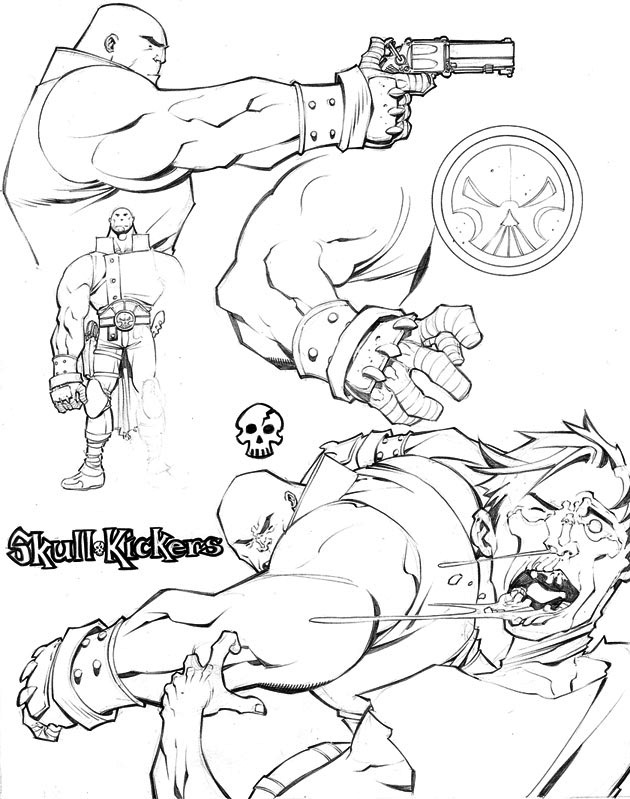
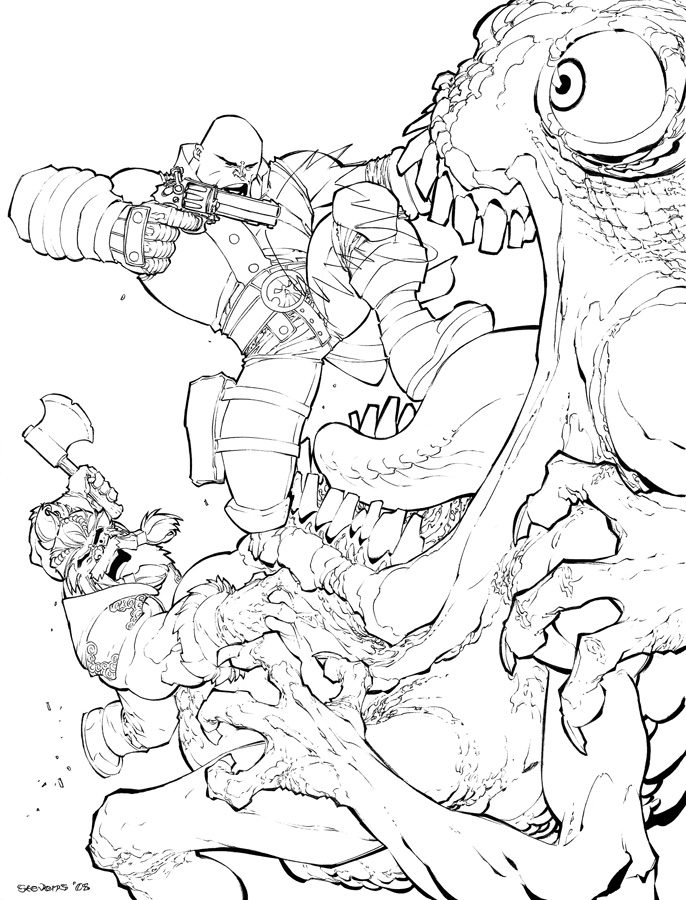
Along with that summary was 4 pages of character sketches by Chris Stevens, helping solidify the ideas presented with his professional quality art:

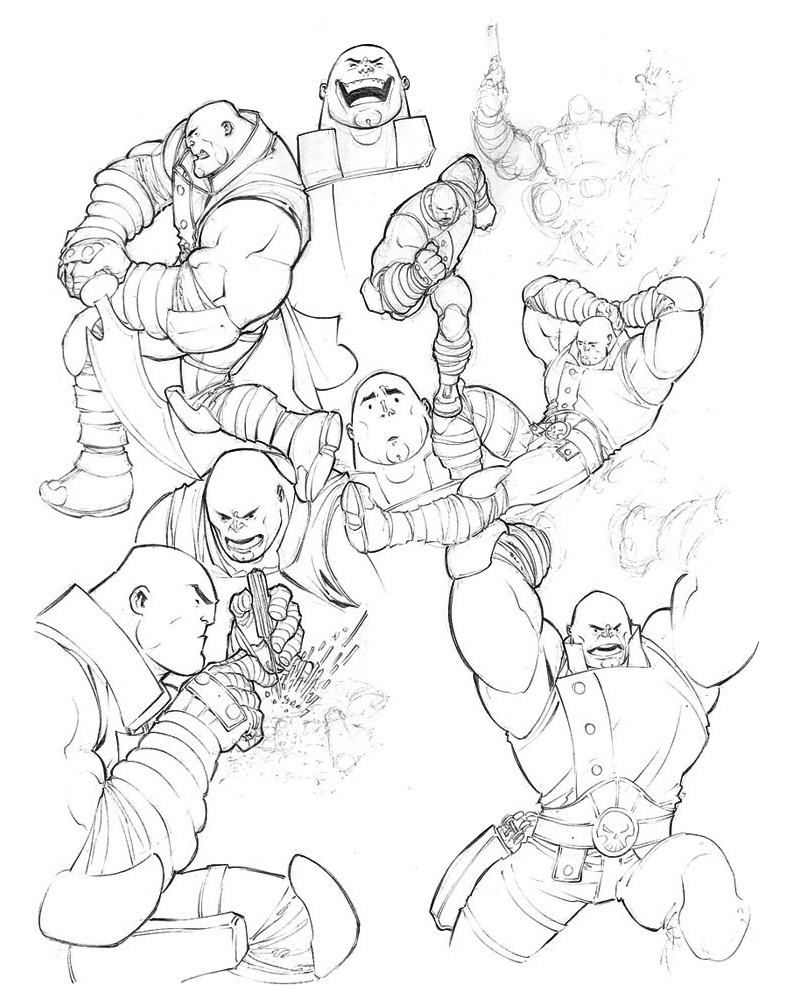
It’s not perfect, but it is concise. You read it and are well informed about the core concept: These two guys are ass-kicking monster hunters and this series is going to be an irreverent fantasy-adventure romp. Conan the Barbarian meets a buddy cop film. Got it.

(Update May 2015– I’ve recently posted the pitch document for Wayward, my new creator-owned series as well. Check that our HERE.)

In short – The pitch is simple and entertaining. The art helps grab attention, reinforces the concept, and solidifies the whole package as professional-looking and appealing.

Skullkickers is a fun and violent pulp adventure, so that’s exactly what’s emphasized at the forefront of the pitch. None of the other back story elements matter at this early stage. There’s nothing subtle here. The editor can quickly read through and decide if they want more information by contacting me (my contact info was in the header/footer on each page). Ideally they’re hooked but, even if they aren’t they’ll probably appreciate that I didn’t waste their time.

Your story ideas can be scrawled out on dozens of pages. Your scripts can look like telephone books. Your plot and world building can fill giant tomes. None of that matters. If you’re breaking in and want a publisher to check out your idea, you need to percolate all that material down into a bite-sized summary to gain their interest.

Make sense?

Next time I’ll talk more about the different sections of the pitch, ways to stand out and some stuff to avoid.

If you found this post helpful, feel free to let me know here (or on Twitter), share the post with your friends and consider buying some of my comics or donating to my Patreon to show your support for me writing this instead of paying work. 😛

Click here to read Part 3 of this tutorial

They Bleed Pixels Wallpaper

This wallpaper image was put together as unlockable guest art for the amazing gory platform game called They Bleed Pixels, created by Miguel Sternberg.

If you haven’t had a chance to play TBP yet, check it out on Steam! It’s a really fun title with tight controls and over the top pixelated combat.

Here Comes The Pitch – Part One

Like I did with the blog series focused on my comic writing methods (parts one, two, three, four and five), I thought I’d break down some of the things I’ve learned so far about pitching comic story ideas to publishers. As with my previous writing advice, these are just my thoughts and methodology, not rules etched in stone. If you find them useful, that’s great. If not, well I hope it’s mildly interesting in any case.

Pitching a story to a publisher can be incredibly difficult, especially when you’re pitching cold. By ‘cold’, I mean that an editor hasn’t approached you looking for writing material and you’re sending it in without any prior ‘heat’ (interest). The cold pitch is the absolute worst position to be in because an editor has absolutely no reason to pay attention to you, and probably has dozens of better things they could/should be doing with their time. Never forget that! Most of the advice I give is centered around this simple fact: You are not a priority when you’re cold pitching a project to a publisher. You have to grab their interest and bring them on board the idea, taking them from uninterested, through neutral, to excited about working with you.

An editor’s primary job is to ensure their current projects are running smoothly (and here’s a hint – it’s extremely rare for projects to run really smoothly). After that’s done for the day they probably want to go home to their family and have some sort of a life. Assuming having a normal life isn’t a viable option for them, then there may be a need for new books/projects, but when those times come up an editor is going to contact trusted/dependable/known talent before anyone else. Why wouldn’t they? Why take a risk on someone who is unproven and (probably) going to require a ton of extra hand-holding to complete the same task an experienced creator could do, especially if the editor could end up putting their own job and reputation on the line if it gets all screwed up?

Think carefully about that. Never forget it. Everyone wants to work with people who are going to make things run smoothly and deliver the goods. Your pitch needs to convince them that you are one of those people (because you are, right? 🙂 ).

The above is why companies like Marvel and DC have a ‘No Blind Writing Submission’ policy. They want people who have previous experience and are already consistently producing high quality stories. They have a large pool of experienced talent to choose from and don’t want to take risks on unknown writers. The simple truth is they’ll approach you (once you have a viable body of work) instead of you approaching them.

Brutal, eh?

But – here’s the good side of things. There are many other outlets for comics and many other publishers you can approach with your rockin’ creator-owned story ideas: Image Comics, Oni Press, Archaia, IDW, Boom!, First-Second, Dynamite and a ton of other great companies producing award-winning kick ass comics. There are opportunities if you can show that you’re professional and capable, even for first-time creators. That doesn’t even take into account self publishing or putting your work directly online, which is more valid than ever before.

So, assuming after all my rambling above you still want to go the pitching route, I suggest you make a strong first impression. You have to make sure your pitch is high quality, easy to digest and engaging.

In short – A pitch is all about clearly explaining your idea and justifying why you are the right person to see it through.

There are many ways to do that and, as long as it achieves the above, you’ve pitched it well. Cross your fingers and see where it goes from there.

I know this was quite the preamble, a blog post all its own, with a mixture of “no one wants to read your stuff” and “get ready to work your butt off”, but that’s a dose of reality I think some people need to hear about the process before we get into the nitty-gritty of it. Before I talk about format, hook, theme or how much information is needed, I felt it was important to talk about the overall purpose of a pitch and what kind of stuff you’re up against when starting out.

Now you know.

If you found this post helpful, feel free to let me know here (or on Twitter), share the post with your friends and consider buying some of my comics or donating to my Patreon to show your support for me writing this instead of paying work. 😛

Click here to read on to part two of this pitching tutorial

Comic Book Daily Interview

Andrew Ardizzi at Comic Book Daily conducted an extensive interview with me at Fan Expo Canada a couple weeks ago and has just posted the article transcribed from it. Click on through to read about my thoughts on Skullkickers, Pathfinder and creator-owned comics.

Jack Kirby Thoughts

The gang over at eXpert Comics asked if I’d put together a few words about Jack Kirby during the week celebrating what would have been his 100th birthday. Here’s what I wrote for them:

With no trade paperback program to speak of and minimal reprints available, I had no idea growing up how much of the “modern” Marvel Universe was derived from Jack Kirby’s creations.

His hard-edged bodies, chisel-topped fingers and black bubbles of cosmic energy stood out as distinctive to me even before I started collecting books based on creators instead of characters, but it wasn’t until years later that I had a chance to really dig in to classic comics and appreciate how much he blazed the trail.

What I thought were original ideas coming from current creators were actually Kirby creations retooled for a new generation.

While other artists were creating distracting yarns, Jack was building worlds that inspired. In his prime he pulled the camera back to bring a sense of epic scale to his stories like no one else. His environmental artwork had a mythic quality to it, a bold approach that couldn’t be contained by the panels they were placed in.

Best of all, he populated those stunning vistas with heroes and villains just as distinctive. His characters struggled against impossible odds, emoting through their entire bodies in a way that was instantly clear and engaging.

Unconstrained, unfettered, impossible – a strange and wonderful fusion of geometric forms mixed with pop art power. The work always stressed drama over realism, and the more comics I create, the more I realize how important that was (and still is).

In short – if Marvel is the ‘House of Ideas’, then the stirring imagination and stunning output of Jack Kirby is the fertile ground that house was firmly built upon. They called him “The King” for a reason. That crown isn’t going anywhere.

More Skullkickers #17 Reviews

Major Spoilers: “5/5. Skullkickers was a great book when the violence and crazy antics drove the book, but now that we are getting that on top of a deep back-story with a complex storyline, Skullkickers has entered the realm of ‘must-buy'”

Forces of Geek: “This is the most fun I have had reading a comic book all year.”

Image Addiction: “…one of the most consistently entertaining comic books in the free market”

Fellowship of the Geeks: “I will happily admit to some bias toward high fantasy, but even so, this book is a delightful read.”

Silver Snail: “4/5. I have to applaud the courage it must have took to end the current arc the way it did”

Futile Position: “Skullkickers remains one of the most beautiful comic books week-in and week-out”

Nerdlocker: “4/5. Really innovative in its sense of using high fantasy and high comedy at the same time.”

Skullkickers #17 Reviews!

Skullkickers #17 is in stores now! I’m incredibly proud of this third story arc and our fans seem to agree that we’ve delivered the goods once again.

Here are links to some of the reviews rolling in:

Comic Buzz: “9/10. The Skullkickers are at their best when things are at their most insane and this arc is a boat full of crazy.”

Fanboy Comics: “Skullkickers is perfect for fans of fantasy adventure or just anyone looking for a fun, violent read that will leave them in stitches.”

First Comics News: “…very good for a final chapter of an arc while also leaving an exciting cliffhanger.”

Geeks of Doom: “…there are few comics on shelves right now that match Skullkickers in terms of pure unfiltered insanity. This is why comics are made and why we love reading them so much.”

One Geek Nation: “5/5. The story itself flows so damn smoothly, you’d think you’re going down a waterslide. Jim Zub is quickly becoming the next best thing in comics.”

Product of my Dreams: “10/10. This is my second time reading Skullkickers and my excitement for this series hasn’t left yet.”

Unleash the Fanboy: “4½/5. Whether it’s the death of a character or the development of the current ones, the actual narrative itself is sustainable without all the jokes and humor; but it’s the funny take that makes it so refreshing.”

Summer is Almost Over

This weekend I’m at PAX Prime 2012 in Seattle, set up with the UDON crew. 3 conventions in 3 weeks. It’s an exhausting end to the summer, but I’m riding through it on quite a high mentally, if not physically.

Gen Con had record-breaking sales for me with lots of interest in both Skullkickers and Pathfinder. This past weekend’s Fan Expo Canada broke Gen Con’s records from the week before, which was really surprising and amazing. The advantage of being in Toronto where I could restock books from home made all the difference. If I would’ve traveled for Fan Expo and shipped what I thought I could sell I would’ve had an empty table by Saturday morning.

The “webcomic effect” on my convention sales is distinctive and pronounced. Putting out a consistent comic, both in print and online, is breaking down resolve people have for trying something new. They see it, they keep seeing it and eventually they try it. At shows this summer I’ve been hearing a lot of “I’ve heard of Skullkickers, but haven’t read it yet” and “I heard it was really good”, which makes it even easier to get people on board when I’m right there ready to autograph a copy for them.

Contrary to what fans may think about Image based on the massive success of its founders, the Skullkickers creative team isn’t riding atop a mountain of money. I joke around that Skullkickers is the most expensive hobby I’ve ever had, but it’s actually quite true. I’ve never been paid to write SK. Practically every dollar I get from Image or make at conventions goes right back into the “warchest” to pay for art production on current/upcoming issues. Every time I have a really solid show, it keeps us moving forward bit by bit.

It’s an exciting time. My fingers are crossed that it all continues to roll onwards and upwards.

Skullkickers #17 Preview

Over on Comic Book Resources they’ve posted a 6 page preview of Skullkickers #17, the finale of our third story arc ‘Six Shooter on the Seven Seas’, which arrives in comic book shops tomorrow.

It’s going to be epic!

The Pull List Podcast Reviews Pathfinder #1

The Pull List Comic podcast crew reviews Pathfinder #1 and they’re really happy with the opening of our fantasy tale. The review starts off at the 11:16 mark of the podcast. Give it a listen.

“I like the back and forth between all the characters.”…”He manages to make this feel different from Skullkickers.”