Thank you to everyone who passed around the link to my blog post last week. It was a whirlwind of conversation and, even with over 140 comments back and forth on the blog and dozens of tweets, the vast majority of people were civil, supportive and incredibly thoughtful.
The most common question that came up last week was “What about digital comics? How do those sales work?” It’s complicated and I don’t know all the ins and outs, but I’ll do my best to share what I know on that front.
With the ubiquitous nature of digital media in all aspects of our lives, digital comics will almost certainly play an important part in the future of the medium. They’re available globally 24/7 and don’t suffer from print run limitations or shipping damage.
The most popular digital comic platform is comiXology. They’re the current 800 pound gorilla in the still-niche digital comic marketplace. Marvel, DC, Image and most of the other major comic publishers are available through their website and app(s).
A lot of people have talked about the need for cheaper digital comic prices to drive impulse buying in casual/new readers. Right now most of the digital comics available are selling at a similar price to their print counterparts. Outside of sales and special promotions, a $2.99 print comic is selling for $2.99 digitally. People assume that digital content should be much cheaper because it has no physical component, but there are development and infrastructure costs that go into creating and maintaining a digital platform. It’s hard to say whether they’re equivalent, but right now the pricing is relatively equal.
Consider this…
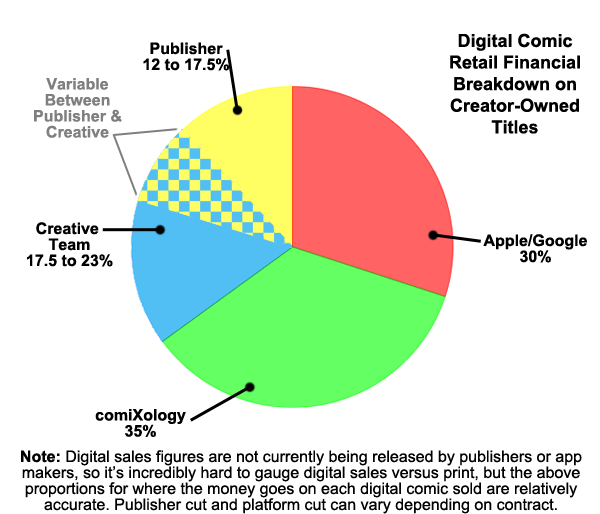
…on a $2.99 digital comic ($3 for simplicity’s sake):
-$0.90: 30% goes to the mobile platform (usually Apple or Google). This is a standard fee leveled on all in-app purchases (which is where the vast majority of digital transactions are happening). This is as close to non-negotiable as things get. You use their device, they take their share. It’s my understanding that comics bought directly through the website don’t have this fee levied against it, which means more money for comiXology, the publisher and the creative team, but it’s way less convenient.
-$1.05: 35% (or, more specifically, 50% of what’s left after Apple/Google takes their share) goes to comiXology. Staff is needed to prep files, maintain servers, update the site and deal with technical issues, so comiXology is acting as the digital distributor. Other digital platforms may take a lower percentage of the cover price, so this amount is by no means universal, but it applies to the current leader in the marketplace.
The remaining $1.05 is split between advertising, the publisher and creative team. Each publisher has their own digital rates and it varies quite a bit from what I’ve been hearing. In some cases publishers don’t offer any percentage of digital sales to the creative team on a creator-owned title. Other than that unfortunate scenario, some publishers are making the same amount they would on a print copy (11-12%), while on the higher end the amount is split evenly between the two. With such a large range it’s hard to nail down exact figures, but it does give you a sense of how things tend to work.
What’s more difficult to answer right now is how well digital comics are actually selling through these platforms. Publishers and companies like comiXology have been very secretive about digital sales numbers. Press releases go out talking about “Best Selling Digital Comics” or “Record Breaking Digital Sales”, but no one’s explaining how many copies are involved in the hype. That makes it impossible to calculate sales figures, understand trends or decide the frequency of sale pricing on digital comics.
Some people have bandied about the broad figure that digital sales are averaging 10-15% of print sales. It’s unfortunately an untested number but, if remotely true, then the 5000 print run example from my previous post would be selling 500-750 digital copies per issue. With a rough range and a rough percentage breakdown that would mean anywhere from $255 to $517 left for the creative team, or $127.5 to $258.50 each for the writer and artist per issue (not counting the cover artist, letterer, colorist, etc.). The creative team gets more of the pie with a digital sale, but it’s a smaller sized pie right now.
If you’re buying digital comics when they’re on sale for 99 cents, the above numbers all get chopped down by 2/3. The pricing drives purchases, but 3 times as many copies have to be sold to make the same amount of money. In addition, the readership may come to expect that 99 cent pricing and wait for another sale rather than buying new digital issues at full price as they’re released.
The above numbers are extremely hard to gauge and shouldn’t be thought of as absolutes. Without solid sales figures to work with it’s impossible to nail down how many copies are actually being sold.
The only remotely solid numbers I have are my own. I’ve done quite a bit of promotion about my comic Skullkickers being available on comiXology, iVerse and Graphicly. We have a free zero issue and we’ve had a couple 99¢ sales, so some of our early issues have sold quite well digitally but, if you count 99¢ copies as a 1/3 sale money-wise, we’re selling at about the 15% range of our print sales on early issues. Later issues are sitting at around 8-10% of print sales right now. Admittedly, the 99¢ pricing has expanded our audience much faster and that’s nothing to sneeze at. They’re not blockbuster sales numbers but at least I know that as our exposure increases back issues will keep selling without any fear of ever being out of stock.
At this point, digital creator-owned comic sales through mainstream platforms aren’t generating a substantial amount of revenue, but it’s growing and things are changing quite quickly. As tablets become more prevalent and people become more at ease with paying for digital content, these figures will expand quite a bit and this space is going to see all kinds of upheaval. Right now it’s really hard to say where it will all end up. I think that having a stake in the ground at this early stage is important and making sure my work is available on as many platforms as possible helps grow our audience.
So, you may be reading this and think “Mainstream print distribution doesn’t make much for creators, mainstream digital doesn’t make much either, so how the heck do I get ahead?!”
Good question!
In my next couple blog posts I’ll talk about online outreach, other revenue streams, working with focused retailers, conventions, and more. Until then, feel free to add your two cents to the above, improve my accuracy and let me know if I’m missing anything. And, if you’re hungry for other things to read, feel free to check out my other tutorial articles about breaking in and writing technique.
If you found this post helpful, please let me know here (or on Twitter) and share the post with your friends. Please consider buying some of my comics online, from your local retailer or from me in person if you see me at a convention.








 Zub on Amazon
 Zub on BlueSky
 Zub on deviantART
 Zub on Facebook
 Zub on GoodReads
 Zub on Instagram
 Zub on Patreon
 Zub on Substack
 Zub on Tumblr
 Zub on Twitter
 Zub on YouTube
 Follow this blog's RSS feed
 Makeshift Miracle