Yearly Archives: 2012 - Page 5

Here Comes The Pitch – Part Four

Okay, I’ve covered quite a few different aspects of how I put together a pitch, from the purpose of a pitch, to summarizing your ideas and the different sections you can use to explain your concept. Above and beyond that information, I wanted to offer some other advice that didn’t quite fit anywhere else.


Comic Story Pitch DO’s

DO check and follow a publisher’s submission guidelines before following any advice I’ve given you. If they ask for specific things you’ll make it a lot easier for them (and they’ll see that you can follow instructions) if you give them what they’ve asked for.

DO explain the elements that make your story compelling, entertaining or unique. It’s okay for you to be inspired by other things, just make sure you have something new to add instead of offering a carbon copy of an existing story.

DO get people you trust to look over the pitch to help edit it for spelling, grammar and clarity. A fresh set of eyeballs checking things over can be invaluable.

DO credit everyone involved in the pitch: the artist(s), colorist(s), letterer, you name it. Everyone involved should have their contribution clearly noted. This isn’t just about your writing.

DO put your contact info on the header or footer of each page so the publisher has it even if the pages get separated.

DO send your pitch to a specific editor rather than “To Whom It May Concern”. Find books from a publisher that fit the kind of story you’re working on, check who the editor is and do your best to track down their contact information.

DO include a brief cover letter/email. Introduce yourself, mention any previous creative work or related experience you have and explain why you think the publisher would be a good fit for the pitch.

DO keep your emails to publishers simple, professional and direct. They’re not your friend (yet, who knows what will happen later on) and this isn’t a social call. They won’t sift through a rambling or confusing email waiting for it to get to the point.

DO hand over a pitch in person at a convention or social event if the opportunity presents itself, but keep it brief. Putting a name to a face can go a long way; just make sure you’re professional and polite. Read the social cues and try to pick a good moment. Try not to stress out about it (easier said than done, I know).

DO be open to adjusting your pitch if an editor wants revisions to the concept. Be open to their feedback/critique. If they want changes you’re uncomfortable with, walk away as politely as possible so you don’t leave a bad impression.

DO build polite social relationships with professionals in person or online. There is a strong social aspect to this industry and it’s important to be around it, just don’t expect people to involve you in every interaction just because you’re there. It can take a really long time, so try not to force it.

DO have an easy to remember email address and website so an editor can stay in touch. Even if they don’t pick up this pitch, having a way for them to easily find you can pay off down the road.

DO remember to be gracious even if your pitch is rejected. As difficult as it can be, thank them for their time and consideration.

DO buy and read more creator-owned comics. If this is what you want to get into, you need to stay current with what’s being released and support the industry if you want the industry to support you.

Comic Story Pitch DON’Ts

DON’T expect other professionals to look over your pitch if they’re not your friends (heck, probably not even then). They’re too busy working on their own projects and probably can’t help you get your work published anyways.

DON’T send your pitch randomly to every comic publisher you can find. Do your research and only choose companies who fit the work you’re putting together. The shotgun approach does not work and sending inappropriate pitches to publishers makes you look desperate and poorly informed.

DON’T use self deprecation as a way to try and get a response from a publisher (things like “I know you probably won’t answer this email, but…”). If they like the work, they’ll contact you. If not, that’s your problem not theirs.

DON’T use your cover letter as a way to explain your life story or how long you’ve wanted to work in comics. Pretty much everyone who works in the industry has been a “lifelong fan”. Just quickly introduce yourself and let them get to the pitch.

DON’T trash other people’s work to try and boost your own (“Since you guys already published [crappy comic] I’m sure my new concept will knock your socks off”). Keep your interactions positive.

DON’T exaggerate how long you’ve been working on a pitch. Telling an editor you’ve spent a decade developing your story or that this is your life’s work is a turn-off, not a selling feature. Remember, your first projects should be small and manageable, not grandiose.

DON’T include hype about sales/media potential in your pitch or cover letter. Even if you think you have the next Harry Potter meets Walking Dead by way of Scott Pilgrim, let the publisher decide its commercial potential.

DON’T spam an editor with multiple pitches at once. They won’t think you’re a story genius, they’ll just find it obnoxious and almost certainly trash them all. Send one at a time and wait for a response before sending another concept, and only if they agree to look at more.

DON’T spend a crazy amount on pitch artwork unless that amount of money is meaningless to you. Creator-owned comics generally make very little, so you don’t want to be starting the process deep in the hole. Team up with artists who are professional quality, but understand that this is a stepping stone to more work, not an instant big-time payout. I know finding those kinds of collaborators can be really tough, but that’s the ideal.

DON’T spend too much printing your pitch package if you’re sending/handing over a physical copy. Sharp print outs in a simple document protector is fine. Paper-clipped/stapled sheets in an envelope work too. You can print it as a sample comic or use fancy paper if you’d like, just don’t break the bank. The quality of work will make or break the pitch, not the printing of your pitch material.

DON’T expect a quick reply to your submission. Remember that looking at your pitch is not a priority for an editor. If you don’t hear from them for a couple months, send them a brief and pleasant email asking for an update. If you don’t hear anything at all a second time, you’re probably not going to make any headway with this pitch at that company.

DON’T phone a publisher about your pitch unless they specifically give you their phone contact and ask you to call. Even if they hand you a business card, ask them if it’s okay to call. A pestering random phone call comes across 10 times worse than a pestering email.

DON’T expect editors to help you get your work up to a professional level. If they give you feedback on a failed pitch that’s great, but if not don’t be surprised. They rarely have time to give in-depth critique on material they’re not interested in publishing.

DON’T expect that getting your first comic published is going to change your life or make you rich. Very few people make a really good living solely from comic work. Hold on to your day job and see how things go. Get into this industry because you love the medium and want to tell stories, not because you expect fame or riches.


…And that’s it! Four parts of info all about comic story pitching.

If you found this post helpful, feel free to let me know here (or on Twitter), share it with your friends and consider buying some of my comics or donating to my Patreon to show support for me teaching you how to steal my job. ;P

Wonder Momo Origin!

Wonder Momo, the idol girl cosmic hero strip Erik Ko and I write, continues on ShiftyLook with two new strips each week.

Jeff ‘Chamba’ Cruz just finished artwork on our Momo ‘interlude’ story recounting the origin of the original Wonder Momo from 1987 and it turned out great! He did a phenomenal job channelling the retro-art style of 80’s anime favourites like Project A-Ko and Urusei Yatsura to lend this fun mini-story an air of authenticity.

The interlude story starts here, so click on through and give it a read!

Skullkickers #18 is Well Loved

Skullkickers #18, the anthology-style “Son of Tavern Tales” issue with 6 short stories by different creative teams, arrived yesterday in comic shops and the reviews its received so far have been strong!

Unleash the Fanboy: “4.5/5 It’s very funny, and very Skullkickers.”

Futile Postion: “…each story takes a microcosm of what makes the series great, from the goofy to the violent.”

Multiversity Comics: “…the various creators’ authenticity to the characters and the humor insure that #18 is just as good a place to start as #1.”

One Geek Nation: “4/5 …a 40 page spectacular that is actually quite enjoyable to read.”

First Comics News: “8/10 …all of them show that they are fans of the series and capture the characters and tone perfectly.”

Fanboy Comics: “…captures the violent fun of the main series in a standalone single issue full of interesting and humorous stories.”

Freakin’ Awesome Network: “…bureaucratic blunderbuss of beards and bludgeoning is vintage Skullkickers!”

SDCC deviantART Panel Footage

Here’s footage shot from the deviantART panel at SDCC talking all about
“How To Supercharge Your deviantART Profile Like the Masters”.

Check it out:

Featured Panelists, from left to right:
Adam Warren(The Dirty Pair, Empowered, Gen-13)
Mark Brooks (Spider-Man, X-Men, Wolverine)
Jim Zubkavich(UDON Project Manager, Skullkickers)
Dave Elliot(Heavy Metal Magazine)
Yuumei (Wenquing Yan)(Digital Artist and Cyber-Activist)
Kevin Eastman(TMNT co-creator)
Chris Sanders(Lilo & Stich, How to Train Your Dragon)

Klonoa Launches This Wednesday!

Klonoa: Dream Traveler of Noctis Sol

Based on the video game by NAMCO BANDAI Games

Written by Jim Zub
Art by Hitoshi Ariga
Coloring by Espen Grundetjern
Made for ShiftyLook by UDON Entertainment
Updates Wednesdays 9:00AM Pacific

If you’ve never had a chance to play any of the Klonoa video games, you really are missing out. Klonoa is a joyous platform adventure game loaded with memorable characters, creative designs and simple but addictive gameplay. The series has been a cult hit amongst gamers for years and has a small but dedicated fanbase who have been hoping for year to see a sequel.

Getting the chance to add a new chapter to the Klonoa story and work with mangaka Hitoshi Ariga (artist of Mega Man and The Big O in Japan) is a dream come true. Bandai-Namco has been extremely supportive and Hitoshi Ariga has done an incredible job at taking some of my ideas and designing/illustrating the heck out of them. His art style melds perfectly with the game’s look and feel. Add in Espen’s top notch coloring to the mix and the final result is pretty stunning.

With so many characters and places from previous games to draw upon, we wanted to make sure we put some fan favorite elements in while not getting so bogged down with nostalgia that we couldn’t move things forward. There will be new friends, new enemies and new places to explore as Noctis Sol rolls out. I hope long time Klonoa fans and new readers appreciate the hard work we’ve put into developing our story.

Here Comes The Pitch – Part Three

So far I’ve talked about the uphill battle getting an editor to look at a cold pitch and the importance of summing up your ideas with a short and entertaining package, so let’s move on to the different sections in a pitch.

Check out the Skullkickers pitch from part 2 and you’ll see a distinct structure at play – I start with broad ideas and then build towards the specific with each subsequent section. Macro to micro. I think it’s a smart way to organize your ideas, but don’t be paranoid if you change it up. This isn’t an exact science. There’s no “wrong” way to put together a pitch as long as your concept is clearly delivered and the editor is interested/impressed by the time they’re done flipping through.

Here are some possible sections you can use:

The Art: Since we’re talking about comics, the art is the other half of your equation. Frankly, when you’re talking about cold pitches it’s more than half. Great art is going to grab an editor’s interest instantly while unprofessional/inappropriate artwork will sink the greatest story idea ever summarized. I think having art right at the front of a pitch is crucial for establishing the look and feel of the story to come. Find a professional quality collaborator, get great artwork and front load it to create the best first impression you can.

Title: Use a title that’s easy to remember but hasn’t been used before. Yeah, I know that’s insanely difficult. Welcome to the creative commercial arts. Finding the right title is rough, but slapping a generic or already taken name on your story just because you want to get it done will really hurt the feel of the pitch. Take your time to find a good fit. While you’re at it, buy the web url for your title once you settle on one. You’ll be thankful to have it later on if everything goes ahead.

Inspirational Quote: Not required, but if you have a little chunk of dialogue or a famous quote, something particularly sharp and appropriate, it can be a nice way to start things off and set the mood for the rest of the pitch. If not, don’t worry about it.

Logline: Having a simple one sentence explanation of your concept can be very helpful for laser-focusing attention, giving people something they can instantly understand. The Hollywood cliché of a logline is a sleazy salesman barking out “Okay, okay… It’s like (popular thing) meets (trendy thing)!” and that’s one form of logline, but not necessarily the most effective in every situation.

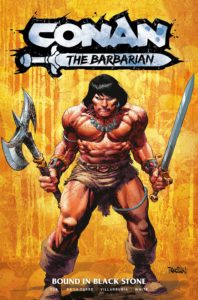
My favorite logline for Skullkickers is “It’s a buddy cop movie slammed into Conan the Barbarian”. Another one I use is “Skullkickers is low-brow high-fantasy”. Both are memorable, ultra-focused and give you a sense of the series very quickly.

Overview: Distilling your story down in to a couple brief paragraphs is brutal as you’re forced to chop away everything but the absolute core but, again, it’s necessary and is your best shot at getting an editor to read and understand the concept. The longer or more complex this is, the less likely you’ll keep their attention. Summarize your overall goals in terms of genre, mood, and inspiration. Remember that your overview is not the plot. Don’t use this section to describe specific events that happen in the story.

Theme: Ideally, your story is about something. I know that sounds sarcastic, but I’m serious. Having a point of view or a message to impart can be the difference between a good story and a great one. It can be difficult to step back from your plot and characters to look at the bigger picture (ie. What does it all mean? Why am I telling this story?), but if you can do that and sum up your intended message in an eloquent way, it can make a big impression on the person reading your pitch. It can also be something to help guide you when your story has lost its way during the writing process.

Character Briefs: It can be nice to have a few sentences about each main character, denoting personality and their goals in the story. Having this also makes it easier for the editor to mentally separate each character and compare them to the art samples.

Plot Summary: Here’s where you can talk about the sequence of events, just do it as briefly as possible. Who are the main characters, who/what opposes them and what’s at stake if they fail? Keep it brief, keep it entertaining and make sure it reflects the genre and mood you expressed in the overview. If you have a grand plot twist, you should probably tell the editor that here as well. Established writers can tease secret stuff in their pitches, but if you don’t already have a professional body of work you’re going to have to tip your hand and show the editor your brilliant twisteroo so they can see you’re capable of sticking the landing on your neat idea.

Format: Here’s where you can specify your vision for how the story could be delivered – a mini-series, a complete graphic novel, an ongoing series, etc. Keep in mind that you should start small. No publisher is going to green light a 100 issue epic written by a newcomer based on their pitch. Start with short stories, one-shots or mini-series concepts and build up to larger/longer stories once you’re more established.

Audience: If you’re pitching subject matter that’s quite young or quite mature you might want to specify that to the editor with a short description of your intended audience. Make sure you understand the difference between content intended for children, middle grade, young adult (teen) and adult.

Afterwards: If your story is self contained this isn’t necessary, but if it’s part of a larger concept you can summarize a few additional ideas about where things could go after your first part. Keep this especially brief. Use this just as a way to show that you’re thinking ahead. Don’t scare away the editor with visions of spin-offs and multi-year storylines.

I thought I’d have enough room for Pitching Do’s and Don’ts, but that will have to wait until next time.

If you found this post helpful, feel free to let me know here (or on Twitter), share it with your friends and consider buying some of my comics or donating to my Patreon to show support for me teaching you how to steal my job. ;P

Click here to read on to part four of this pitching tutorial

Pathfinder #4 Solicitation

Arriving in December…

Pathfinder #4

Rating: Teen +
Covers: Lucio Parillo and Various
Writer: Jim Zub
Artist: Andrew Huerta
Colorist: Ross A. Campbell
Publication Date: Dec 2012

Age range: 16+

The Pathfinder adventurers have trekked deep into the Mosswood, overcoming dangerous creatures and perilous terrain to reach their goal. With victory so close, the brutal defeat to come will be even more bittersweet…

Paizo’s incredible award-winning fantasy world, fiction line and tabletop RPG is now the ultimate fantasy comic from Dynamite Entertainment. Includes over 5 pages of character profiles and Pathfinder RPG game statistics, plus an EXCLUSIVE removable, playable tactical map and poster.

Here Comes The Pitch – Part Two

In part one of this tutorial series I gave a pep talk/beatdown about how difficult it is to cold pitch publishers and what you’re up against. This time I actually show a pitch example and stress the importance of length.

A lot of would-be comic writers are under the impression that pitching their comic story is all about showing how much work they’ve done. They pound out 100 pages of story notes/script and send it all off in a huge batch, expecting it will blow away the editor who reads it when they see how in-depth it is and how much hard work has been put into it.

The reality is the complete opposite:

Your pitch should be short! The longer it is, the worse your chances are of making a positive impression because the editor won’t even finish reading it.

Remember what I said last time about the cold pitch being incredibly low on an editor’s priority list? Editors don’t have time to pore over long writing samples, especially from someone who doesn’t have a professional body of work to back them up. They’d be hard pressed to read a lot from writers they’re actively working with on current projects let alone someone new sending them a pitch out of the blue.

You need to sum up your concept in 1-2 pages and grab their attention right off the bat.
It’s not about how much you send, it’s how engaging and focused it is.

Your story idea may be incredibly complex. It may span dozens of characters over generations and cover every emotion in the human condition, but if you’re trying to break in you need to filter all that detail down into something manageable and concise.

One page is ideal. Two if you absolutely must. I’m serious.

My creator-owned comic called Skullkickers has 18 issues published so far. Over the course of those issues it’s grown in surprising ways and now encompasses werewolf hunting, goblin attacks, necromancers, poison brewing, hallucinogenic prophecies, undead giants, plant creatures, murderous faerie folk, Lovecraft-style elder gods, demons, interdimensional time travel, cursed artifacts, pirates, cowboys and legendary sea monsters. All of it is fun and kooky stuff.

BUT – practically none of that complexity was in the original pitch. The pitch was tight and simple, covering the broad concept of the series in a straight forward way so it was easy to understand and digest. When an editor saw the pitch, they could immediately understand the main idea and ask for more details if they liked what they’d initially read.

Here’s the original Skullkickers one page pitch:


SKULLKICKERS
by Jim Zub

“No magic. No problem.”

Pitch:
In a backwater fantasy world filled with all manners of magical beasts, poverty, disease and other horrifying threats, it’s a daily struggle to survive. Most people keep their head low, stay in the village they were born and eke out a life as a farmer or simple trades person. The only ones strong enough to have anything else are protected by sorcerous powers or are in the employ of the demonic.

Except for our two protagonists – They thrive by being stubborn and tough as Hell.

No one knows where this human and dwarf came from or how they’ve survived so long without using a speck of magic. They travel the land slaying every kind of beast in their path with sheer physical grit and vicious trickery. They’re not heroic or even nice – in fact they might be two of the most irritating and ornery assholes to ever heft a blade. No matter how obnoxious they may be, no one can argue with their results and the huge trail of corpses left in their wake. In a world of the weak, they’re fighters.

Some folks will despise them, others will praise or even worship them – they don’t care. They’d kill anything for 2 copper pieces.

Overview:
Skullkickers is a fantasy parody on steroids. It revels in the clichés of sword and sorcery while injecting them with an extra spark of sass and violence. It’s not deep and meaningful by any stretch, instead keeping readers engaged with snappy dialogue and inventive use of monsters and action. Like Ash from the movie Army of Darkness, our “heroes” are so full of themselves and yet incredibly capable that readers will like them even when they’re being absolute jerks.

Summary:
Our two jackasses become entangled in the plot of an evil necromancer who is gathering together an army of skeletons, shambling dead and stitched-together horrors to conquer the local countryside. What this death mage doesn’t know is that the rituals he’s using to build his army of the dead are actually binding demonic spirits to corpses, not just animating them to life. The forces he’s set in motion lead to a full-on demonic invasion from the nether regions and the only thing standing between burning hellfire and the kingdom are a pair of death dealing mercenary assholes.


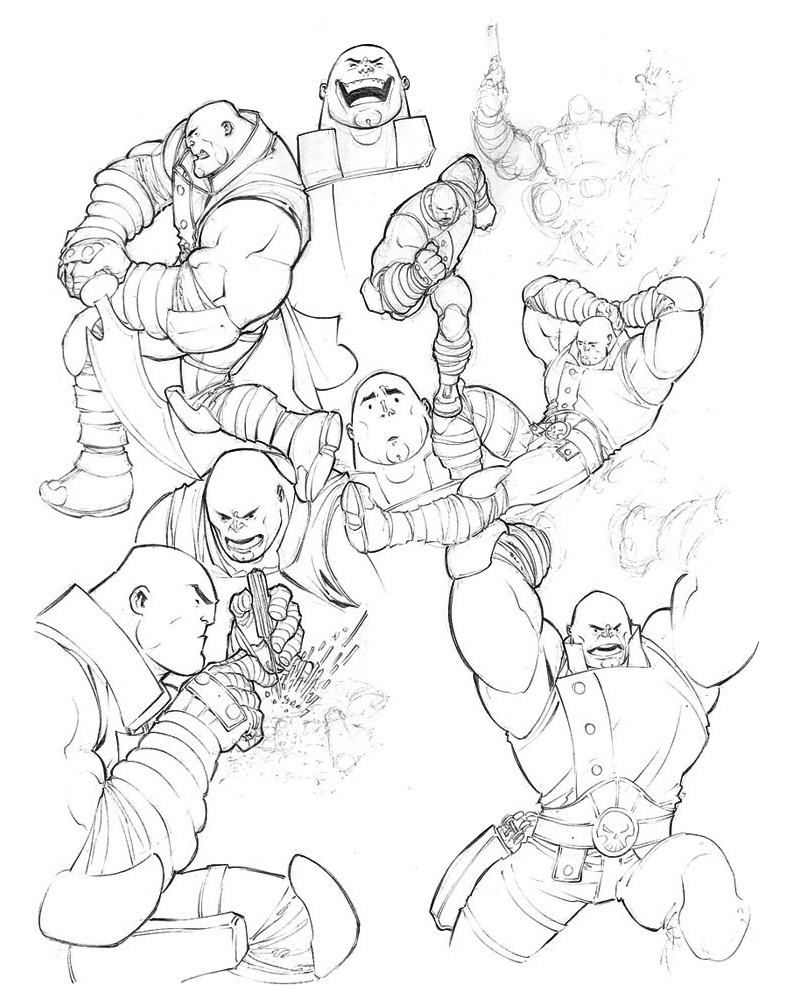
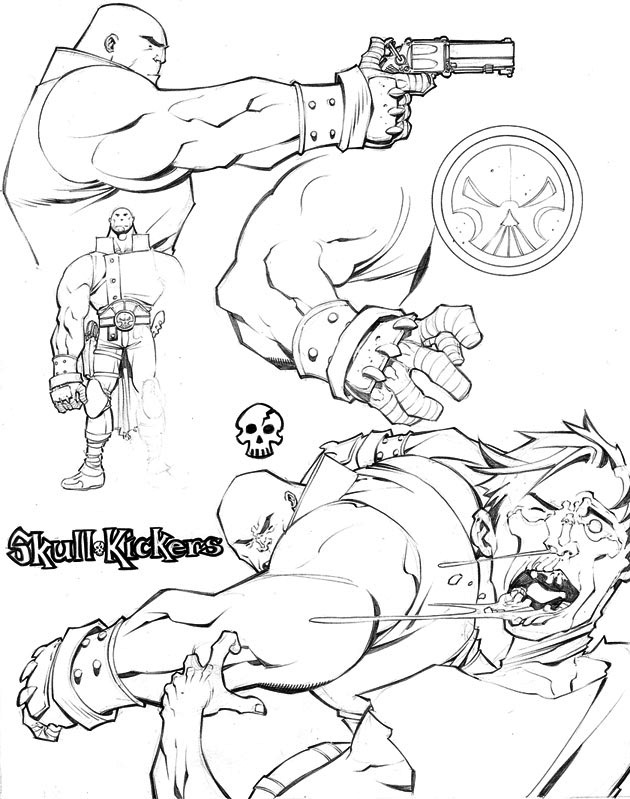
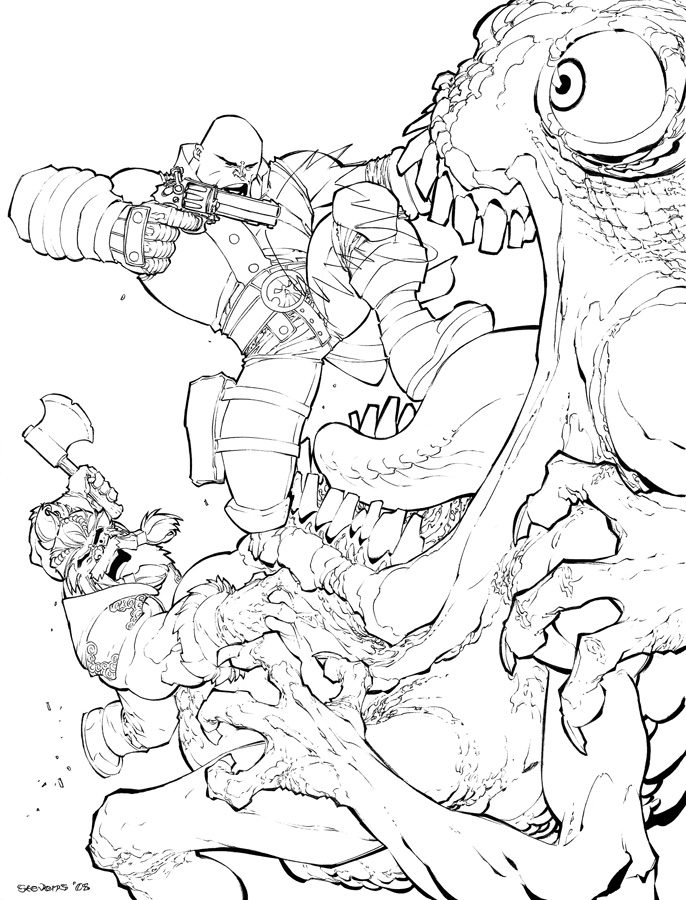
Along with that summary was 4 pages of character sketches by Chris Stevens, helping solidify the ideas presented with his professional quality art:

It’s not perfect, but it is concise. You read it and are well informed about the core concept: These two guys are ass-kicking monster hunters and this series is going to be an irreverent fantasy-adventure romp. Conan the Barbarian meets a buddy cop film. Got it.

(Update May 2015– I’ve recently posted the pitch document for Wayward, my new creator-owned series as well. Check that our HERE.)

In short – The pitch is simple and entertaining. The art helps grab attention, reinforces the concept, and solidifies the whole package as professional-looking and appealing.

Skullkickers is a fun and violent pulp adventure, so that’s exactly what’s emphasized at the forefront of the pitch. None of the other back story elements matter at this early stage. There’s nothing subtle here. The editor can quickly read through and decide if they want more information by contacting me (my contact info was in the header/footer on each page). Ideally they’re hooked but, even if they aren’t they’ll probably appreciate that I didn’t waste their time.

Your story ideas can be scrawled out on dozens of pages. Your scripts can look like telephone books. Your plot and world building can fill giant tomes. None of that matters. If you’re breaking in and want a publisher to check out your idea, you need to percolate all that material down into a bite-sized summary to gain their interest.

Make sense?

Next time I’ll talk more about the different sections of the pitch, ways to stand out and some stuff to avoid.

If you found this post helpful, feel free to let me know here (or on Twitter), share the post with your friends and consider buying some of my comics or donating to my Patreon to show your support for me writing this instead of paying work. 😛

Click here to read Part 3 of this tutorial

They Bleed Pixels Wallpaper

This wallpaper image was put together as unlockable guest art for the amazing gory platform game called They Bleed Pixels, created by Miguel Sternberg.

If you haven’t had a chance to play TBP yet, check it out on Steam! It’s a really fun title with tight controls and over the top pixelated combat.

Here Comes The Pitch – Part One

Like I did with the blog series focused on my comic writing methods (parts one, two, three, four and five), I thought I’d break down some of the things I’ve learned so far about pitching comic story ideas to publishers. As with my previous writing advice, these are just my thoughts and methodology, not rules etched in stone. If you find them useful, that’s great. If not, well I hope it’s mildly interesting in any case.

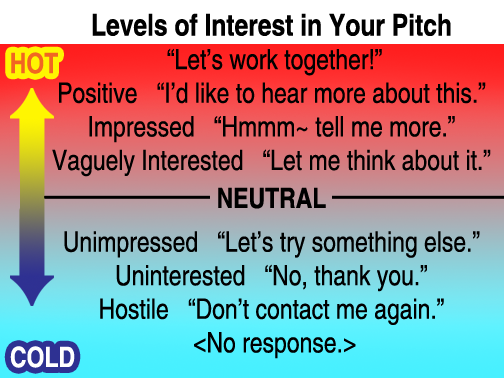
Pitching a story to a publisher can be incredibly difficult, especially when you’re pitching cold. By ‘cold’, I mean that an editor hasn’t approached you looking for writing material and you’re sending it in without any prior ‘heat’ (interest). The cold pitch is the absolute worst position to be in because an editor has absolutely no reason to pay attention to you, and probably has dozens of better things they could/should be doing with their time. Never forget that! Most of the advice I give is centered around this simple fact: You are not a priority when you’re cold pitching a project to a publisher. You have to grab their interest and bring them on board the idea, taking them from uninterested, through neutral, to excited about working with you.

An editor’s primary job is to ensure their current projects are running smoothly (and here’s a hint – it’s extremely rare for projects to run really smoothly). After that’s done for the day they probably want to go home to their family and have some sort of a life. Assuming having a normal life isn’t a viable option for them, then there may be a need for new books/projects, but when those times come up an editor is going to contact trusted/dependable/known talent before anyone else. Why wouldn’t they? Why take a risk on someone who is unproven and (probably) going to require a ton of extra hand-holding to complete the same task an experienced creator could do, especially if the editor could end up putting their own job and reputation on the line if it gets all screwed up?

Think carefully about that. Never forget it. Everyone wants to work with people who are going to make things run smoothly and deliver the goods. Your pitch needs to convince them that you are one of those people (because you are, right? 🙂 ).

The above is why companies like Marvel and DC have a ‘No Blind Writing Submission’ policy. They want people who have previous experience and are already consistently producing high quality stories. They have a large pool of experienced talent to choose from and don’t want to take risks on unknown writers. The simple truth is they’ll approach you (once you have a viable body of work) instead of you approaching them.

Brutal, eh?

But – here’s the good side of things. There are many other outlets for comics and many other publishers you can approach with your rockin’ creator-owned story ideas: Image Comics, Oni Press, Archaia, IDW, Boom!, First-Second, Dynamite and a ton of other great companies producing award-winning kick ass comics. There are opportunities if you can show that you’re professional and capable, even for first-time creators. That doesn’t even take into account self publishing or putting your work directly online, which is more valid than ever before.

So, assuming after all my rambling above you still want to go the pitching route, I suggest you make a strong first impression. You have to make sure your pitch is high quality, easy to digest and engaging.

In short – A pitch is all about clearly explaining your idea and justifying why you are the right person to see it through.

There are many ways to do that and, as long as it achieves the above, you’ve pitched it well. Cross your fingers and see where it goes from there.

I know this was quite the preamble, a blog post all its own, with a mixture of “no one wants to read your stuff” and “get ready to work your butt off”, but that’s a dose of reality I think some people need to hear about the process before we get into the nitty-gritty of it. Before I talk about format, hook, theme or how much information is needed, I felt it was important to talk about the overall purpose of a pitch and what kind of stuff you’re up against when starting out.

Now you know.

If you found this post helpful, feel free to let me know here (or on Twitter), share the post with your friends and consider buying some of my comics or donating to my Patreon to show your support for me writing this instead of paying work. 😛

Click here to read on to part two of this pitching tutorial