Matt O’Keefe over at The Beat has posted an extensive interview with me covering a slew of different topics – Skullkickers, Makeshift Miracle, Pathfinder, ShiftyLook, comic writing and much more.

Matt O’Keefe over at The Beat has posted an extensive interview with me covering a slew of different topics – Skullkickers, Makeshift Miracle, Pathfinder, ShiftyLook, comic writing and much more.

I was thrilled to be a guest on the award-winning Writing Excuses podcast hosted by Brandon Sanderson (Mistborn, The Wheel of Time), Mary Robinette Kowal (Shades of Milk and Honey) and Howard Tayler (Schlock Mercenary).
In 15 minutes we sweep through a brisk chat all about comic writing technique, differences from prose, working with artists and breaking into the comic business.
Please give it a listen and share the link with others.
In previous tutorial posts I’ve talked about my comic writing methods and helpful tips on pitching original stories to comic publishers. This time I’m going to talk about a subject every creator-owned comic writer has wracked their brains over: How do I find a good artist to work with?
Believe me, there’s no easy answer. I could just say “persistence and luck”, and those two elements definitely factor into it, but there are some tips I can give that might improve your chances.
First things first, I know you want to find an incredibly skilled artist, a diamond in the rough who’s been winding away their time doodling top notch pro quality pages just waiting for the right comic story to sink their teeth into. But, before you start that search, you need to make sure you are the kind of writer they’ll want to work with.
Just like I suggested with the pitch tutorial, you need to think like you’re on the other side:
If you were an artist, what would convince you to get on board the project you’re pitching?
MONEY: This is the easy one. If you’re independently wealthy and can afford a professional page rate, you’ll be able to convince a much larger pool of artists to work with you, even if your story sucks. Freelance artists, even great ones, go through slow periods. If your money is good they’ll take on the commission if they’re available. Since that’s probably not the case, you’re definitely gonna need to be…
PROFESSIONAL: You need to present yourself in a professional and courteous way. Your pitch should be clear and catchy. You’ll need to be flexible to their schedule and fair with sharing ownership of the final work. Your communication should be straight forward, your ideas should be easy to understand and your attitude should be upbeat and friendly. Don’t trash your own work and don’t come across as cocky and egotistical.
If you get a chance to send a potential artist your story concepts, make sure they’re tightly written, engaging and, for the love of all that’s holy, grammar and spell-checked. You’re asking someone to slave over your story for little/no pay out of the blue. That’s a ballsy thing to do and if they have any doubts about your ability to deliver on that, it’s going to sour the working relationship really fast. Even if you do everything right it’s still going to be a grueling…
SEARCH: When you’re just starting out you need to initiate contact with potential artists. There are far more people who believe they’re writers than there are great artists to draw their stories, so the onus is on you to find a good fit for your project. Online art communities like deviantART, The Drawing Board, Penciljack, Digital Webbing, ConceptArt or the forums of comic publishers and fan sites are a good place to start. Exploring Artist’s Alley at a convention and making face-to-face contact is even better.
I find deviantART and ArtStation particularly useful because each artist there has a Favorites/Likes gallery (here’s mine). This means when you find one good artist they’ve inevitably favorite-ed pieces by other good artists, which lead to other good artists, and their favorites, and so on, and so on. I’ll go on Favorite searching binges, bookmarking artist pages based on style, tone and skill level. That’s how I found Andrew Huerta, who I ended up recommending to Dynamite for the Pathfinder comic series we worked on together.
Once you find an artist whose work has potential, dig deeper. Find out about them, read their blog posts, get to know a bit about who they are, how they feel about their own art and what they’re currently working on. Approaching an artist who’s already working professionally in comics or who complains a lot about their inability to finish things they start is almost guaranteed to go nowhere. Approaching a professional working artist with your very first comic story is an almost impossible uphill battle. You’re going to have a lot better chance with a talented student or recent art school graduate. Do your research and you’ll save yourself a lot of rejection and hassle. Once you start narrowing things down, your next step is to make…
CONTACT: In the same way I suggested approaching specific publishers with your pitch, I recommend approaching an artist directly with a personalized message. It’s far more engaging than a Want-Ad style post on an art forum where you’re hoping someone great comes along and contacts you. In my experience sending a personalized message comes across way better and elicits a much, much higher percentage of responses. Even if they turn you down, there’s communication and a connection established, which could be helpful later on. A “no” now could become a “yes” down the road.
It’s okay to have certain bits of your introduction letter pre-written in advance, especially parts about yourself or your story concept, but make sure you write a personalized section about the artist – what you see in their work that appeals to you and why you think they’d be a good match for your project. Sending a generic form letter doesn’t make anyone feel special or wanted.
I recommend not sending your pitch or writing samples to the artist in this introduction email. You don’t want to come across as pushy or demanding. It’s just a short request asking about their availability and interest, just an…
INTRODUCTION: Here’s an example of an intro email I’ve sent in the past, with the artist’s name and some of the specifics removed:
Hi (artist),
Comics Alliance has a weekly column called ‘Best Art Ever’ where they post up pin-ups, old and new. This week’s article had a link to a (describes the artist’s pin-up) you did a while back and it immediately grabbed my attention. Finding your art blog and searching through the archives, I discovered more of your work – expressive characters, detailed backgrounds and great storytelling. Awesome stuff!
My name is Jim Zubkavich (friends and colleagues call me ‘Zub’) and, in and among other things, I’m writing a comic series being published at Image called ‘Skullkickers‘. Boiled down to its essence, Skullkickers is a buddy cop film slammed into Conan-style sword and sorcery. The book has been doing quite well for an indy comic launching in this market and it’s starting to get a bit of media attention, which is thrilling and scary at the same time. While things are going well I want to make sure I utilize the momentum, so I’m on the hunt for artists to collaborate with on new comics – mini-series or something more involved.
If you’d like to give Skullkickers a read I can send you links to review PDFs or mail you a set of issues if you give me your mailing address. I’m developing a variety of concepts with different tones and subject matter, but reading Skullkickers will give you a solid idea about how I work.
I don’t know what your current work slate is like or if you’d be interested in doing creator-owned comic work, but I did want to let you know I was blown away by your quality and would be ecstatic to develop something with you any time.
However it goes, keep creating beautiful art and comics.
Sincerely,
Jim
Without trying to sound too cold and analytical about the above, what I’m doing with this letter is complimenting the artist, establishing my credentials and then checking to see if they might be open to talking about future projects. It’s short, professional and friendly.
I’m in a position now where I have a professionally published comic I can reference, which definitely gives me an edge. Although I can’t 100% guarantee my next creator-owned project will be published, having a track record makes it a heck of a lot more likely. Assuming you’re not in that situation, then you’re going to have to make up for it at first with enthusiasm and really great story concepts to get over the hump. It’s not easy, believe me.
Although you may have a specific project in mind, I think it’s always good to leave the field open at first. If you receive a positive response you can see if they have a particular genre/style they’re excited about pursuing or you can mention a particular story concept you want to collaborate with them on. I’d rather create a brand new story that excites an artist rather than try to force them to draw something they’re not clicking with.
The search can be long. It requires persistence and patience. You can send out a ton of introduction messages before you get a positive response and, even when you do, the initial contact might not lead to a successful collaboration. Even with quite a few projects under my belt I still find it hard to connect with new artists who are both high quality and dependable. The creative commercial arts can be as exhausting as they are invigorating. Welcome to the business.
Starting a work relationship with an artist is similar to dating – you want to make a really strong first impression and showcase qualities that’ll convince them you’re the right person to move to the next stage with. Think carefully about how you’re presenting yourself and your work to make sure you’re an “attractive” creative collaborator.
Once you start working with an artist, make sure you have a clear agreement in place so everyone knows what’s expected of them. Charles Soule (the wonderful writer of 27 and Strange Attractors) has a great tutorial series on his site called Agree to Agree (parts one, two, three and four) all about creator-owned contracts you should really check out.
If you found this post helpful, feel free to let me know here (or on Twitter) and share the post with your friends. By telling you about how I find artists to work with I’m limiting my own potential artist pool, so please take pity on me and consider buying some of my comics or donating to my Patreon to staunch the bleeding wound I’m inflicting on myself here by telling you my secrets. 😛
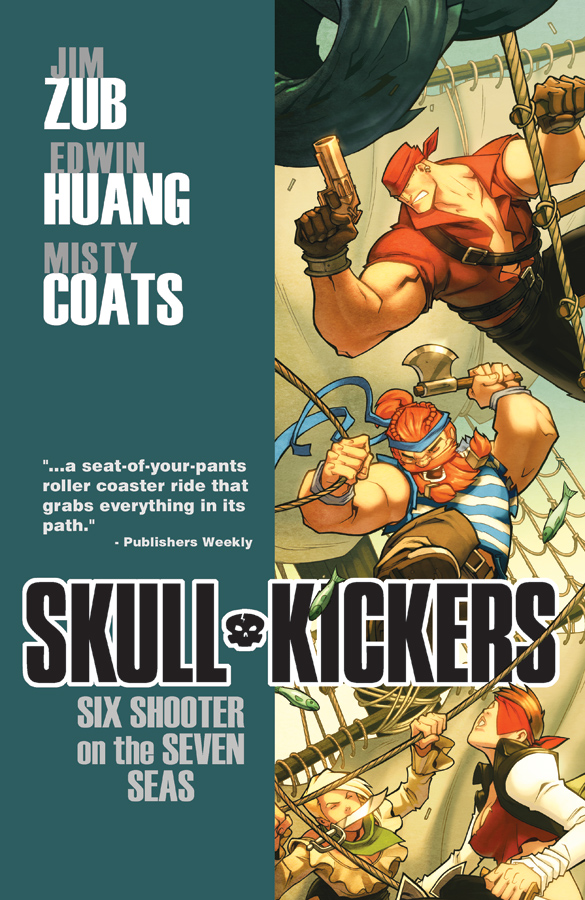
After a successful launch over the weekend at New York Comicon, I’m very proud to announce that Skullkickers Vol. 3: Six Shooter on the Seven Seas is available starting today at comic shops across North America.
The whole team worked their butts off on this third story arc and it really shows. If you’ve been enjoying the series, please show your support by picking up a copy of our latest collection and letting your friends know that we’re bringing the goods with each and every issue.
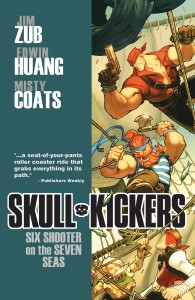
DIAMOND ORDER CODE: AUG12 0492
Order now from Amazon
Order now from Barnes & Noble
Order now from Book Depository
Order now from Forbidden Planet
Order now from Midtown Comics
Order now from Waterstones (UK)

New York Comicon 2012 was a chaotic and exciting show – a satisfying finish to this year’s whirlwind convention season.
It also felt like a level-up moment. Edwin and I had a lot of great interactions with fans of Skullkickers. The good word of mouth and intense promotion we’ve been putting into it seems to be paying off, bit by bit. Having 3 trade paperbacks and a spiffy 1+2 combined hardcover works well, giving people enough material to start digging in to the series without feeling left behind.
Thank you to everyone who came by to visit, longtime readers and new readers alike. Thank you to my friends and colleagues at Bandai-Namco, Image Comics and UDON for helping make the show so successful and enjoyable.
Before the year wraps up I’ve got at least one more comic project announcement. I was hoping it would be unveiled in New York, but am okay with holding out a bit longer as momentum slowly builds.
I’m intensely excited for 2013.
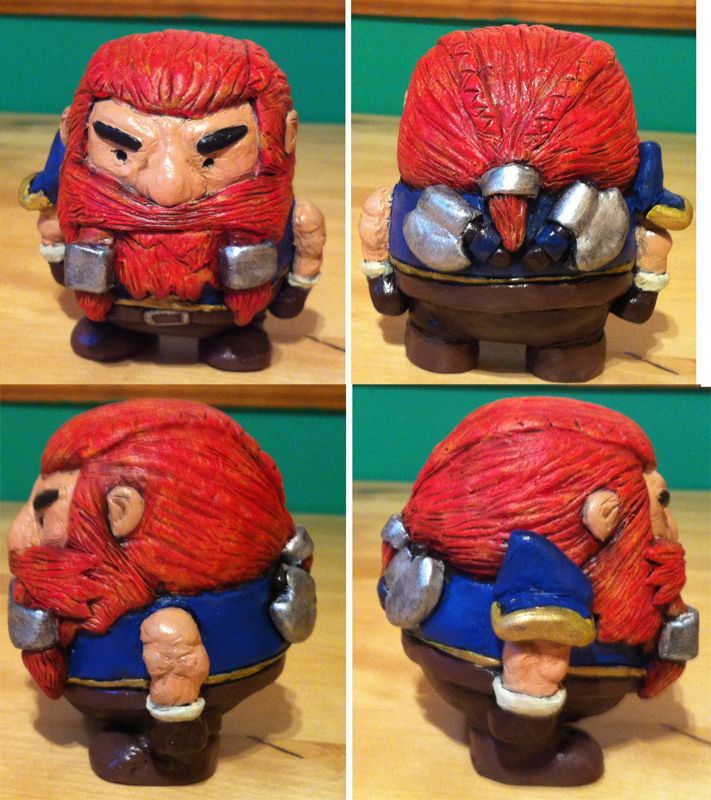
SK mega-fan Jon Walsh had sculptor Travis MacIntosh put together this custom dwarf figurine. So amazing!
If you’re interested in commissioning one of your own, feel free to drop him a line via email.

The UDON crew are writing and drawing a bunch of strips for the ShiftyLook webcomics portal, and ShiftyLook is going to have a totally amazing booth on the New York Comicon floor with signings, games, and much more! You can find the me at the Shiftylook Booth and Stage, #3374, at the following dates and times:
Thursday October 11
4:00PM – 5:00PM: Wonder Momo: Draw a Comic Live & Fireside Chat. Wonder Momo writer Jim Zub talks Wonder Momo while artist Omar Dogan draws live.
Friday October 12
11:00AM – 12:00PM: BMxWM: Bravoman x Wonder Momo. The Super-Unequalled Hero of Excellence meets the Battle Idol this Fall! Bravoman writer Matt Moylan and artist Dax Gordine join Wonder Momo writer Jim Zub and artist Omar Dogan on-stage to discuss ShiftyLook’s first ever crossover event.
2:00PM – 3:00PM: ShiftyLook Meet & Greet. ShiftyLook Producer & Editor-in-Chief Rob Pereyda introduces the NYCC crew. With Rob Paulsen, Chris Hastings, Anthony Clark, Jim Zub, Omar Dogan, Matt Moylan, and Dax Gordine.
Saturday October 13
12:00AM – 1:00PM: Wonder Momo Party. Wonder Momo writer Jim Zub and artist Omar Dogan hang out and talk about all things Momo!
3:00PM – 4:00PM: Bravoman: Cartoon of Unequalled Excellence. With voice of Bravoman Rob Paulsen, character designer Dax Gordine, writer Matt Moylan, writer-producer Jim Zub, and producer Rob Pereyda talk about ShiftyLook’s first animation project.
6:00PM – 7:00PM: ShiftyCast Live! NYCC Day Three. With guests Jim Zub (writer, Klonoa, Wonder Momo and Dragon Spirit) and Matt Moylan (writer, Bravoman) talk all about writing for Bandai-Namco.
New York Comicon, the 4-day pop culture extravaganza, arrives this weekend and I’ll be there in a big way.
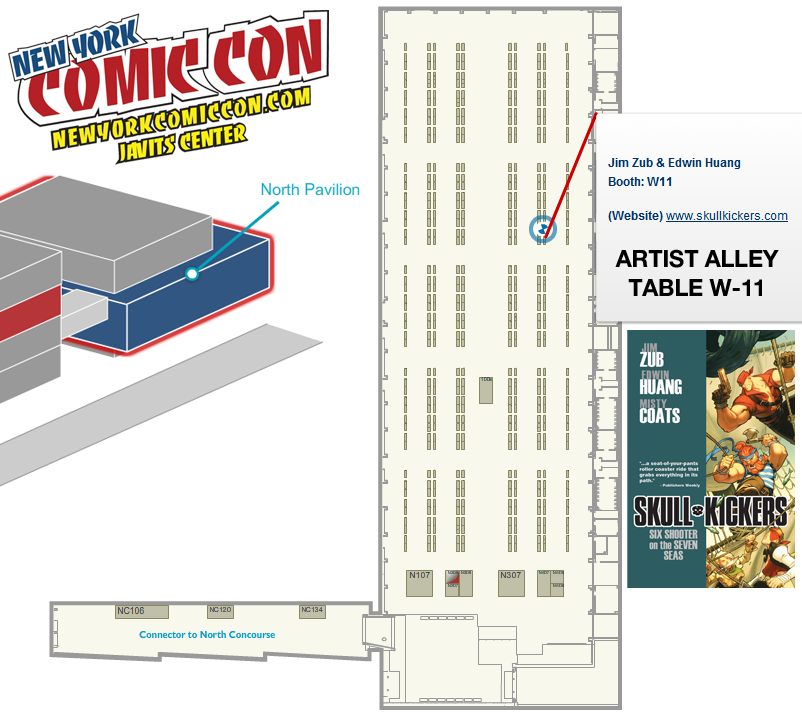
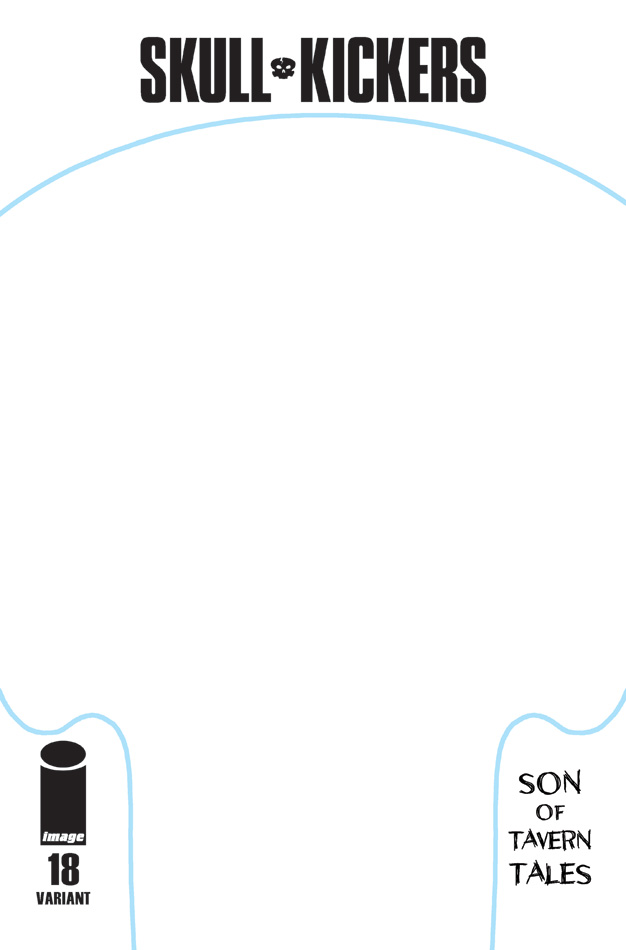
Edwin and I will be set up at Artist Alley Table W-11, and we’re very proud to be launching the Skullkickers Vol. 3: Six Shooter on the Seven Seas trade paperback at the show, along with a convention-exclusive sketch variant of Skullkickers #18, our latest Tavern Tales short story issue.
I’ll also be moderating another writing/pitching panel on Friday evening…
Writers Unite: Pitching and Writing Creator-Owned Comics
Date: Friday, October 12
Time: 5:15 pm – 6:15 pm
Location: 1A14
Speakers: Jim Zub, Charles Soule, Cullen Bunn, Justin Jordan, Ray Fawkes
Description: Creator-owned comics have grabbed the imagination of the comic-reading community all over again and publishers are looking for fresh ideas from a new generation of talent. Listen closely as creators Cullen Bunn (The Sixth Gun), Ray Fawkes (One Soul), Charles Soule (27), Justin Jordan (Luther Strode) and moderator Jim Zub (Skullkickers) discuss pitching their hit comic series to publishers and offer advice on how to climb to the top of the treacherous submission mountain, along with comic writing techniques and amusing anecdotes.
…and will also be appearing at the ShiftyLook booth area promoting Wonder Momo, Klonoa, Sky Kid and Dragon Spirit.
It’s going to be a great weekend and I hope to see you there!
I originally posted this up back in June 2007 on my old Livejournal site, but all of the advice in it still rings true so I thought I’d re-post it here on to my Jim Zub Blog as a way to make sure it stays archived.
Read on…
I don’t know where I first heard someone say “Everyone at cons not already in the industry is trying to break in”, but it’s a great description. Although it’s not actually true, it certainly feels that way. Attend any of the How-To panels at a convention and they’re always packed. Go to any of those panels and invariably the question gets asked:
“How do I break into the industry?”
If it was just about making comics, it wouldn’t even be an issue. Just go make comics. Post them up online or self publish them. Just like that, you’re in the industry.
What they really mean is:
“How do I break in with a publisher?”
Editors and creators should just have their answer to that question on a photocopied handout so they can save themselves endless repetition and add 10 minutes of better questions to the panel. I know that sounds callous and cocky, but hear me out.
Every time I hear this question get asked the answer is almost always the same: hard work, time and determination mixed with a bit of luck and good social skills. It’s almost always a letdown to the person asking because they already know that. They wanted the ultimate secret, some kind of industry handshake or way to stand out from the rest of the submissions.
So, barring just saying “hard work, time and determination mixed with a bit of luck and good social skills”, here’s some important things to keep in mind:
Just like any other occupation, you’ve got to have enough skill to take on the job and be a part of a company’s workflow as seamlessly as possible. So…
A) Have you worked on a comic before?
If the answer is “No”, you need to do so, even if it’s a webcomic or simple photocopied pages stapled together, to show that you can actually do the job and create comics.
If the answer is “Yes”, you need to ensure that it has a similar level of quality to the company you’re showing it to. Remember, you want to show them that you can near-seamlessly become a part of what they already do and be an asset. If your comic isn’t up to par with what they’re already doing, they’re not even going to consider you… in which case you need to create more comics until your samples are good enough.
I used to think 3-6 pages of sequential art would be enough to get a job as an artist, but I’m less convinced of that now. Doing a small number of pages doesn’t show the full spectrum of what the job entails. It may sound like a lot of work to draw a full 18-22 page story but if you can’t/won’t do that, how do you expect to do it day-in/day-out once you break in? If doing that all at once seems too intimidating, start with short stories: 1-3 pages, then 6+, building up your storytelling skills bit by bit.
If you create comics on your own, you’ll improve creatively and build up your work ethic. You’ll also get a chance to see if this is what you want to do with your career. Think of it as the minor leagues before you make your way up to majors. Once you have a body of work, it’s much easier to convince smaller publishers to take you on for new work or possibly publish the stories you’ve already created. The more you create, the better you’ll get at it and the more material you’ll have to show larger publishers.
Writers write, artists illustrate.
If you’re not working on it, you’re not growing.
B) Are you applying to the right place?
Does your artwork/writing/coloring/lettering/etc fit the publishers you’re sending submissions to? Again, this is about integrating with what a company already does. Be selective and choose publishers that mesh well with your style/mindset. A handful of targeted submissions are far more effective than shotgunning every publisher out there. Also, make sure you know the name of the person who will be receiving your submission so your cover letter doesn’t say “Dear Sir/Madam” or “To Whom It May Concern”. That personal touch can go a long way.
Do your research. You’ll save yourself embarrassment and an undue amount of rejection letters.
C) Are you getting socially involved in the industry?
In my experience, even if you have a great portfolio submission it won’t necessarily translate in to a job. Reread that. I know it sounds impossible and depressing but I’ll explain.
These jobs have an important social component. Editors and Art Directors prefer to work with people they know or people recommended by folks they trust – PERIOD. Major publishers generally accept submissions as a PR tactic. They don’t want to appear ungrateful to their fans, so they open the floodgates to submissions but ignore 99.99% of them. With so many experienced and skilled freelancers on the market they have NO reason to hire strangers who send samples out of the blue, no matter how talented they are. Untested talent almost always proves to be more trouble than they’re worth. You need experience and a push from friends on the inside to make it through that barrier.
People talk about being in the “right place at the right time”. What they don’t tell you is if you’re around for enough social interactions with industry people, you’ll create those right places and right times.
Attend a convention. Be friendly, accessible and professional. It’s easy to chat about comics, video games, RPGs and movies with folks at a con built from those hobbies. Keep your art/writing portfolio stashed away and just interact with people. The industry is small enough that the more people you meet, invariably, the better chance you’ll get some kind of social hook-up to a publisher you’d like to work with. You can’t force it. Just be a friendly person and don’t snub any one. You’ll make some lifelong friends who love the same things you do and slowly but surely get closer to your goal. It can take a while, but it works. Seriously.
So… after all that blah-blah this is the kicker, the most important sentence in this post:
Having great work and a social connection with people already working in the field is a rock solid way to break in.
This holds true for comics, RPGs, video games, animation… you name it. There are other ways and outright lucky breaks but you can’t count on those. A good and appropriate body of work coupled with a few solid social contacts is the killer combo. Once your foot is in the door, you can leverage that with more work/credits and contacts to climb up to where you want to be. Along the way you may realize a smaller publisher fits your work and gives you the creative fulfillment you always wanted. Your needs will constantly change as you learn and grow.
So, in brief: Go make stuff and go make friends. 🙂
If you found this post helpful, feel free to let me know here (or on Twitter), share the post with your friends and consider buying some of my comics or donating to my Patreon to show your support for me writing this instead of doing paying work. 😛
Makeshift Miracle: The Girl From Nowhere is now available on DriveThru Comics as a digital download. If you haven’t had a chance to pick it up, now’s the perfect time to download a copy at 40% off the regular cover price.


 Zub on Amazon
 Zub on BlueSky
 Zub on deviantART
 Zub on Facebook
 Zub on GoodReads
 Zub on Instagram
 Zub on Patreon
 Zub on Substack
 Zub on Tumblr
 Zub on Twitter
 Zub on YouTube
 Follow this blog's RSS feed
 Makeshift Miracle