Category Archives: Tutorial - Page 8
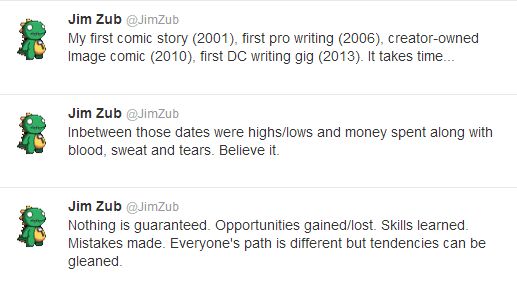
It Takes Time…
Why Don’t Publishers Give Brand New Writers a Chance?
Here’s a question I received about comic writers breaking in to the business:
—
Thanks for the advise… but this works only for people that can attend comic cons or similar in the states. What about aspiring writers that live in other countries and have no possibility to attend those events? I’m asking because I’ve read from many artists that were hired by sending samples, but that seems not to work for writers. In fact, the majority of the USA companies do not receive written submissions (if not packaged together with art). In fact, I consider this policy as unfair and discriminative.
Can you give some advice to this? Meaning, is there any other way to be considered than to socialize with the editors at cons? I understand reading samples takes a lot of time, but is it not part of the editor’s job to “discover” or attract new talents? (and by “new talents” I do not imply novelists, TV writers or any other writers that have entered other media and seem to be “offered” a gig writing comics, even if they haven’t done that before!). Thanks in advance for your answer and for your time.
—
Writers definitely have an uphill battle because, unlike an artist, it’s incredibly hard to take a quick look and see what a writer is capable of.
An editor’s job is to make sure their projects are taken care of by capable people who can deliver high quality professional work on time and, ideally, whose involvement with the project will help sell the work. Testing and nurturing new talent is generally low on their priority list compared to managing current ongoing projects. Trying new people is risky and difficult compared to using people who have a body of work and proof that they can hit their deadlines. I know it can be frustrating seeing writers plucked from other talent pools but if someone has writing work in other mediums (novels, TV, etc.) at least there’s proof they can tell stories, even if it’s not comic specific. Why should a publisher (a business) take a risk on using unknown/untested talent when they don’t have to? What’s the advantage?
If you had a choice between working with people you knew could do the work and others who might not and your job depended on making the right choice, I expect you’d choose the proven talent almost every single time. That’s not discrimination, it’s just common sense.
If I wanted to be a chef I wouldn’t just walk into a restaurant, tell people I could cook and expect them to take me seriously. I’d need to prove that I could be a chef by practicing my craft, slowly working my way up through the ranks until I had the skills and experience to give an employer confidence that I was the right person to be in charge of the kitchen.
The same goes for sports. People start with amateur teams, then intermural matches, single-A, double-A, triple-A and then, possibly, get their shot at the major leagues. You’re essentially asking why major league sports don’t randomly pluck people out of the crowd at a stadium to tryout for their team. Why should they? Why would they expect someone to be ready when they haven’t shown they can do it at all? Why hope for that one-in-a-million long shot amateur when they can work with capable people who are actively proving they can do the job?
The most consistent way to get an editor’s attention is by creating your own comics as a platform to show you can do the work instead of just sending incomplete sample concepts or scripts and expecting someone to take their time poring over it (and the hundreds of other submissions just like it) to see if it’s any good.
If you don’t have a body of work you need to create one and keep building. If you’re not willing to put in the time to create quality stories on your own then how is anyone supposed to trust that you’ll suddenly be able to do it ‘on the job’?
There’s no open spot waiting for you. You have to earn it.
You need to prove you can write complete stories and deliver quality before people are going to pay you to do it for them. That’s the simple truth of it. It’s skill, passion, hard work, promotion and a bit of luck all working in tandem.
Okay, But What About Digital Comics?
Thank you to everyone who passed around the link to my blog post last week. It was a whirlwind of conversation and, even with over 140 comments back and forth on the blog and dozens of tweets, the vast majority of people were civil, supportive and incredibly thoughtful.
The most common question that came up last week was “What about digital comics? How do those sales work?” It’s complicated and I don’t know all the ins and outs, but I’ll do my best to share what I know on that front.
With the ubiquitous nature of digital media in all aspects of our lives, digital comics will almost certainly play an important part in the future of the medium. They’re available globally 24/7 and don’t suffer from print run limitations or shipping damage.
The most popular digital comic platform is comiXology. They’re the current 800 pound gorilla in the still-niche digital comic marketplace. Marvel, DC, Image and most of the other major comic publishers are available through their website and app(s).
A lot of people have talked about the need for cheaper digital comic prices to drive impulse buying in casual/new readers. Right now most of the digital comics available are selling at a similar price to their print counterparts. Outside of sales and special promotions, a $2.99 print comic is selling for $2.99 digitally. People assume that digital content should be much cheaper because it has no physical component, but there are development and infrastructure costs that go into creating and maintaining a digital platform. It’s hard to say whether they’re equivalent, but right now the pricing is relatively equal.
Consider this…

…on a $2.99 digital comic ($3 for simplicity’s sake):
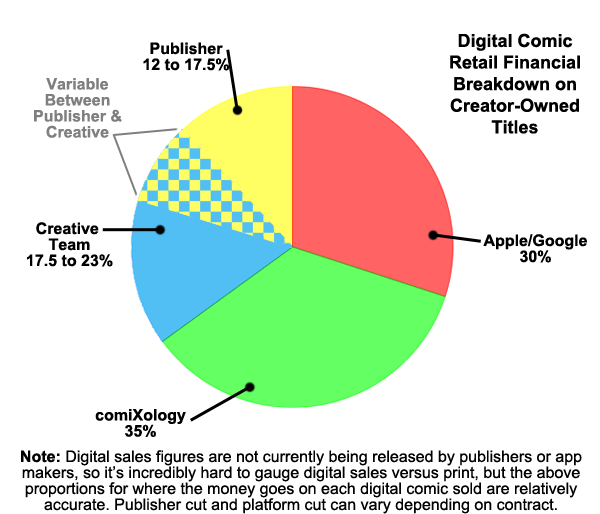
-$0.90: 30% goes to the mobile platform (usually Apple or Google). This is a standard fee leveled on all in-app purchases (which is where the vast majority of digital transactions are happening). This is as close to non-negotiable as things get. You use their device, they take their share. It’s my understanding that comics bought directly through the website don’t have this fee levied against it, which means more money for comiXology, the publisher and the creative team, but it’s way less convenient.
-$1.05: 35% (or, more specifically, 50% of what’s left after Apple/Google takes their share) goes to comiXology. Staff is needed to prep files, maintain servers, update the site and deal with technical issues, so comiXology is acting as the digital distributor. Other digital platforms may take a lower percentage of the cover price, so this amount is by no means universal, but it applies to the current leader in the marketplace.
The remaining $1.05 is split between advertising, the publisher and creative team. Each publisher has their own digital rates and it varies quite a bit from what I’ve been hearing. In some cases publishers don’t offer any percentage of digital sales to the creative team on a creator-owned title. Other than that unfortunate scenario, some publishers are making the same amount they would on a print copy (11-12%), while on the higher end the amount is split evenly between the two. With such a large range it’s hard to nail down exact figures, but it does give you a sense of how things tend to work.
What’s more difficult to answer right now is how well digital comics are actually selling through these platforms. Publishers and companies like comiXology have been very secretive about digital sales numbers. Press releases go out talking about “Best Selling Digital Comics” or “Record Breaking Digital Sales”, but no one’s explaining how many copies are involved in the hype. That makes it impossible to calculate sales figures, understand trends or decide the frequency of sale pricing on digital comics.
Some people have bandied about the broad figure that digital sales are averaging 10-15% of print sales. It’s unfortunately an untested number but, if remotely true, then the 5000 print run example from my previous post would be selling 500-750 digital copies per issue. With a rough range and a rough percentage breakdown that would mean anywhere from $255 to $517 left for the creative team, or $127.5 to $258.50 each for the writer and artist per issue (not counting the cover artist, letterer, colorist, etc.). The creative team gets more of the pie with a digital sale, but it’s a smaller sized pie right now.
If you’re buying digital comics when they’re on sale for 99 cents, the above numbers all get chopped down by 2/3. The pricing drives purchases, but 3 times as many copies have to be sold to make the same amount of money. In addition, the readership may come to expect that 99 cent pricing and wait for another sale rather than buying new digital issues at full price as they’re released.
The above numbers are extremely hard to gauge and shouldn’t be thought of as absolutes. Without solid sales figures to work with it’s impossible to nail down how many copies are actually being sold.
The only remotely solid numbers I have are my own. I’ve done quite a bit of promotion about my comic Skullkickers being available on comiXology, iVerse and Graphicly. We have a free zero issue and we’ve had a couple 99¢ sales, so some of our early issues have sold quite well digitally but, if you count 99¢ copies as a 1/3 sale money-wise, we’re selling at about the 15% range of our print sales on early issues. Later issues are sitting at around 8-10% of print sales right now. Admittedly, the 99¢ pricing has expanded our audience much faster and that’s nothing to sneeze at. They’re not blockbuster sales numbers but at least I know that as our exposure increases back issues will keep selling without any fear of ever being out of stock.
At this point, digital creator-owned comic sales through mainstream platforms aren’t generating a substantial amount of revenue, but it’s growing and things are changing quite quickly. As tablets become more prevalent and people become more at ease with paying for digital content, these figures will expand quite a bit and this space is going to see all kinds of upheaval. Right now it’s really hard to say where it will all end up. I think that having a stake in the ground at this early stage is important and making sure my work is available on as many platforms as possible helps grow our audience.
So, you may be reading this and think “Mainstream print distribution doesn’t make much for creators, mainstream digital doesn’t make much either, so how the heck do I get ahead?!”
Good question!
In my next couple blog posts I’ll talk about online outreach, other revenue streams, working with focused retailers, conventions, and more. Until then, feel free to add your two cents to the above, improve my accuracy and let me know if I’m missing anything. And, if you’re hungry for other things to read, feel free to check out my other tutorial articles about breaking in and writing technique.
If you found this post helpful, please let me know here (or on Twitter) and share the post with your friends. Please consider buying some of my comics online, from your local retailer or from me in person if you see me at a convention.
The Reality of Mainstream Creator-Owned Comics
I’m absolutely thrilled to be working in comics. I’m even happier that one of my major projects right now is a creator-owned comic series I have control of. Writing/Creating Skullkickers and being published by Image Comics is a thrill and an honor. They give me complete ownership and stewardship of my creation and that’s a rare thing in this industry. I want to make sure that’s all up front and very clear.
(UPDATE: I posted an update in February 2015 about how the comic market has changed over the past two and a half years and the expanded potential for creator-owned comics. A lot of the information in this article is still relatively accurate for low print run books, but I recommend checking out the new article as well to get a sense of the whole picture.)
A recent discussion I had about money making in comics took a weird turn and I realized that a lot of people make assumptions about how the financials break down in the comic business. Being published isn’t an instant key to fame and fortune.
Consider this…
…on a $2.99 cover-priced comic ($3, for simplicity’s sake):
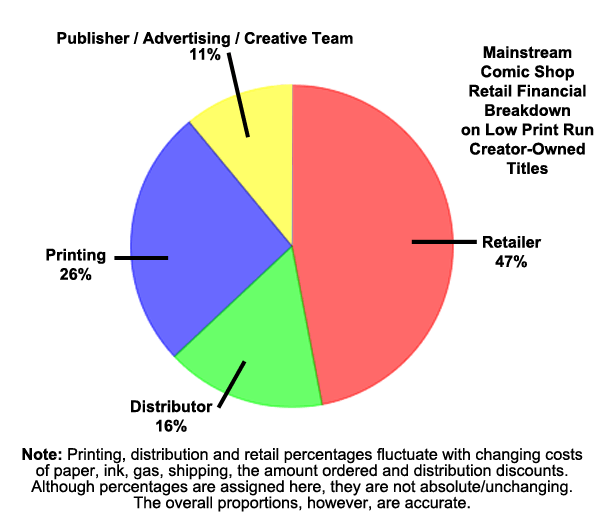
-$1.40: 40-50% of that cover price goes to retailers, the people selling the comics to customers. This amount varies quite a bit based on the publisher and the number of copies ordered by the retailer, but is a base approximation. Retailers deserve their share for selling comics to their local customer base. They buy non-returnable product and take great risk each and every week. In many ways, they’re the distributor’s actual “customer”.
-$0.80: Printing is substantial (and it varies wildly based on the amount printed, paper availability, and press availability so this is NOT an exact figure). 80 cents is a pretty good benchmark for small print runs. On very low print runs (sub 3000), printing can cost more than $1.00 per copy, which really eats into the budget.
-$0.50: 1/6 of that cover price goes to Diamond, the distributor who solicits orders and ships comics to retailers. This varies based on shipping, gas prices, amount ordered and who the publisher is but it’s a good approximation. Diamond deserves their share for soliciting, storing and shipping comics to retail outlets. They’re an international distributor with lots of expenses to keep the system running.
Printing varies wildly, but let’s say 80 cents per issue holds true. With the remaining 30 cents per issue, the following has to be paid:
• Advertising/promotion.
• Publisher operation/office expenses.
• Money left over for the creative team to actually get paid anything.
• Profit?
On a print run of 5000 comics (and many, many creator-owned titles sell less than that in the current market), it means $1500 remains for those 4 important categories. Guess how that breaks down?
If the advertising cost was ZERO and publisher expenses were ZERO, then the writer and artist of a 20 page comic would each get $37.50 PER PAGE. Oops, no money in there for the cover art, sorry. Add in more people (inker, colorist, letterer, etc) and the amount gets split even further, but this is a BOGUS number. The publisher has expenses/staff to pay for.
The reality is that once the publisher takes their share of what’s left (and they absolutely deserve it), there may be no money left for the creative team, let alone advertising.
Even if the cover price was $3.99 for that same indy comic, the distribution and retailer amounts are percentages, not flat rates. An extra dollar for the comic doesn’t suddenly put an extra dollar in the creative payment pool. It gives about 40 cents more per issue for those 4 categories listed above. It’s quite helpful and can keep a book afloat, but doesn’t magically solve the equation.
Lastly, none of the above considers copies lost or damaged in transit that cost money to print but make ZERO dollars. A small percentage of books don’t make any money for anyone in this chain (except printers) when they’re wrecked or lost. Accidents happen.
The above is simplified. Percentages vary depending on the publisher, special discounts and order volume. Please don’t use these figures to make an exact budget for your future comic project.
Believe it or not, I’m not bitter about all of this. It’s the price of doing business in the mainstream comic industry via retail outlets and international distribution. That’s how it works. I just want to make it very clear so people understand what I mean when I say I’m not getting rich making my own comic. Skullkickers is the most expensive hobby I’ve ever had. 😛
That’s why you should
• Support indy titles.
• Support creator-owned comics.
• Pre-order books you’re interested in from your local retailer.
• Tell your friends about books and help build support.
• Support Kickstarter campaigns for great independent comic projects.
• Buy direct from creators at conventions so that more of the cover price goes into their pocket.
Now you know.
There are other outlets and, when I get a bit more time, I’m going to talk about trade paperback collection/graphic novel sales, digital sales and convention sales. The above is the reality of small print run indy comics competing in the same sales space as mainstream pop culture icons like Spider-Man, X-Men or Batman. Mainstream retail production/sales relies on large volumes sold at deep discount. For every breakout Walking Dead there are thousands of titles that will never make a profit in the same space against that competition.
If you found this post helpful, feel free to let me know here (or on Twitter) and share the post with your friends. Please consider buying some of my comics online, from your local retailer or from me in person if you see me at a convention.
Comic Pitch Critique
Two weeks ago I was sent a pitch package for a comic series from a new creator eager to get feedback.
I generally refuse to do critiques on pitches/scripts for multiple reasons:
– I’m a creator, not an editor. I can’t get your story published.
– I don’t want to see other people’s stories, just in case I have something similar of my own in the works.
– I don’t have enough time to work on my own stuff, let alone help someone else with theirs.
– People usually don’t want critique, they want compliments and I’m a terrible liar.
Even still, this person previously met me at a convention over the summer and we had a nice chat, so they weren’t completely emailing me “cold“. They were polite, reasonable and seemed driven enough to put together a professional concept. I asked if they wanted encouragement or critique and they told me to be as honest/brutal as possible so they could improve. That took guts.
Here’s what I sent them back, with specifics removed, so other people who read my blog can benefit from it too:
—
Some quick thoughts on the pitch package you sent in-
THE GOOD
• Overall the pages are professional quality. The art is clear, the storytelling is easy to follow and everything makes sense from panel to panel and page to page. Considering how hard that is for the vast majority of people I see trying to break in, it’s a very solid start. Pat yourself on the back.
• The character designs are fun and the base concept of (story specific stuff removed) has solid potential.
THE NOT SO MUCH
• I think the logo is boring. Stock fonts and a treatment that looks like an 80’s straight-to-video movie. It doesn’t create a strong impression.
• Your character designs are neat, but there’s minimal variety between body types. You draw the generic sexy girl, the medium-sized guy and the slightly bigger guy. Your bad guys fall into the exact same size/shape categories. I know some big name comic artists do that too, but I find it generic and unimpressive compared to a full range of characters with unique proportions and silhouettes, especially with character concepts this unique.
• The coloring is base-level competent but doesn’t do anything to enhance the visuals. The backgrounds are always grey/neutral/boring with large washes of the exact same color no matter what depth things are at in the panels. The character colors are vibrant, but they never seem to be affected by mood or lighting no matter what’s happening. The lighting is never dramatic and there’s never a clear sense of a light source affecting the colors around it. I’d almost prefer to see the pages just as line art.
• I’m not personally a fan of line-thin gutters between panels. It muddies the storytelling, especially with the weak coloring. Opinions vary, but that’s how I feel about it.
• The title is amusing, the concept seems fun, the characters are a zany mix, but the sample pages have zero humor/joy. The dialogue isn’t snappy, just generic, the scenario the characters get themselves into is generic and the outcome of the fight is a bullet in the head and a punch out. It’s nothing people haven’t seen a thousand times before. It falls completely flat.
What makes (comic title removed) different/better than a hundred other action-style concepts? What are you trying to say about action, about characters, about anything? What will people get in this comic that they can’t get anywhere else? Why does this comic need to exist? Solve that and you’ll be in much better shape with the pitch.
That’s my quick critique. I hope you’re not offended by the brevity of it. I’m slamming on deadlines right now so that’s all the time I’ve got. I wish you the best of luck with it.
Sincerely,
Jim
—
I honestly don’t have time to give people one-on-one feedback, which is why I’m writing tutorial blogposts instead, so this is the last critique I’m going to be able to do for the foreseeable future.
The core of my criticism with the pitch wasn’t the professionalism of the sample pages, the art was actually pretty sweet, but more about standing out in a sea of similar ideas.
I see this a lot with story ideas/pitches. People want to create a book just like X (fill-in the blank). Being inspired by X is fine, but if all you’re doing is creating another X, then why wouldn’t people just go read the original X instead?
Anyways, the person in question responded very positively to the feedback, which is always a relief. The last thing I want to do is spend time putting together feedback that angers/offends someone instead of helping them. I’m confident they’ve got a solid base to build from and hope that this concept, or another one they develop, really hits the mark with a publisher.
Comic Q&A – Rates, Cons and Distribution
Since posting up tutorials about writing, pitching and finding artists I’ve received quite a few messages asking for other information about the comic publishing/creator-owned business. I figured I’d answer a few here on my site so other people could benefit from the info.
Q) In your blog you mention a professional page rate – What is the average for a professional page rate? How much should I expect to pay on commission work to have a quality artist work on my comic?
The reason I didn’t list rates in my post is because there’s a massive possible range. Seriously, there are times when it feels like anything goes in this business. Whatever you and an artist can agree to is the rate that works for your project.
If you’re able to work with a talented art student/graduate they might do the work for cheap/free as an experience and for their portfolio, but it’s best not to plan on that.
If someone, especially an established professional artist, is making this their primary income then they’re going to expect some kind of semi-living wage. That’s going to vary wildly depending on where they live, how they live and what they expect. Everyone’s threshold is different.
Marvel/DC can pay double-triple what most independent publishers/individuals can afford, which is one of the many reasons why creators tend to drop everything else to work for them.
There’s a reason why Edwin and I have to take breaks between story arcs of Skullkickers. It’s not due to our production speed, it’s because I need to rebuild a buffer of money (from freelance work) in order to pay Edwin, Misty and Marshall for their hard work. I have never received a page rate for writing Skullkickers. It’s the most expensive “hobby” I’ve ever had. ;P
Q) When an artist works for a commission rate, does this replace their ownership rights for the comic, or is this in addition to what an artist would expect as compensation?
Illustrating a comic takes far longer than writing one does, so I personally think it’s reasonable for an artist to get some pay (though not necessarily a lot) and still expect a split on creator rights, but that’s just my opinion, not any kind of absolute rule.
If you’re paying a pro rate for the work then I think it’s reasonable (as long as everything’s stated up front) to set up a work-for-hire scenario and keep sole rights. Just make sure the communication and accounting is clear.
Q) In general how many issues do you have to sell for a comic to break even?
It varies wildly depending on your creative costs. It also depends on fluctuating costs like paper stock, which printer is being used, how many comics you’re printing (which change the price/unit cost), advertising costs and shipping/storage fees (which vary with the rising price of gas).
I wrote an entire blog post about the profitability of creator-owned comics you can check out right HERE.
Q) You wrote about how to find an artist, but what about a letterer and colorist? How do you find them?
There are quite a few letterers out there and most are willing to take on extra work because they’re rarely full-up. Check the credits of your favorite indy comics and look them up online. Don’t scrimp on lettering or think that it’s something you can just do yourself without practice/training. Lettering can make or break a comic.
Quality colorists are more numerous than pencilers, but you still have to hunt them down, in many of the same places I recommended you look out for line artists.
Q) Does a publisher require payment up front to publish a creator-owned comic? If that isn’t typical, can someone pay a publisher to publish their comic?
For reputable publishers, no. If they don’t think a project can make back a minimum amount then they’re not going to take the risk and publish that book.
There are some small publishers that will solicit and publish a comic for a fee but I think that kind of stuff is a scam. When a publisher is that small they’re not helping get the work out to a larger audience anyways. You’d be better off just posting the work online for free and save yourself the printing/distribution hassle.
Q) How does a comic get distributed to comic shops? How does it show up in the catalogue? Is this something the publisher does?
Publishers that have an agreement with Diamond (the only major comic distributor right now in the market) list books they want to solicit in the Previews catalogue. Diamond takes orders and, once the order period is finished, they send the publisher a PO (purchase order). Based on the number of sales, the publisher will set their print run, print the comics and then see that they’re shipped to the distribution warehouses. The publisher takes care of these steps.
Q) When you get invited to do signings or conventions, is that something you’re paid to do or have your expenses covered with?
I attended 15 conventions in 2012 and each one operated differently. There’s no absolute rule.
Some cover everything (but that’s quite rare this early in my career), some just my table/booth, others cover airfare OR hotel but not both, some cover nothing at all and my expenses are all out of pocket.
I have to budget carefully to make sure I’m not losing money by attending a convention. I can’t afford to spend money on promotion right now. If I lose money on a show I either have to figure out how to make it work better next time or not attend that convention again. A convention has to make some money to go into the “war chest” I’m building up to pay for other creator-owned projects I’m planning.
In short: buy creator-owned books at conventions. It means a lot to the creators exhibiting there.
Q) Is there any other good advice you can give for my pursuit of a comic career?
Way too much for me to impart and I’m still learning a lot. Some of it is stuff you have to go through personally in terms of the industry roller coaster and other stuff is common sense.
Here are a few quick tips:
– Don’t spend money you don’t have/can’t do without, even for your creative dreams.
– Don’t assume you are the exception to the rule.
– Be brutally honest with yourself about the quality of the work you’re producing and strive to improve each and every time you put your stuff out there.
If you found these answers helpful, feel free to let me know here (or on Twitter), share the posts with your friends and consider buying some of my comics to show your support.
How Do I Find An Artist?
In previous tutorial posts I’ve talked about my comic writing methods and helpful tips on pitching original stories to comic publishers. This time I’m going to talk about a subject every creator-owned comic writer has wracked their brains over: How do I find a good artist to work with?
Believe me, there’s no easy answer. I could just say “persistence and luck”, and those two elements definitely factor into it, but there are some tips I can give that might improve your chances.
First things first, I know you want to find an incredibly skilled artist, a diamond in the rough who’s been winding away their time doodling top notch pro quality pages just waiting for the right comic story to sink their teeth into. But, before you start that search, you need to make sure you are the kind of writer they’ll want to work with.
Just like I suggested with the pitch tutorial, you need to think like you’re on the other side:
If you were an artist, what would convince you to get on board the project you’re pitching?
MONEY: This is the easy one. If you’re independently wealthy and can afford a professional page rate, you’ll be able to convince a much larger pool of artists to work with you, even if your story sucks. Freelance artists, even great ones, go through slow periods. If your money is good they’ll take on the commission if they’re available. Since that’s probably not the case, you’re definitely gonna need to be…
PROFESSIONAL: You need to present yourself in a professional and courteous way. Your pitch should be clear and catchy. You’ll need to be flexible to their schedule and fair with sharing ownership of the final work. Your communication should be straight forward, your ideas should be easy to understand and your attitude should be upbeat and friendly. Don’t trash your own work and don’t come across as cocky and egotistical.
If you get a chance to send a potential artist your story concepts, make sure they’re tightly written, engaging and, for the love of all that’s holy, grammar and spell-checked. You’re asking someone to slave over your story for little/no pay out of the blue. That’s a ballsy thing to do and if they have any doubts about your ability to deliver on that, it’s going to sour the working relationship really fast. Even if you do everything right it’s still going to be a grueling…
SEARCH: When you’re just starting out you need to initiate contact with potential artists. There are far more people who believe they’re writers than there are great artists to draw their stories, so the onus is on you to find a good fit for your project. Online art communities like deviantART, The Drawing Board, Penciljack, Digital Webbing, ConceptArt or the forums of comic publishers and fan sites are a good place to start. Exploring Artist’s Alley at a convention and making face-to-face contact is even better.
I find deviantART and ArtStation particularly useful because each artist there has a Favorites/Likes gallery (here’s mine). This means when you find one good artist they’ve inevitably favorite-ed pieces by other good artists, which lead to other good artists, and their favorites, and so on, and so on. I’ll go on Favorite searching binges, bookmarking artist pages based on style, tone and skill level. That’s how I found Andrew Huerta, who I ended up recommending to Dynamite for the Pathfinder comic series we worked on together.
Once you find an artist whose work has potential, dig deeper. Find out about them, read their blog posts, get to know a bit about who they are, how they feel about their own art and what they’re currently working on. Approaching an artist who’s already working professionally in comics or who complains a lot about their inability to finish things they start is almost guaranteed to go nowhere. Approaching a professional working artist with your very first comic story is an almost impossible uphill battle. You’re going to have a lot better chance with a talented student or recent art school graduate. Do your research and you’ll save yourself a lot of rejection and hassle. Once you start narrowing things down, your next step is to make…
CONTACT: In the same way I suggested approaching specific publishers with your pitch, I recommend approaching an artist directly with a personalized message. It’s far more engaging than a Want-Ad style post on an art forum where you’re hoping someone great comes along and contacts you. In my experience sending a personalized message comes across way better and elicits a much, much higher percentage of responses. Even if they turn you down, there’s communication and a connection established, which could be helpful later on. A “no” now could become a “yes” down the road.
It’s okay to have certain bits of your introduction letter pre-written in advance, especially parts about yourself or your story concept, but make sure you write a personalized section about the artist – what you see in their work that appeals to you and why you think they’d be a good match for your project. Sending a generic form letter doesn’t make anyone feel special or wanted.
I recommend not sending your pitch or writing samples to the artist in this introduction email. You don’t want to come across as pushy or demanding. It’s just a short request asking about their availability and interest, just an…
INTRODUCTION: Here’s an example of an intro email I’ve sent in the past, with the artist’s name and some of the specifics removed:
Hi (artist),
Comics Alliance has a weekly column called ‘Best Art Ever’ where they post up pin-ups, old and new. This week’s article had a link to a (describes the artist’s pin-up) you did a while back and it immediately grabbed my attention. Finding your art blog and searching through the archives, I discovered more of your work – expressive characters, detailed backgrounds and great storytelling. Awesome stuff!
My name is Jim Zubkavich (friends and colleagues call me ‘Zub’) and, in and among other things, I’m writing a comic series being published at Image called ‘Skullkickers‘. Boiled down to its essence, Skullkickers is a buddy cop film slammed into Conan-style sword and sorcery. The book has been doing quite well for an indy comic launching in this market and it’s starting to get a bit of media attention, which is thrilling and scary at the same time. While things are going well I want to make sure I utilize the momentum, so I’m on the hunt for artists to collaborate with on new comics – mini-series or something more involved.
If you’d like to give Skullkickers a read I can send you links to review PDFs or mail you a set of issues if you give me your mailing address. I’m developing a variety of concepts with different tones and subject matter, but reading Skullkickers will give you a solid idea about how I work.
I don’t know what your current work slate is like or if you’d be interested in doing creator-owned comic work, but I did want to let you know I was blown away by your quality and would be ecstatic to develop something with you any time.
However it goes, keep creating beautiful art and comics.
Sincerely,
Jim
Without trying to sound too cold and analytical about the above, what I’m doing with this letter is complimenting the artist, establishing my credentials and then checking to see if they might be open to talking about future projects. It’s short, professional and friendly.
I’m in a position now where I have a professionally published comic I can reference, which definitely gives me an edge. Although I can’t 100% guarantee my next creator-owned project will be published, having a track record makes it a heck of a lot more likely. Assuming you’re not in that situation, then you’re going to have to make up for it at first with enthusiasm and really great story concepts to get over the hump. It’s not easy, believe me.
Although you may have a specific project in mind, I think it’s always good to leave the field open at first. If you receive a positive response you can see if they have a particular genre/style they’re excited about pursuing or you can mention a particular story concept you want to collaborate with them on. I’d rather create a brand new story that excites an artist rather than try to force them to draw something they’re not clicking with.
The search can be long. It requires persistence and patience. You can send out a ton of introduction messages before you get a positive response and, even when you do, the initial contact might not lead to a successful collaboration. Even with quite a few projects under my belt I still find it hard to connect with new artists who are both high quality and dependable. The creative commercial arts can be as exhausting as they are invigorating. Welcome to the business.
Starting a work relationship with an artist is similar to dating – you want to make a really strong first impression and showcase qualities that’ll convince them you’re the right person to move to the next stage with. Think carefully about how you’re presenting yourself and your work to make sure you’re an “attractive” creative collaborator.
Once you start working with an artist, make sure you have a clear agreement in place so everyone knows what’s expected of them. Charles Soule (the wonderful writer of 27 and Strange Attractors) has a great tutorial series on his site called Agree to Agree (parts one, two, three and four) all about creator-owned contracts you should really check out.
If you found this post helpful, feel free to let me know here (or on Twitter) and share the post with your friends. By telling you about how I find artists to work with I’m limiting my own potential artist pool, so please take pity on me and consider buying some of my comics or donating to my Patreon to staunch the bleeding wound I’m inflicting on myself here by telling you my secrets. 😛

How Do I Break In?
I originally posted this up back in June 2007 on my old Livejournal site, but all of the advice in it still rings true so I thought I’d re-post it here on to my Jim Zub Blog as a way to make sure it stays archived.
Read on…
I don’t know where I first heard someone say “Everyone at cons not already in the industry is trying to break in”, but it’s a great description. Although it’s not actually true, it certainly feels that way. Attend any of the How-To panels at a convention and they’re always packed. Go to any of those panels and invariably the question gets asked:
“How do I break into the industry?”
If it was just about making comics, it wouldn’t even be an issue. Just go make comics. Post them up online or self publish them. Just like that, you’re in the industry.
What they really mean is:
“How do I break in with a publisher?”
Editors and creators should just have their answer to that question on a photocopied handout so they can save themselves endless repetition and add 10 minutes of better questions to the panel. I know that sounds callous and cocky, but hear me out.
Every time I hear this question get asked the answer is almost always the same: hard work, time and determination mixed with a bit of luck and good social skills. It’s almost always a letdown to the person asking because they already know that. They wanted the ultimate secret, some kind of industry handshake or way to stand out from the rest of the submissions.
So, barring just saying “hard work, time and determination mixed with a bit of luck and good social skills”, here’s some important things to keep in mind:
Just like any other occupation, you’ve got to have enough skill to take on the job and be a part of a company’s workflow as seamlessly as possible. So…
A) Have you worked on a comic before?
If the answer is “No”, you need to do so, even if it’s a webcomic or simple photocopied pages stapled together, to show that you can actually do the job and create comics.
If the answer is “Yes”, you need to ensure that it has a similar level of quality to the company you’re showing it to. Remember, you want to show them that you can near-seamlessly become a part of what they already do and be an asset. If your comic isn’t up to par with what they’re already doing, they’re not even going to consider you… in which case you need to create more comics until your samples are good enough.
I used to think 3-6 pages of sequential art would be enough to get a job as an artist, but I’m less convinced of that now. Doing a small number of pages doesn’t show the full spectrum of what the job entails. It may sound like a lot of work to draw a full 18-22 page story but if you can’t/won’t do that, how do you expect to do it day-in/day-out once you break in? If doing that all at once seems too intimidating, start with short stories: 1-3 pages, then 6+, building up your storytelling skills bit by bit.
If you create comics on your own, you’ll improve creatively and build up your work ethic. You’ll also get a chance to see if this is what you want to do with your career. Think of it as the minor leagues before you make your way up to majors. Once you have a body of work, it’s much easier to convince smaller publishers to take you on for new work or possibly publish the stories you’ve already created. The more you create, the better you’ll get at it and the more material you’ll have to show larger publishers.
Writers write, artists illustrate.
If you’re not working on it, you’re not growing.
B) Are you applying to the right place?
Does your artwork/writing/coloring/lettering/etc fit the publishers you’re sending submissions to? Again, this is about integrating with what a company already does. Be selective and choose publishers that mesh well with your style/mindset. A handful of targeted submissions are far more effective than shotgunning every publisher out there. Also, make sure you know the name of the person who will be receiving your submission so your cover letter doesn’t say “Dear Sir/Madam” or “To Whom It May Concern”. That personal touch can go a long way.
Do your research. You’ll save yourself embarrassment and an undue amount of rejection letters.
C) Are you getting socially involved in the industry?
In my experience, even if you have a great portfolio submission it won’t necessarily translate in to a job. Reread that. I know it sounds impossible and depressing but I’ll explain.
These jobs have an important social component. Editors and Art Directors prefer to work with people they know or people recommended by folks they trust – PERIOD. Major publishers generally accept submissions as a PR tactic. They don’t want to appear ungrateful to their fans, so they open the floodgates to submissions but ignore 99.99% of them. With so many experienced and skilled freelancers on the market they have NO reason to hire strangers who send samples out of the blue, no matter how talented they are. Untested talent almost always proves to be more trouble than they’re worth. You need experience and a push from friends on the inside to make it through that barrier.
People talk about being in the “right place at the right time”. What they don’t tell you is if you’re around for enough social interactions with industry people, you’ll create those right places and right times.
Attend a convention. Be friendly, accessible and professional. It’s easy to chat about comics, video games, RPGs and movies with folks at a con built from those hobbies. Keep your art/writing portfolio stashed away and just interact with people. The industry is small enough that the more people you meet, invariably, the better chance you’ll get some kind of social hook-up to a publisher you’d like to work with. You can’t force it. Just be a friendly person and don’t snub any one. You’ll make some lifelong friends who love the same things you do and slowly but surely get closer to your goal. It can take a while, but it works. Seriously.
So… after all that blah-blah this is the kicker, the most important sentence in this post:
Having great work and a social connection with people already working in the field is a rock solid way to break in.
This holds true for comics, RPGs, video games, animation… you name it. There are other ways and outright lucky breaks but you can’t count on those. A good and appropriate body of work coupled with a few solid social contacts is the killer combo. Once your foot is in the door, you can leverage that with more work/credits and contacts to climb up to where you want to be. Along the way you may realize a smaller publisher fits your work and gives you the creative fulfillment you always wanted. Your needs will constantly change as you learn and grow.
So, in brief: Go make stuff and go make friends. 🙂
If you found this post helpful, feel free to let me know here (or on Twitter), share the post with your friends and consider buying some of my comics or donating to my Patreon to show your support for me writing this instead of doing paying work. 😛
Here Comes The Pitch – Part Four
Okay, I’ve covered quite a few different aspects of how I put together a pitch, from the purpose of a pitch, to summarizing your ideas and the different sections you can use to explain your concept. Above and beyond that information, I wanted to offer some other advice that didn’t quite fit anywhere else.
DO check and follow a publisher’s submission guidelines before following any advice I’ve given you. If they ask for specific things you’ll make it a lot easier for them (and they’ll see that you can follow instructions) if you give them what they’ve asked for.
DO explain the elements that make your story compelling, entertaining or unique. It’s okay for you to be inspired by other things, just make sure you have something new to add instead of offering a carbon copy of an existing story.
DO get people you trust to look over the pitch to help edit it for spelling, grammar and clarity. A fresh set of eyeballs checking things over can be invaluable.
DO credit everyone involved in the pitch: the artist(s), colorist(s), letterer, you name it. Everyone involved should have their contribution clearly noted. This isn’t just about your writing.
DO put your contact info on the header or footer of each page so the publisher has it even if the pages get separated.
DO send your pitch to a specific editor rather than “To Whom It May Concern”. Find books from a publisher that fit the kind of story you’re working on, check who the editor is and do your best to track down their contact information.
DO include a brief cover letter/email. Introduce yourself, mention any previous creative work or related experience you have and explain why you think the publisher would be a good fit for the pitch.
DO keep your emails to publishers simple, professional and direct. They’re not your friend (yet, who knows what will happen later on) and this isn’t a social call. They won’t sift through a rambling or confusing email waiting for it to get to the point.
DO hand over a pitch in person at a convention or social event if the opportunity presents itself, but keep it brief. Putting a name to a face can go a long way; just make sure you’re professional and polite. Read the social cues and try to pick a good moment. Try not to stress out about it (easier said than done, I know).
DO be open to adjusting your pitch if an editor wants revisions to the concept. Be open to their feedback/critique. If they want changes you’re uncomfortable with, walk away as politely as possible so you don’t leave a bad impression.
DO build polite social relationships with professionals in person or online. There is a strong social aspect to this industry and it’s important to be around it, just don’t expect people to involve you in every interaction just because you’re there. It can take a really long time, so try not to force it.
DO have an easy to remember email address and website so an editor can stay in touch. Even if they don’t pick up this pitch, having a way for them to easily find you can pay off down the road.
DO remember to be gracious even if your pitch is rejected. As difficult as it can be, thank them for their time and consideration.
DO buy and read more creator-owned comics. If this is what you want to get into, you need to stay current with what’s being released and support the industry if you want the industry to support you.
DON’T expect other professionals to look over your pitch if they’re not your friends (heck, probably not even then). They’re too busy working on their own projects and probably can’t help you get your work published anyways.
DON’T send your pitch randomly to every comic publisher you can find. Do your research and only choose companies who fit the work you’re putting together. The shotgun approach does not work and sending inappropriate pitches to publishers makes you look desperate and poorly informed.
DON’T use self deprecation as a way to try and get a response from a publisher (things like “I know you probably won’t answer this email, but…”). If they like the work, they’ll contact you. If not, that’s your problem not theirs.
DON’T use your cover letter as a way to explain your life story or how long you’ve wanted to work in comics. Pretty much everyone who works in the industry has been a “lifelong fan”. Just quickly introduce yourself and let them get to the pitch.
DON’T trash other people’s work to try and boost your own (“Since you guys already published [crappy comic] I’m sure my new concept will knock your socks off”). Keep your interactions positive.
DON’T exaggerate how long you’ve been working on a pitch. Telling an editor you’ve spent a decade developing your story or that this is your life’s work is a turn-off, not a selling feature. Remember, your first projects should be small and manageable, not grandiose.
DON’T include hype about sales/media potential in your pitch or cover letter. Even if you think you have the next Harry Potter meets Walking Dead by way of Scott Pilgrim, let the publisher decide its commercial potential.
DON’T spam an editor with multiple pitches at once. They won’t think you’re a story genius, they’ll just find it obnoxious and almost certainly trash them all. Send one at a time and wait for a response before sending another concept, and only if they agree to look at more.
DON’T spend a crazy amount on pitch artwork unless that amount of money is meaningless to you. Creator-owned comics generally make very little, so you don’t want to be starting the process deep in the hole. Team up with artists who are professional quality, but understand that this is a stepping stone to more work, not an instant big-time payout. I know finding those kinds of collaborators can be really tough, but that’s the ideal.
DON’T spend too much printing your pitch package if you’re sending/handing over a physical copy. Sharp print outs in a simple document protector is fine. Paper-clipped/stapled sheets in an envelope work too. You can print it as a sample comic or use fancy paper if you’d like, just don’t break the bank. The quality of work will make or break the pitch, not the printing of your pitch material.
DON’T expect a quick reply to your submission. Remember that looking at your pitch is not a priority for an editor. If you don’t hear from them for a couple months, send them a brief and pleasant email asking for an update. If you don’t hear anything at all a second time, you’re probably not going to make any headway with this pitch at that company.
DON’T phone a publisher about your pitch unless they specifically give you their phone contact and ask you to call. Even if they hand you a business card, ask them if it’s okay to call. A pestering random phone call comes across 10 times worse than a pestering email.
DON’T expect editors to help you get your work up to a professional level. If they give you feedback on a failed pitch that’s great, but if not don’t be surprised. They rarely have time to give in-depth critique on material they’re not interested in publishing.
DON’T expect that getting your first comic published is going to change your life or make you rich. Very few people make a really good living solely from comic work. Hold on to your day job and see how things go. Get into this industry because you love the medium and want to tell stories, not because you expect fame or riches.
…And that’s it! Four parts of info all about comic story pitching.
If you found this post helpful, feel free to let me know here (or on Twitter), share it with your friends and consider buying some of my comics or donating to my Patreon to show support for me teaching you how to steal my job. ;P
Here Comes The Pitch – Part Three
So far I’ve talked about the uphill battle getting an editor to look at a cold pitch and the importance of summing up your ideas with a short and entertaining package, so let’s move on to the different sections in a pitch.
Check out the Skullkickers pitch from part 2 and you’ll see a distinct structure at play – I start with broad ideas and then build towards the specific with each subsequent section. Macro to micro. I think it’s a smart way to organize your ideas, but don’t be paranoid if you change it up. This isn’t an exact science. There’s no “wrong” way to put together a pitch as long as your concept is clearly delivered and the editor is interested/impressed by the time they’re done flipping through.
Here are some possible sections you can use:
The Art: Since we’re talking about comics, the art is the other half of your equation. Frankly, when you’re talking about cold pitches it’s more than half. Great art is going to grab an editor’s interest instantly while unprofessional/inappropriate artwork will sink the greatest story idea ever summarized. I think having art right at the front of a pitch is crucial for establishing the look and feel of the story to come. Find a professional quality collaborator, get great artwork and front load it to create the best first impression you can.
Title: Use a title that’s easy to remember but hasn’t been used before. Yeah, I know that’s insanely difficult. Welcome to the creative commercial arts. Finding the right title is rough, but slapping a generic or already taken name on your story just because you want to get it done will really hurt the feel of the pitch. Take your time to find a good fit. While you’re at it, buy the web url for your title once you settle on one. You’ll be thankful to have it later on if everything goes ahead.
Inspirational Quote: Not required, but if you have a little chunk of dialogue or a famous quote, something particularly sharp and appropriate, it can be a nice way to start things off and set the mood for the rest of the pitch. If not, don’t worry about it.
Logline: Having a simple one sentence explanation of your concept can be very helpful for laser-focusing attention, giving people something they can instantly understand. The Hollywood cliché of a logline is a sleazy salesman barking out “Okay, okay… It’s like (popular thing) meets (trendy thing)!” and that’s one form of logline, but not necessarily the most effective in every situation.
My favorite logline for Skullkickers is “It’s a buddy cop movie slammed into Conan the Barbarian”. Another one I use is “Skullkickers is low-brow high-fantasy”. Both are memorable, ultra-focused and give you a sense of the series very quickly.
Overview: Distilling your story down in to a couple brief paragraphs is brutal as you’re forced to chop away everything but the absolute core but, again, it’s necessary and is your best shot at getting an editor to read and understand the concept. The longer or more complex this is, the less likely you’ll keep their attention. Summarize your overall goals in terms of genre, mood, and inspiration. Remember that your overview is not the plot. Don’t use this section to describe specific events that happen in the story.
Theme: Ideally, your story is about something. I know that sounds sarcastic, but I’m serious. Having a point of view or a message to impart can be the difference between a good story and a great one. It can be difficult to step back from your plot and characters to look at the bigger picture (ie. What does it all mean? Why am I telling this story?), but if you can do that and sum up your intended message in an eloquent way, it can make a big impression on the person reading your pitch. It can also be something to help guide you when your story has lost its way during the writing process.
Character Briefs: It can be nice to have a few sentences about each main character, denoting personality and their goals in the story. Having this also makes it easier for the editor to mentally separate each character and compare them to the art samples.
Plot Summary: Here’s where you can talk about the sequence of events, just do it as briefly as possible. Who are the main characters, who/what opposes them and what’s at stake if they fail? Keep it brief, keep it entertaining and make sure it reflects the genre and mood you expressed in the overview. If you have a grand plot twist, you should probably tell the editor that here as well. Established writers can tease secret stuff in their pitches, but if you don’t already have a professional body of work you’re going to have to tip your hand and show the editor your brilliant twisteroo so they can see you’re capable of sticking the landing on your neat idea.
Format: Here’s where you can specify your vision for how the story could be delivered – a mini-series, a complete graphic novel, an ongoing series, etc. Keep in mind that you should start small. No publisher is going to green light a 100 issue epic written by a newcomer based on their pitch. Start with short stories, one-shots or mini-series concepts and build up to larger/longer stories once you’re more established.
Audience: If you’re pitching subject matter that’s quite young or quite mature you might want to specify that to the editor with a short description of your intended audience. Make sure you understand the difference between content intended for children, middle grade, young adult (teen) and adult.
Afterwards: If your story is self contained this isn’t necessary, but if it’s part of a larger concept you can summarize a few additional ideas about where things could go after your first part. Keep this especially brief. Use this just as a way to show that you’re thinking ahead. Don’t scare away the editor with visions of spin-offs and multi-year storylines.
I thought I’d have enough room for Pitching Do’s and Don’ts, but that will have to wait until next time.
If you found this post helpful, feel free to let me know here (or on Twitter), share it with your friends and consider buying some of my comics or donating to my Patreon to show support for me teaching you how to steal my job. ;P


Zub on Amazon
Zub on Instagram
Zub on Twitter