Category Archives: Tutorial - Page 7

Comic Writing: Every Story Is A Learning Experience

Gail Simone asked a bunch of her friends who write comics to send her bite-sized writing advice she could use as part of a lecture series she did at a convention. Below is the advice I sent her, expanded with more detail on the core concept.

If you want to create stories professionally you need to stop being a passive viewer of entertainment.

You have to understand how stories/characters work in order to improve your story building skills. That’s one of the big differences between an amateur and a professional. Professional writers make a conscious decision to deconstruct and understand storytelling. It never stops. Storytelling is a joy but it also becomes an obsession.

When I watch a TV show or movie, I move into analysis mode. It’s second nature to me now. I can still be entertained, but a whole other series of gears in my brain are turning at the same time, trying to understand what I like/dislike about it and doing all I can to learn from it, good or bad. I can’t be passive about stories any more. It’s almost impossible for me to ‘turn my brain off’ when it comes to fiction.

The same goes for comics. I read comics for enjoyment but I also analyse them as part of my job. Plot, dialogue, pacing, character development, continuity – I don’t take any of that stuff for granted. This is a career I’m slowly building and it’s one very few people get the chance to do professionally. Telling stories is fun and I wouldn’t do it if I didn’t enjoy it, but it’s also a skill. There are tools and methods that can be built upon, but only if you’re critical of the work you take in and equally critical of the work you create.

(An important note: Being “critical” is different from being a “critic”. I focus the vast majority of my public discourse on the positive. I don’t post critical reviews on my blog. I praise stories I’m enjoying and support my friends who put out creative work. This critical exercise is internal (or kept to discussion with close friends). It’s a way for me to improve my own skills, not an ego-building exercise in taking apart other people’s work publicly to prove I’m “better”.)

Taste is obviously part of this whole process. I don’t think I’m always “right” about the stories I enjoy or the ones that didn’t click for me. Part of that analysis is trying to understand my personal preferences and also understanding where biases are narrowing my focus. It gives me perspective on my own work and gives me ample reason to force myself outside of the confines of my own expectations from time to time. It helps me understand how stories might appeal to an audience quite different from myself. Just because a story isn’t “for me” doesn’t mean it’s not worthy.

Think carefully about stories you love and quantify why they affect you the way they do –

• At what point did you feel committed to the characters?
• What elements of the story created a bond with you?
• What emotions did the story bring out in you?
• What themes or ‘truths’ were left with you after the story was complete?

Do the same thing with stories that don’t work for you –

• At what point did the story lose your attention?
• What elements didn’t ring true?
• What aspects of the story seemed unclear or too cliché?
• What aspects of the story felt like they were lacking?

And here’s the one that keeps me thinking long after I’m finished a story I didn’t enjoy:

• What’s the minimal number of changes you could have made to improve the story?

That last one is like a chess game where I want to ‘win’ with the lowest number of ‘moves’. If someone handed you that story and you had to keep as much of it as possible, how could you clarify/redeem it in the smallest way? What cancerous parts could be cut away or scenes added in to make it work? That kind of story problem solving teaches me more than almost anything else.

In the end, you’re trying to enter a field filled with intensely skilled people who tell stories for a living. In order to meet and exceed that skill level you need to up your game. That happens by writing a hell of a lot, reading a hell of a lot more, understanding how stories are built, and scrutinizing how those stories affect you.

Don’t be passive. Study the stories you’re experiencing (books, comics, film, video games, all of it). Even if they’re vastly different from your own ideas, analysing why you like/dislike them with a critical eye will improve your work. Every time I read, watch, or hear a story I’m gathering information.

If you find my tutorial blogposts helpful, feel free to let me know here (or on Twitter), share them with your friends and consider buying some of my comics or donating to my Patreon to show your support.

Communication Is Everything – Part Two

Last time in my tutorial series about communication I talked about staying organized. This time it’s all about tone.

Before the advent of digital-everything, the majority of freelancers lived in close proximity and interacted with comic publishers far more directly. There was a lot of face-to-face discussion, phone calls aplenty and all the nuance of human behaviour that comes with direct communication. In the modern era, with people working around the globe, most contact is filtered through email, tweeting or texting. Barring the occasional convention or business trip those mediums have become the replacement for in-person interaction. The quality of your emails, blog posts or tweets are the way people get to ‘know’ you and how they judge your character.

What this means is: How you communicate is just as important as the content itself.

Quality:

My friend Wyeth Johnson, Art Director at Epic Games, explained in his Animex presentation this year how the Human Resources team at Epic penalizes applicants who have spelling/grammatical errors in their cover letters or resumes, even if they’re applying for art-related positions at the company. You may think that sounds finicky and short-sighted, but their reasoning is sound – If an applicant isn’t detail-oriented enough to make sure their initial correspondence is flawless, how can the company expect them to deliver high quality detail-oriented production work under a strict deadline? That first impression is absolutely crucial and it starts or stops everything after it.

When I’m emailing someone new I do everything I can to make sure it reads well. Spell check and grammar check is a must. I know a lot of people read emails on their phone so I try to keep my messages bite-sized with paragraph breaks clearly denoting ‘blocks’ of information that all go together. I re-read sentences out loud to make sure they’re clear, don’t ramble, and don’t use the same word over and over again. I probably spend 6-8 times as long writing initial correspondence compared to the time I’d spend drafting up a regular email.

When I send out professional writing (pitches, scripts, etc.) I make sure it’s formatted properly and well organized. I want clients to know that I take their assignments seriously and that they’re paying for something I’ve paid attention to.

When I’m posting something online (like this blog post), I’m extra-careful about what I say and how I say it. Those words are a reflection of who I am, a publicly accessible archive of my attitude and capability that anyone can come across down the road. If I see a mistake, I correct it as soon as possible, even if it’s just a tweet or Facebook status update. Attention to detail counts.

After a relationship is established and things are rolling smoothly, it gets easier. When I send a quick email to a friend or a rapid reply to someone I’ve worked with for a while I’m not as careful and I know typos and run-on sentences will find their way in there. The overall impression of my attitude and quality of communication has previously been set. My formal work submissions are still carefully checked, but the other communication happening around it gets a bit more relaxed.

Attitude:

Tone is also really important when it comes to professional communication. Again, if someone has never met you in person the only thing they have to gauge about who you are is the text you’ve typed.

Does your communication come across as confident (but not cocky), clear (but not terse), and capable (but not know-it-all)? If you read your blog, your Facebook, your emails or your Twitter feed as a complete stranger, what would you think of the person who wrote that material? Would you hire them?

Like everyone else, I have times where I’m extremely negative, emotional, frustrated or full-on angry. I’m not perfect about it, but I try really hard not to bring that stuff online or send that nastiness out to people over email. I’m thankful I have a few near and dear friends I can contact to use as a sounding board for that kind of stuff so it doesn’t have to be permanently archived online for colleagues and strangers to see. The initial rush of adrenalin that comes from venomous output is rarely worth the troubles it will cause later on.

Tonally, my communication tends towards “conversational professional” in nature. It’s relatively formal, formal enough to show I can write competently but not English Professor-level intimidating in my choice of words or writing structure. My written grammar can be a bit loose at times, sort of like I’m typing up a conversation, just with the “um”, “hmm”, and “yeah” parts taken out.

The impression I hope I leave with people is that I’m conversational, approachable and organized. Although I make a conscious choice to come across that way in my professional correspondence, it’s not like I’m “manufacturing” it. In general that’s how I am in person as well, so I carry that same attitude over to my online chatter, adding in an extra editorial pass to ensure I make the right impression.

I don’t think any of the above is obscuring who you really are, it’s about emphasizing positive traits that will improve business relationships and dialling back negative ones that can hurt them. As much as we all wish people could instantly see how genuine and amazing we can be, all they have to go from is what we present to them. Set the right tone and you’ll get more chances to impress people with your work.

If you find my tutorial blog posts helpful, feel free to let me know here (or on Twitter), share them with your friends and consider buying some of my comics to show your support.

Kicking Up Sales Interest

Readers have found my previous creator-owned economic posts interesting/informative and I thought I’d post some new data now that we’re a couple months into our ridiculous 5 month unbooted issue promotion.

In my previous post about sales I focused heavily on the dollars and cents of creator-owned sales; How much money each issue and trade has made so far based on printing, shipping and distribution costs. Those numbers are far more complex than straight-out sales numbers: How many issues we’ve sold to retailers/readers.

As you’d expect, most comics fall into an attrition sales pattern. Some series see sales improvements based on stellar reviews, creative team changes, awards, press hype or media tie-in announcements, but those aren’t the norm. Over time some readers will drop a series or decide they’re going to move on to a “trade waiting” sales pattern (buying collections rather than single issues). After launch publishers hope a series will stabilize with a collector base at a sales level where it continues to be profitable over the long haul.

As Skullkickers continued through our 3rd story arc, we’d settled into a low-but-stable sales pattern. Although we were picking up new readers through our web comic site or trades, most new readers weren’t going to jump on board buying singles 18+ issues into the series.

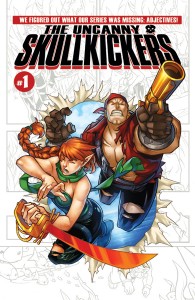
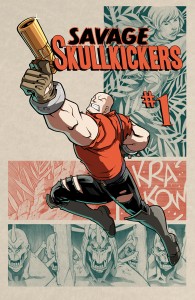
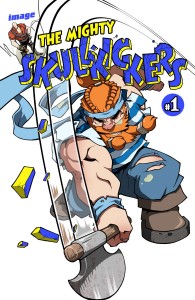
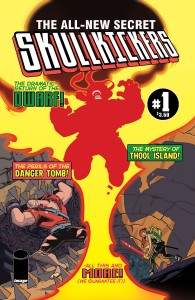
In the spirit of the sarcasm that permeates the Skullkickers concept, I came up with a way to try hyping things in an irreverent way, announcing new adjectives and new #1’s for our entire fourth story arc, making it clear that these would be the next issues in our series but that we were having fun with the whole “reboot” thing and that Skullkickers was worth checking out. I figured our hardcore audience would stick around no matter what but that we might be able to gather some new readers by playing with adjectives and cover designs based on mainstream superhero homages.

Here’s the checklist of names and release dates we rolled out:
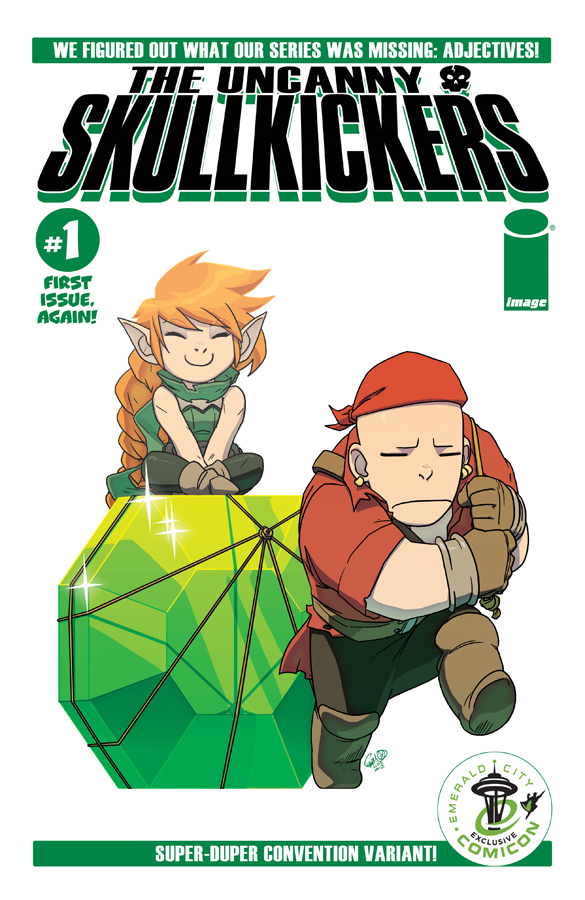
FEB: The Uncanny Skullkickers #1
MAR: Savage Skullkickers #1
APR: The Mighty Skullkickers #1
MAY: The All-New Secret Skullkickers #1
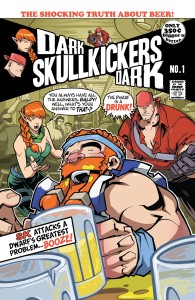
JUN: Dark Skullkickers Dark #1

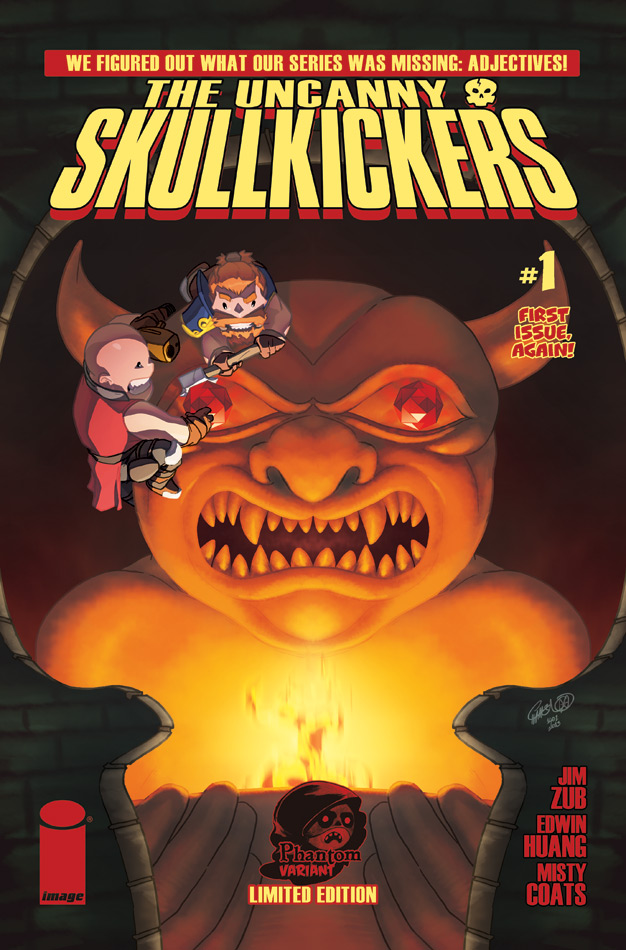
UncannySkullkickers01-585x900SavageSkullkickers01A-585x900mightyskullkickers01All-NewSecretSkullkickers01-585x900DarkSkullkickersDark01
Five ‘Unbooted’ new #1’s in five months. Yes, we’re jerks.

If you click on the above you can read our press releases and see the sarcasm grow with each one as we pull out all the stops to hype the series. I have to tip my hat to Image PR person Jennifer DeGuzman and Image Publisher Eric Stephenson for letting me run with this insane thing. Image really does put control in the hands of their creators and I’m thankful for their support. Contrary to anything else you may have heard, we’re doing this for five months and then going back to normal (well, as normal as we ever get). There’s no Superior Skullkickers or Justice League of Skullkickers coming.

Now that a couple have been released, we can parse the numbers and, here are the results so far. As before, I’ve removed specific sales numbers and am just focusing on the overall visual percentages to show sales trends:

SKSalesChart2013

Needless to say, I was shocked at how well it’s gone over. Sales are up more than double from issue #18 to #19 (Uncanny #1) and are at their highest level since the original issue #1. We put the series back on the sales chart in a big way (for an indy title) and increased our visibility. For the first time in a long time, people beyond our hardcore readership were talking about Skullkickers.

I don’t know if sales will fall back to previous levels once our little adjective game is over, but I’m hoping we can keep some of our new readers on board if they were enticed to give the series a try. If we’re able to level out higher than we were before, I’ll consider the whole experiment a “success”.

That being said, I don’t think this is something other people can necessarily reproduce. It’s a weird and wonderful sales spike based on a very specific promotion that I feel hit the zeitgeist of Marvel/DC reboots, poking fun at a larger comic marketing trend while simultaneously benefiting from the very same thing it was mocking.

As I noted in my previous post, digital is not a huge percentage of our sales right now, but the flexibility and lack of print limits keeps our early issues selling long after they’ve gone out of print. Coupled with print sales it can help keep us rolling forward and I expect digital will become even more important in the future.

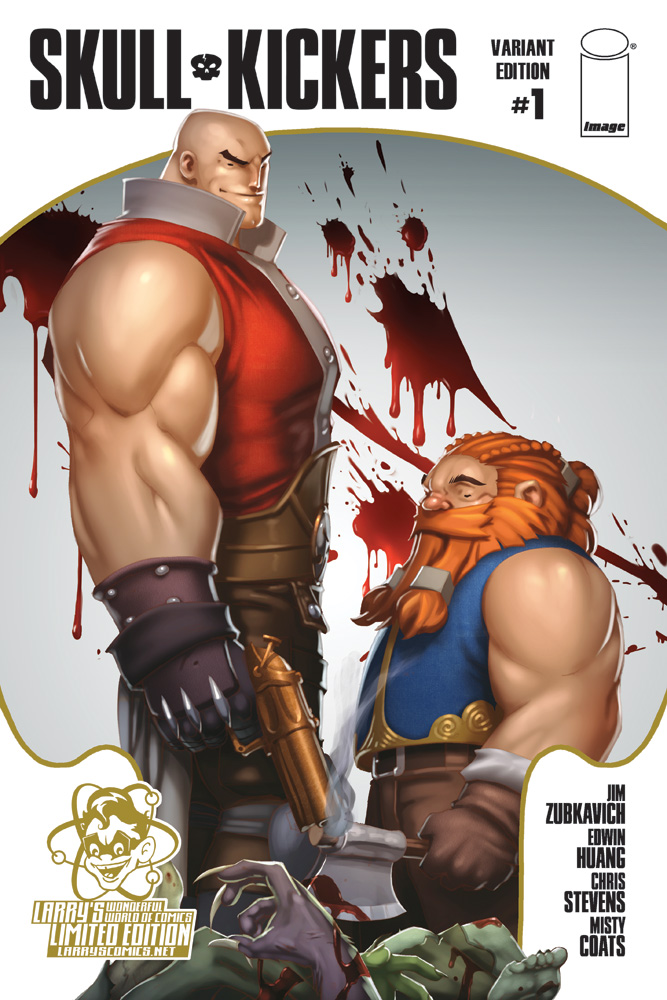
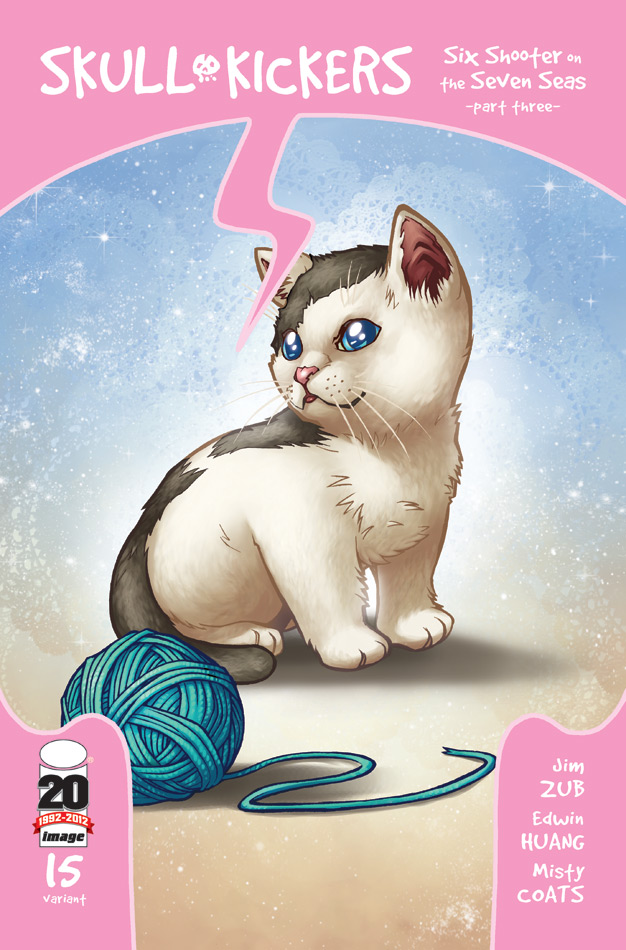
Notice also the extra bump provided by well-timed retailer-specific variants on issues #1 and 19. They’ve helped increase visibility and created beacon locations where Skullkickers sells upwards of 10 times our average numbers.

Skullkickers_01_3rdprintVariantskullkickers_07_00_variantskullkickers_15_JOKEUncannySkullkickers01-ECCCUncannySkullkickers_01_D&DRiff
Our retailer and convention-specific variants have helped increase visibility.

All in all, a bit of luck and circus-worthy hucksterism helped stir some short term interest and sales. The reviews for this new story arc have been really strong so far and I’m proud of the mix of action and humor we’ve put together. I don’t know what the long term sales effects will be, but I hope the quality of our work keeps readers engaged and allows us to finish the big story the team and I have planned.

Also, in case it wasn’t clear, a sales spike like the above doesn’t suddenly mean we’re rolling in money. It lengthens the viable sales life of our series and keeps our head above water. We’re still on the hunt for long term profitability. A gimmick is fun and can be useful, but it’s not a replacement for stabilized reader/retailer support.

I don’t know if there’s really a teach-able moment in this post. It’s more of a general analysis of our issue-by-issue sales curve and the result of some out-of-the-box marketing. As I’ve mentioned before, I don’t think people should use my economic posts as a master plan for their own creative projects. Every series is different and all of this is a learning experience for me too. Whatever I create after Skullkickers will benefit from the things I’ve learned building and marketing this series.

If you find my tutorial blogposts helpful, feel free to let me know here (or on Twitter), share them with your friends and consider buying some of my comics to show your support.

Communication Is Everything – Part One

A lot of people have asked me how I stay on top of my workload. I’m currently juggling a full-time day job (teaching and coordinating Seneca College’s Animation program), a part-time creative career job (project managing UDON creative services projects), other work (freelance comic writing) and writing/managing a creator-owned comic series (Skullkickers at Image).

When I write it all out like that it seems impossibly huge and ridiculous, it’s true. It can be easy for me to psyche myself out and let the amount of work in the queue overwhelm me, but I’ve been able to find some techniques that help keep it all in check.

Communication is everything.

Storytelling is all about communication. As creators we’re communicating ideas, characters, plot lines, emotions… The better we are at engaging and entertaining the audience, the stronger the response they’ll have to our work. People want to work with good communicators. Communication is at the very core of what we do. If you do it well you’ll have a serious leg up on the competition.

This may seem like an odd topic for a tutorial but, believe me, it’s just as important as anything else I’ve covered so far. The quality of your communication and how you’re perceived as a communicator has a direct correlation to how you’re treated as a professional.

In this article I’ll talk about organization, but in future tutorials I’ll also talk about the tone of communication, automating repetitive tasks and anticipating client needs to save time. Some of these things will seem pretty obvious, but all put together they save me a ton of time and keep projects rolling forward.


Email Habits

I’m obsessive about good email communication. My inbox rarely has more than 10 emails hanging around. I doubt I’ll ever be able to “zero” my inbox, but communication as a whole is under control and constant. Here’s how email works for me:

• I always reply. Even if that reply is a short and sweet “No” or a polite “I can’t do this right now but I’ll get back to it as soon as I can” type response, people always hear back from me. There’s no ambiguity or wondering if I received a message. It’s polite and the right thing to do.

I would ignore death threats or messages from crazy people but, thankfully, I haven’t had anything horrible like that so far in my career. Fingers crossed that I never do.

• If I receive a message I can respond to quickly now, I do it as soon as possible so emails don’t pile up. If it takes me less than a minute to respond to then there’s no reason for me to wait and do it later.

• If someone else can’t do their job until I reply, I prioritize that over anything else. I never want people to feel like they’re waiting on me unnecessarily.

• When I receive information or a file, even if the conversation is done, I hit the sender back with a short “Got it” or similar reply. I want people to know I’ve received their information and am good to go.

• Once an email is replied to, I either archive it (if it has information I’ll need later) or trash it immediately. Again, I don’t want messages to pile up. It’s a psychological way of pushing stuff that’s not relevant right now off my plate.

• I always title my emails with subjects that are short and clear. That way it’s easy to find if I need to search for that information later on. If someone sends me an email titled “Yo”, I reply with a subject that’s more relevant to what we’re talking about. According to Thunderbird, I sent over 5000 emails in 2012. I need to be able to find this stuff later on.

• In my emails I keep sentences clear and ensure that major points I’m trying to make are either bold or separate so that, even if someone quickly scans my message on their phone, they’ll see the important things I need them to. If I have questions, they are always separate or bullet pointed. Clarity is key.

• I always do my damnedest to follow through on my commitments but, if something is falling off schedule or not happening as planned, I communicate that as soon as possible. I’ve found that people are way more understanding if you confront a problem early than if you ignore it. It shows responsibility and saves a lot of headaches later on.

• The only emails that hang around in my inbox are ones where a conversation is active/relevant. My inbox isn’t just a mass of headlines stretching back into infinity; it’s a To-Do List reminding me of what I’m currently committed to. I can scan my inbox at any point and have a sense of my work schedule for the next few weeks.

When I hear people bragging that they have hundreds (sometimes thousands) of emails in their inbox, I’m not impressed. I worry that they’re overwhelmed and won’t be able to do their job properly.

Right now, for example, I have 8 emails in my inbox:
3 are reminding me about current writing deadlines
2 are reminding me about artwork I committed to completing next month
1 is a podcast interview date happening this week
1 is a book launch event I committed to that’s coming up
1 is the latest email in an ongoing conversation I’m having with an artist about a potential new creator-owned project

That’s what I need to keep in mind right now so those emails stay up front. The rest gets archived in folders clearly labeled by project name. Once a project is finished I shove the whole folder into a deeper Archive folder so it’s out of the way. It’s sort of like RAM versus hard drive space. The relevant NOW stuff is in my inbox and instantly accessible. The other important stuff is filed away for later access if needed.

New Project Organization

When a conversation starts up about a new potential project I immediately gather all the relevant info into a new project folder. In there I put reference material, links, contracts and usually a few text files with hastily jotted down notes I made while on the phone with clients so I can refer to them later. I can’t assume that I’ll remember details later and I don’t assume anyone else has the information I need. I keep as much material ‘local’ as possible so I’m up to date and organized in a way that makes sense for me.

When new deadlines or commitments pop up, they instantly go into my Google Calendar so I can see availability and plan my time. My wife and I share Google Calendar information so we can see how our weeks are filling up and plan downtime too. I know that sounds ridiculous, but with a work schedule filled to the brim it’s a necessity.


All the above sounds anal and, sure, it absolutely is. It’s a methodical process that keeps a lot of different projects moving forward on a constant basis. It’s detail-oriented and streamlined because I can’t afford to let things fall through the cracks and don’t want to waste time anymore. I have to be proactive and organized because otherwise none of this would work.

If I’m doing it right, my communication should showcase hard-work, organization and reliability. Those are traits I’m happy to take ownership of.

If you find my tutorial blog posts helpful, feel free to let me know here (or on Twitter), share them with your friends and consider buying some of my comics to show your support.

Creator-Owned Sales Over the Long Haul

Quite a few people have asked me how sales are going on Skullkickers and whether or not serializing our previous issues online for free has had a negative impact on sales. With the latest accounting information from Image wrapping up 2012 I had a chance to plug those numbers in and was surprised at the results. I’ve removed the dollar amounts from the charts below, but the visuals should give you an understanding of overall trends for analysis.

Digging into the accounting was honestly quite daunting at first. There are dozens of categories, debts and credits applied based on sales, printing, shipping, storage and book orders for conventions. Thankfully each section is broken down with a current loss/gain total and those totals are carried over from previous accruals.

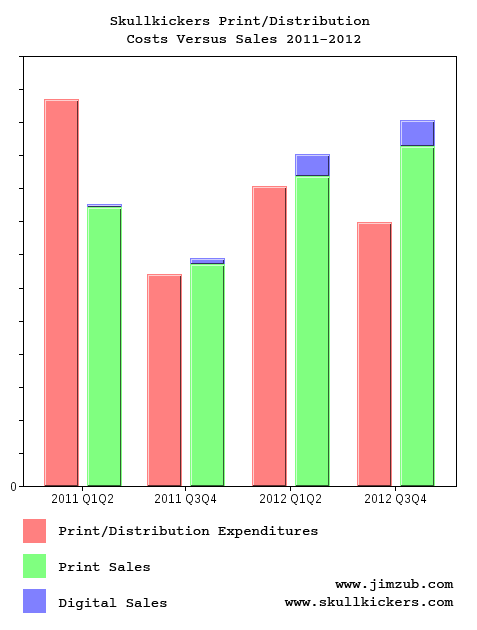
Here’s how Skullkickers has performed over the past two years:
SkullkickersSales2011-2012B

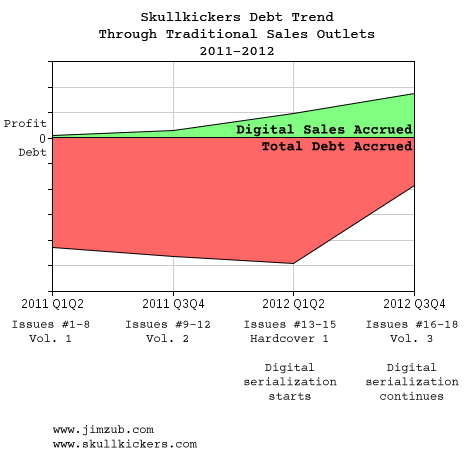
2011 Q1-Q2: We dug into the red aggressively overprinting the first trade paperback to keep it in stock and profits gained from the issues, trade and minuscule digital sales didn’t cover the difference that early into its sales cycle. All in all, we dug down 27% more than we made in the first half of 2011.

For most creators that would’ve been the end of it and that’s totally reasonable. Even with Image covering costs so we didn’t have to spend our own money to print or distribute, the complete lack of profits for 6 months would have sealed the series’ fate. Thankfully, Edwin, Misty and I all have day job income and stuck it out for the long haul.

2011 Q3-Q4: In the second half of 2011 we turned things around, actually making 8% more than we spent for that half of the year. It wasn’t enough to pay back the debt incurred from the first half of 2011, but it showed some promise. Most new businesses have to go into debt to start something new. The fact that within 6 months we were able to reverse that trend and start paying it back was encouraging.

2012 Q1-Q2: Printing a hardcover deluxe collection of 1 & 2 together cost a lot, but we were still able to stay narrowly ahead. Digital made a huge sales jump here compared to 2011 and that corresponds with us starting to serialize Skullkickers online for free. I don’t think that’s a coincidence. Our web visibility exploded and digital comic sales followed. Digital wasn’t a large percentage of total sales, but helped keep our head above water.

2012 Q3-Q4: Now we’re starting to see the benefit of the back catalogue and digital sales as our overall profitability goes up on the series. It’s still not enough to pay off that original debt incurred in 2011 but the overall trend is a positive one. If the first half of 2013 is as strong as the last half of 2012 we’ll be in good shape as we head into the last third of the series (we’re planning six arcs in total).

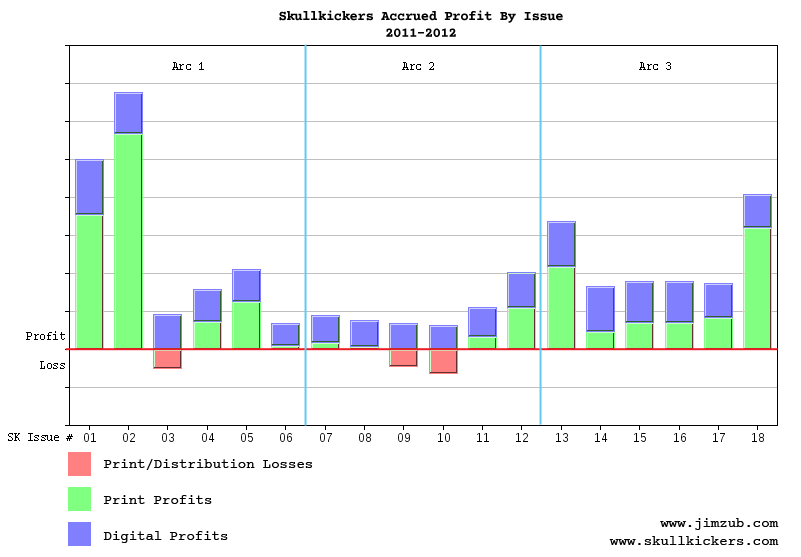
I was fascinated at how the profits broke down by issue:
SkullkickersSales2011-2012D

Keep in mind this is profitability, not sales.

Our first two issues became speculator-hyped and went through multiple printings in the first couple weeks. Issue #1 sold more than #2, but had three printings instead of two, so it became less profitable overall. Even without the exact dollar amount you can see how strong that launch was. I know the tall green bar looks like it would be a lot of money but, without talking exact figures, I will say that the payout on issue #1 and 2 were at a level where an indy creator could sustain a meager existence if that was their sole income. Unfortunately we didn’t stay at that profit level for long.

Issue three narrowly sold out and we decided to do a second printing on it, but reorders weren’t as strong, pushing it out of profitability.

As retailers adjusted their expectations and we settled into a more reasonable sales trend for a fantasy-comedy comic in a serious superhero-centric market we struggled to keep the book profitable at all. Extra press, a comiXology sale and raising the price by 50 cents to $3.50 saved our butts as we headed into issue #13 and our third story arc.

You can really see the profit difference with issue #18 because it was priced at $3.99 for 40 pages of short stories. That extra 50 cents helped a lot. If our print sales dip again I may have to switch it to $3.99 for the regular issues to keep us afloat.

You can see the importance of digital sales here. On issues that have long been out of print the digital version keeps selling 24/7 without any additional printing or shipping cost. That build up of digital sales over 2+ years has put issues like #3, 9 and 10 into profitable territory even though the print versions lost money. You can see how steady the digital sales are too. Not a lot of fluctuation past issue #1. People tend to buy the whole series digitally and the profit margin on that doesn’t fluctuate much. It’s small, but every bit helps.

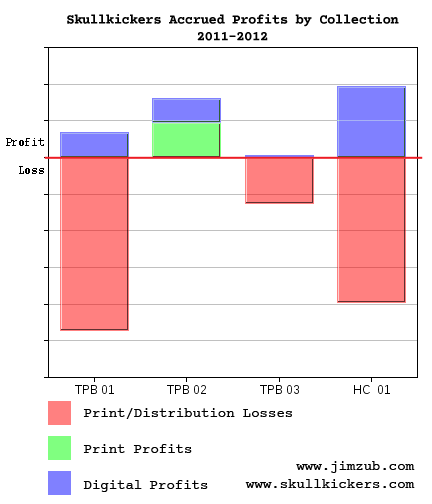
Okay, so you look at that and wonder how we could be so deep in the red if practically all of our issues made some money. Here’s the accrued collection profits:
SkullkickersSales2011-2012E

Ouch, right? Printing and distributing softcovers and hardcovers is a long game with lots of pitfalls. The numbers involved are much larger and a cult book like Skullkickers doesn’t have huge print runs or massive pre-orders to bring in big bucks right off the bat.

Skullkickers Vol. 1: 1000 Opas and a Dead Body is value-priced at $9.99 and has to stay in print otherwise people can’t get started on the series. Keeping this first volume in print at that price point is tough, but we use it as a loss leader to grow our overall readership. Over the long-long haul it pays off if people get on board and pick up other full price volumes. With 6 volumes planned we want the bar to entry as low as possible.

Profitability on volume 1 fluctuates a lot due to larger print runs and the wider push it gets as the entry point for the series. By the midway point of 2013 sales will hopefully catch up with the print debt incurred. Like volume 3, it looks worse here than it really is.


UPDATE April 8th: I received clarification on this from Image Comics’ accounting. There are two reasons why this book is so deep in the red. One is because of bookstore returns/liquidations (Borders collapsing and flushing stock, etc.) and the second reason is because we printed a series of special limited edition hardcover volume 1’s we sold directly at conventions in 2011. The printing and shipping cost is reflected in the accruals, but the money made on them wasn’t through standard distribution, it was direct sales at conventions. Without those two deductions Skullkickers Vol. 1 would be profitable even with its $9.99 cover price. We’re in better shape than I thought!


Skullkickers Vol. 2: Five Funerals and a Bucket of Blood is what we’re aiming for across the board. It has a $16.99 cover price, is selling well overall and has now turned a small profit.

Skullkickers Vol. 3: Six Shooter on the Seven Seas looks dire but keep in mind it just came out as 2012 was wrapping up. The print bill was paid but print sales hadn’t come back yet. By the time we get our 2013 Q1-Q2 statement it should be in similar territory to Volume 2.

Skullkickers Treasure Trove Vol. 1, our 1+2 combined deluxe hardback, is an expensive book to produce. It hasn’t sold like crazy through comic shops but over the long haul I think it will work out because of the high cover price. It’s also a sales dynamo for me at conventions so I want to keep it in print and keep selling it directly to fans.

Again, look at the digital profits. I was shocked at how well digital trades have helped top us up. I wasn’t expecting that at all. Digital comics are picking up steam and work well when added to print sales.

So, what’s the overall trend looking like?
SkullkickersSales2011-2012

Skullkickers is still in the red, but it looks like we hit our lowest point and are now climbing steadily. Print and digital sales are up and our ridiculous relaunch promotion has garnered a lot of visibility for the series in 2013. The fact that Image has stuck with us and believes in our quality and long term potential gives us a lot more leeway than we’d have at most other publishers. They’re able to make their base amount and keep us rolling. I genuinely believe we’ll be indy-profitable by the time the series is done and the trending numbers seem to agree with that.

Keep in mind this is just analysis of one creator-owned series. As interesting as that is I can’t speak to anyone else’s sales or their financial situation. I don’t think this sales cycle corresponds to all creator-owned books. Please don’t assume every money losing comic will bounce back over the long term and don’t make your own financial decisions based on what I’ve done. Everyone’s risk threshold and situation is different. My next creator-owned project will have a completely different sales life cycle.

Note that these charts don’t include convention sales, which have more than doubled from 2011-2012. The money made from direct convention sales, sketch covers, commissions and selling original page art has helped keep us going and viable. I exhibited at 15 conventions last year and, even though it was exhausting, it paid off in terms of sales and visibility for the series.

Also note that none of the above takes into account freelance work that’s come from working on Skullkickers. If you factor in money made from the writing jobs I’ve done for UDON, Bandai-Namco, Dynamite and DC Comics since the series began, it has “turned a profit” in that way even after paying the art team out of my own pocket. Skullkickers helped me build a 2nd career as a professional comic writer over a relatively short period of time.

Most importantly, we put out a comic that stands favorably beside some of the best titles in the industry and I’m incredibly proud of that. It represents the professional quality and work ethic of our creative team.

If you find my tutorial blogposts helpful, feel free to let me know here (or on Twitter), share them with your friends and consider buying some of my comics to show your support.

Comic Promotion: Your Press List

Starting a comic is tough. Finishing one is even tougher. Letting people know it exists once it’s ready to go can be tougher still if you’re not sure how to get the word out.

“Marketing and Promotion” tends to carry a slightly slimy sheen in the modern vernacular. The words have an impression of vapid hype and artificial interest, but they really shouldn’t. In a world where new projects are being announced all the time and everyone wants your attention you need to make some noise and generate a bit of excitement about your hard work.

I know personal drum beating can come across as a bit crass and egotistical at times, but it is important. Publishers used to do a lot of outreach and hype-building but that’s not always the case nowadays. As a creator in 2013 you need to be active and involved in your own promotion. Here’s how I see it-
If you’re not excited about your new project, why should you expect anyone else to be?

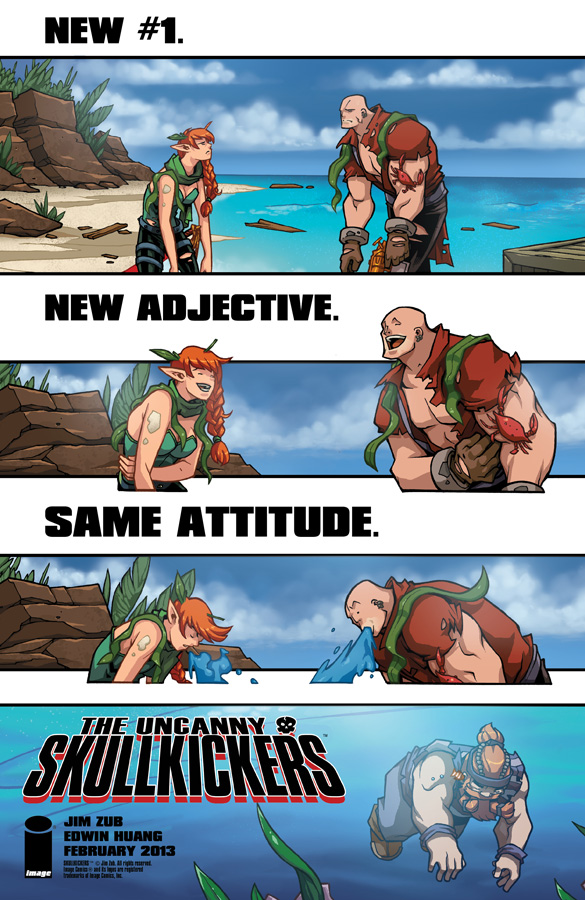
ad-UncannySkullkickersFINALOur new ad for Uncanny Skullkickers #1, arriving Feb 27

I don’t have the time to cover every aspect of creator-owned marketing, but I can give you a run through of one of the most important weapons in my promotional arsenal: a press list.

A press list is a database of email addresses from reviewers and journalists who have taken an interest in my work. They’re my first and best chance at getting coverage from news sites, big or small.

Having a relevant and active press list gives me an outlet for previews, reviews and interviews (lotsa ‘views’ there) that might move outwards to a larger potential audience.

As nice as it would be to have a master list of active, vibrant and interested reviewers/journalists every comic creator could pass around and contact, that’s not how this stuff works. My personal press list has been slowly built from cold call emails I sent to websites, in-person meetings at conventions, tweets, fan emails and tracking down reviewers I discovered by keeping an eye out for positive reviews of my work through Google Alerts.

Building from a small base list I now have 60-70 ‘active’ reviewers I interact with. Some of them are working with larger sites like Comics Alliance, Newsarama, CBR, The Beat, Multiversity, MTV or USA Today, but there are many smaller news, review and blog sites I stay in touch with because they tend to give extra attention to a creator like me who isn’t a top name in the industry.

I also continue to look for non-comic press outlets that pertain to my work for extra outreach. With titles like Skullkickers and Pathfinder I’ve found fantasy and RPG news sites that have been just as receptive and valuable as comic sites. With Makeshift Miracle and Skullkickers both serializing online I’ve had success contacting webcomic-centric sites and Reddit. It’s important to think about the broader appeal of your story and where you might be able to get added press traction.

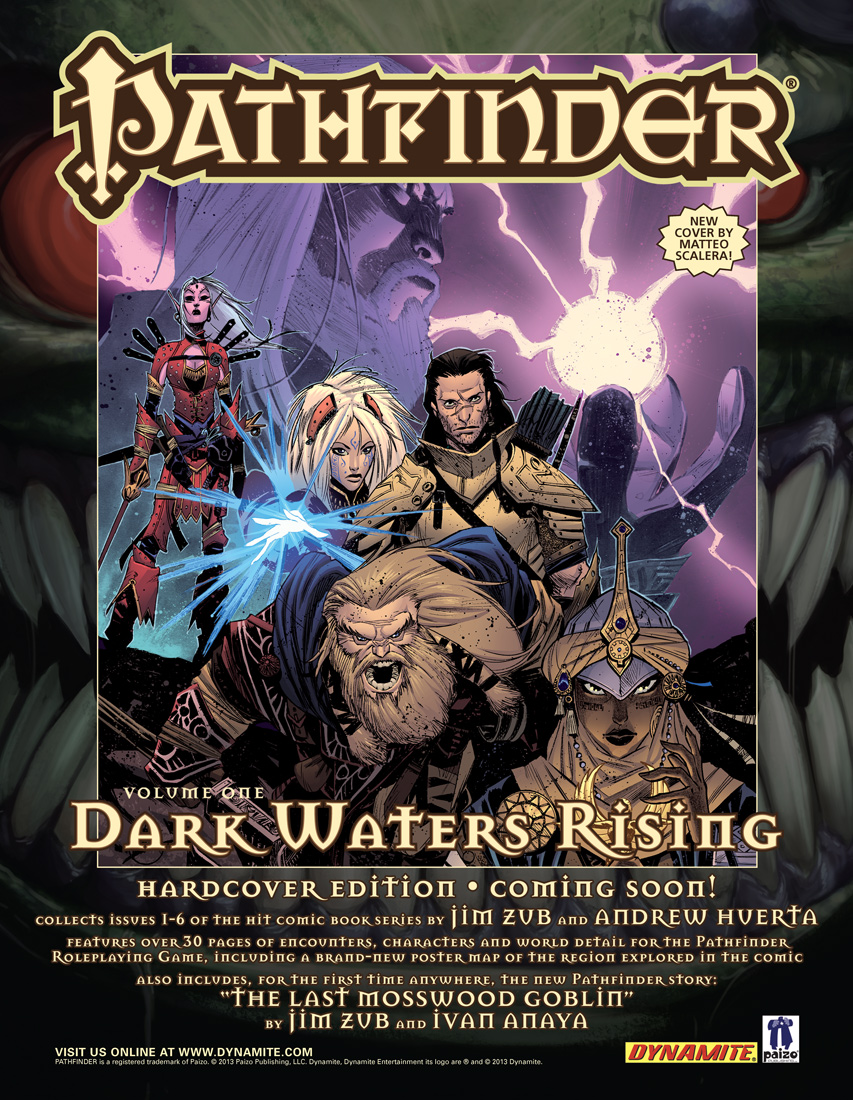
PathfinderHCAdAd for the upcoming Pathfinder comic hardcover arriving in April.

A personalized press list starts small, very small, and you have to put time and effort into cultivating it. Like any kind of networking or social interaction you can’t force things or put on airs about it. Be polite, be honest and be accessible. It’s taken a couple years of focused effort to build my contact list, but now I’m seeing the benefit of that work. My press list can work wonders at getting the word out about new comics and projects I have coming down the pipe.

As with everything, it starts with the work itself. Make sure you have a finished comic and that it’s as high quality as possible. Cold emailing press outlets is only going to work if your work makes a good first impression. Make sure the comic is professional and keep your first contact simple and on-point. Don’t waste their time or yours. A quick introduction and sample is enough to start the ball rolling.

Once you have a list of press people who want to receive updates from you, I recommend sending out advanced previews (images or PDFs) using a newsletter/bulk email service. I use MailChimp, (recommended to me by the ever-awesome Chris Butcher) but there are all sorts of options available and they each have advantages/disadvantages. Do a bit of research to make sure whichever one you use is reputable and that you won’t be spamming people.

Along with previews I recommend including additional information to make it as easy as possible for the press to promote your work:

• Cover image and/or logo
• Credits
• Ordering info
• Key info about the art and story they may find useful/interesting
• Website, twitter, email
• Any upcoming appearances/conventions

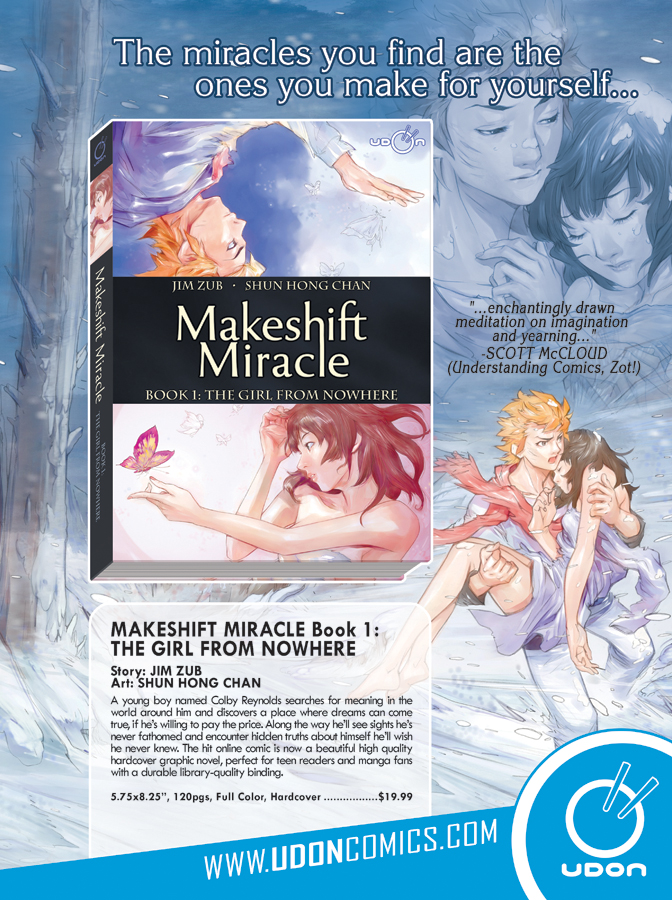
MM_solsOld Previews ad for Makeshift Miracle Vol. 1

I don’t attach large bulky files to the actual email message, as that can gum-up people’s inboxes or get caught by spam filters. It’s far better to upload zip files to a web directory and link it in your message so people can download it when they’re ready. Trust me, they’ll appreciate that. It also allows you to remove the file later on once the comic is released.

Beyond bulk emails, taking the time to personally contact select press outlets and offer exclusive images or an interview can be quite valuable. Everyone appreciates a bit more personal attention and a focused release of information and art can sometimes work better than a bland mass mail out. I try to offer these kinds of exclusives to different sites in a bit of a rotation so I’m covering a broader audience and giving each site something ‘special’ every so often.

Promotion tends to happen in cycles. Some possible promotion ‘milestones’ you may want to consider promoting around include:

• Teaser: “What is this? Looks intriguing…” (Iconic art, name and logo).
• Announcement/Ordering: “Hey, this thing is happening!” (Previews, interviews, more information).
• Almost There: “It’s about to be released!” (Longer previews, interviews, advanced review).
• Release: “Go get it! It’s great!” (Signing, launch party, interview).
• Reviews: “Check it out. People like it!” (Amalgamate positive reviews).

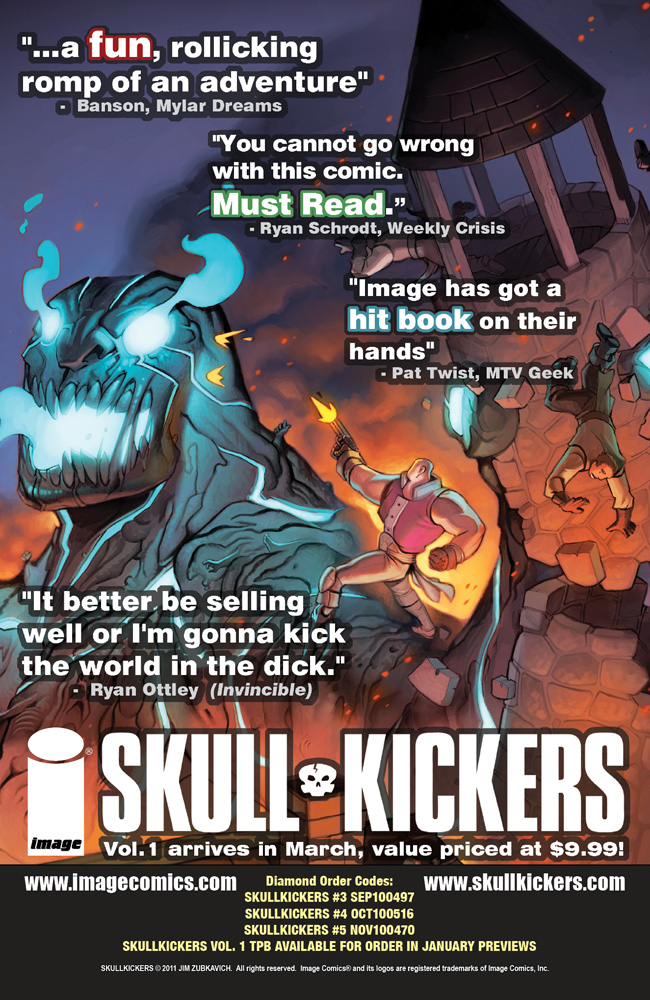
SkullkickersQuoteAd5Our old ‘press quote’ ad for Skullkickers Vol. 1

When you have a body of work and a good reputation people will come to you for interviews or information. Until that happens you need to push from your side to make the work stand out. Developing and maintaining a press list is a valuable way to show people what you’re up to, network with the larger industry and, ideally, build a loyal readership.

If you find these tutorial posts helpful, feel free to let me know here (or on Twitter), share them with your friends and consider buying some of my comics to show your support.
Comic Writing Part Six- Writin’ ‘Bout Fightin’

After several marketing/economic-focused tutorials it feels good to get back to a post about writing craft. In previous tutorials I’ve talked about pitching and scripting. This time I want to specifically focus on how I write action scenes.

Most of the comic writing I’m known for at this early point in my career have big action at their core: Skullkickers, Street Fighter and Pathfinder (also, apparently, a lot of books with “er” in the title). I like the momentum and intensity a good action scene can add to a story and enjoy brainstorming new and amusing combat scenarios.

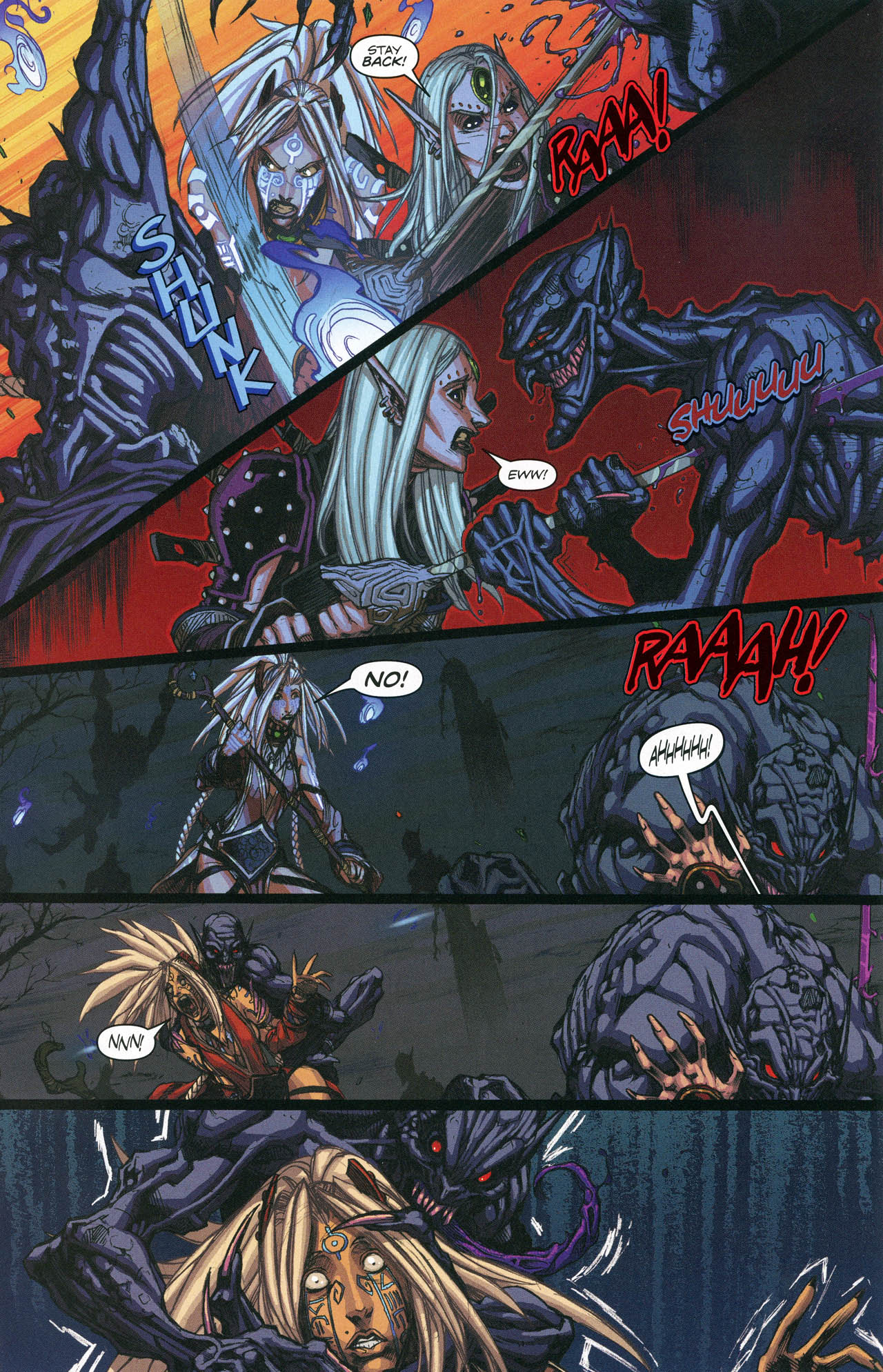
Pathfinder 003-13Pathfinder: Seoni and Merisiel VS Ghouls with a paralyzing touch.

Before I start scripting I’ll do some “battle brainstorming” to come up with inventive and entertaining action possibilities. It’s easy to fall into a rut with characters mindlessly throwing punches and announcing themselves with big speeches so this idea generation phase helps me break free of the most obvious and boring combat options. This is comics, not prose, so I want to make sure I give readers something both visually entertaining and character appropriate.

WHO is fighting?
• What are the characters’ capabilities (physical, mental, unusual powers)?
• How can they be used visually?
• What kind of training do the characters have?
• How does their training and abilities affect the way they perceive combat?
• Is there anything new we can/should reveal about them in this battle?

WHERE is this fight happening?
• Is the location primarily interior or exterior?
• Can the location be used as part of the battle to aid/hinder the characters?
• Is it clear where everyone is in the fight?
• Is it visually interesting?
• Does weather, visibility or time of day factor into this scene?
• Can we move locations/alter the environment during the battle?
• Is reference required for the artist?

WHEN in the story is the fight happening?
• What attitude do the characters have towards this fight?
• How seriously are they taking it?
• What is at stake if they lose?
• What will they gain if they win?

WHAT’s the result?
• How should the reader feel when the fight is over?
• Is there a clear winner/loser to this combat?
• Was it a “fair” fight? If not, why not?
• Does the loser escape?
• Will anyone need to recover after this battle?
• Is any of it too obvious/expected/repetitive?

Most of these questions will be self evident but they can help generate new ideas and change up a battle from the norm. Even if the reader has seen these characters duke it out a dozen times before, changing why they’re fighting, what‘s at stake or where it’s taking place can generate new momentum and entertainment.

Fight scenes, just like the plot itself, have to build up intensity. At the start of a story arc conflict will usually be straight forward and then, with each new chapter or battle, things tend to grow more difficult with bigger challenges and more surprises. This can be reflected in what’s at stake, how long the fights are and visually impressive ways a fight can play out. Each story has its own challenges and changes, but starting with a bit of structure like this can help if you’re struggling to raise the stakes along the way.

When scripting the Street Fighter Legends: Ibuki mini-series for UDON I actually counted how many pages I used for action in each issue, adding more combat with each one to increase the intensity in the series as it progressed. I do this with each arc of Skullkickers as well, usually brainstorming big combat “set pieces” for each arc first and then working my way backwards to logically build up to them in the story.

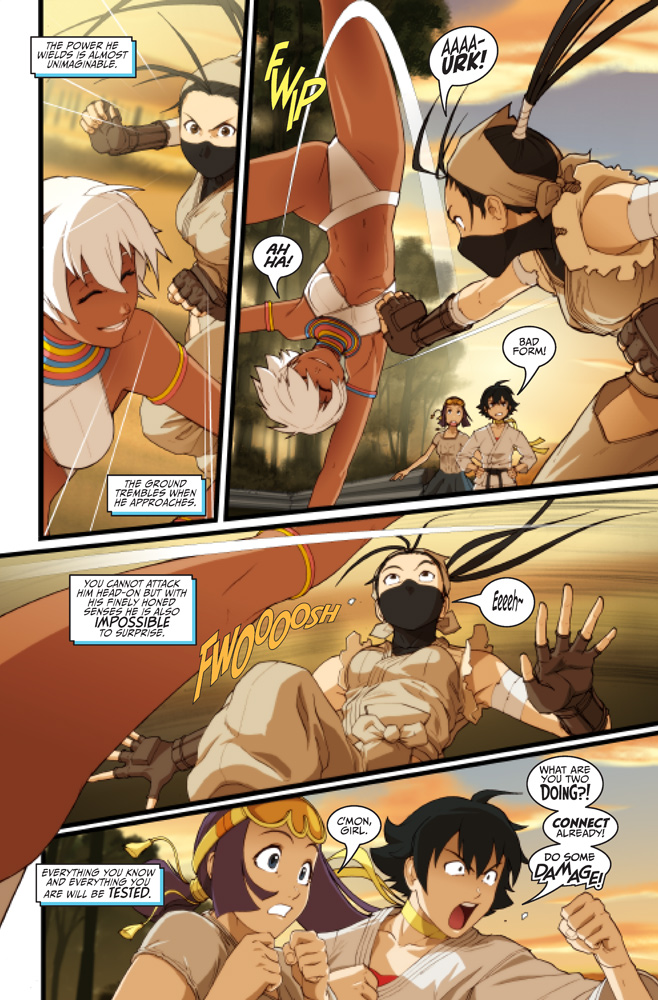
SFL_Ibuki_03_01-22_Page_02Street Fighter: Makoto spars with Ibuki while an earlier conversation runs via narration.

Street Fighter Legends: Ibuki mini-series
Issue #1: 8 pages of action, mostly fun combat without much at stake.
Issue #2: 9 pages of action, building up intensity.
Issue #3: 10 pages of action. Bigger action and serious threats.
Issue #4: 14 pages of action. The biggest threats and big wrap up of all the main plotlines.

Skullkickers first story arc
Issue #1: 10 pages of action with little at stake.
Issue #2: 11 pages of action. A bit more dangerous/difficult.
Issue #3: 8 pages of action. Developing plot and building up the big threat.
Issue #4: 12 pages of action. Much more at stake and things look grim for the protagonists.
Issue #5: 15 pages of action. The biggest visual moments of the arc and the big payoff.

I find that this “action-first” approach to storytelling works well for series like Street Fighter or Skullkickers. I do the same thing with character moments/emotions in Makeshift Miracle, using that element of the story as the core and building the rest around it. When people describe Skullkickers “action/adventure” is what stands out most about the series. In Makeshift Miracle it’s “drama/emotion”. With both series that’s built into my writing structure by design.

Major actions can be broken down into 3 parts: anticipation, action, and reaction. When scripting action scenes I imagine the key ‘snapshot’ moments that tell the reader the most important elements. I suggest small panels to set up attacks and larger panels to pay off the outcome, saving full page shots or double page spreads for the biggest and most epic moments.

I tend to keep dialogue to a minimum when combat begins. Logically people can’t say a lot when fists start flying anyways, but it also reflects the brisk reading pace I want to maintain in the action scene. Big chunks of text tend to make a fight seem slower and less energetic. If I need characters to say a bunch of stuff as they fight I’ll stretch that dialogue/interaction out over multiple panels so we keep momentum rolling. They get to say their speech but the combatants aren’t standing still while it happens.

I try to avoid “Character A punches Character B in the face” kind of stuff. Even a simple punch can be more visually interesting if you target different parts of the body. A punch in the stomach, kidneys, throat, ear, knee or anywhere else will stand out a bit more. That doesn’t even take into account characters missing, narrowly deflecting blows, or other things happening around them at the same time. Keep it interesting and it’ll excite the artist and reader a lot more.

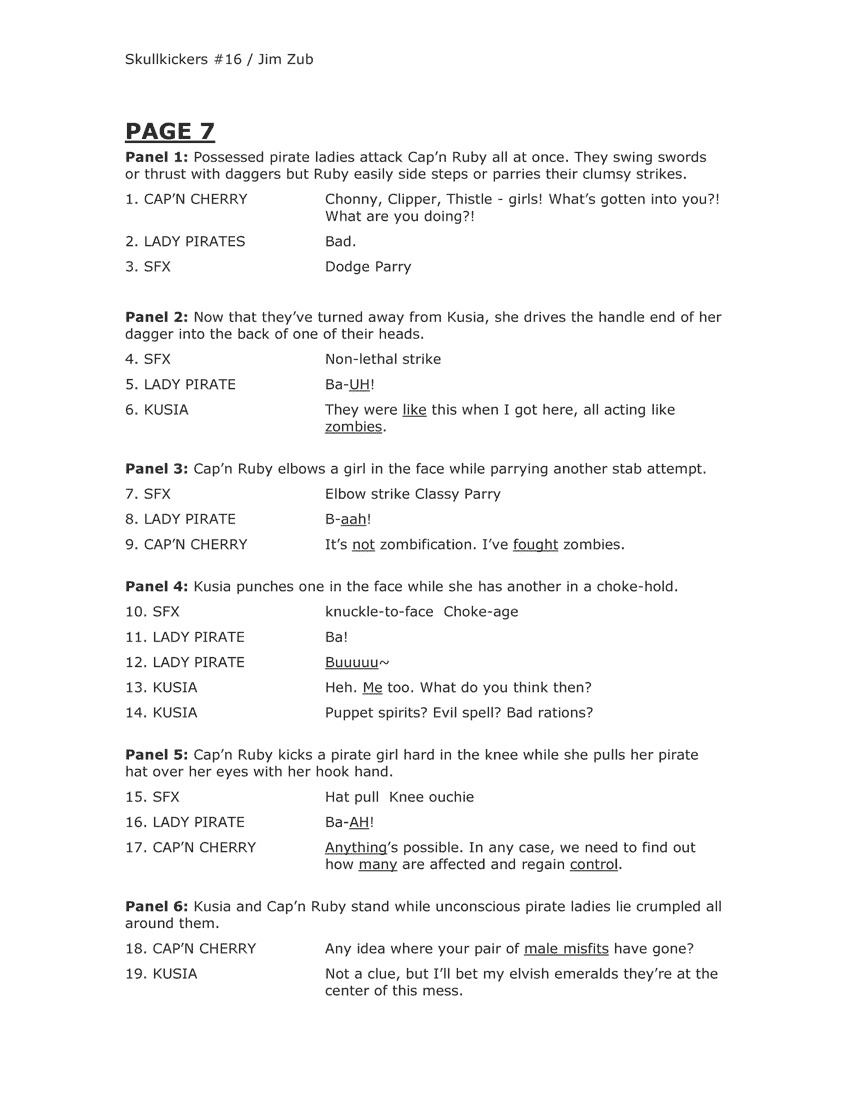
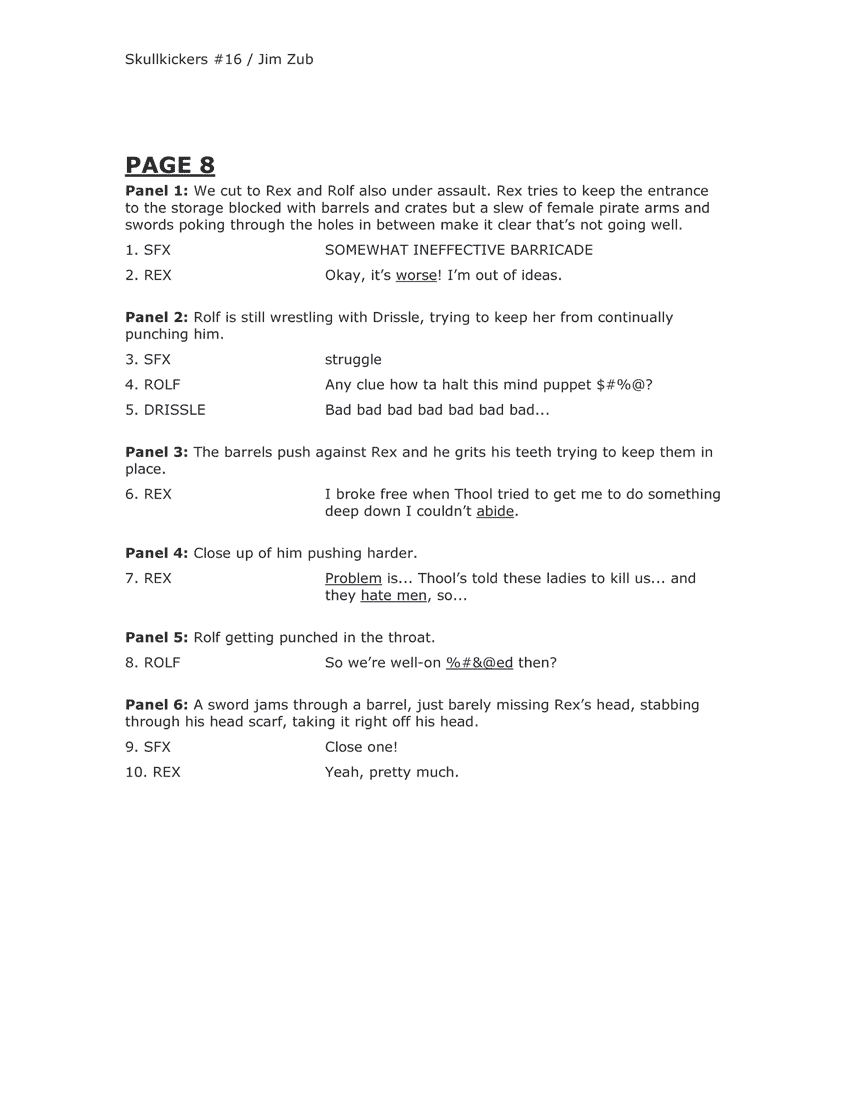
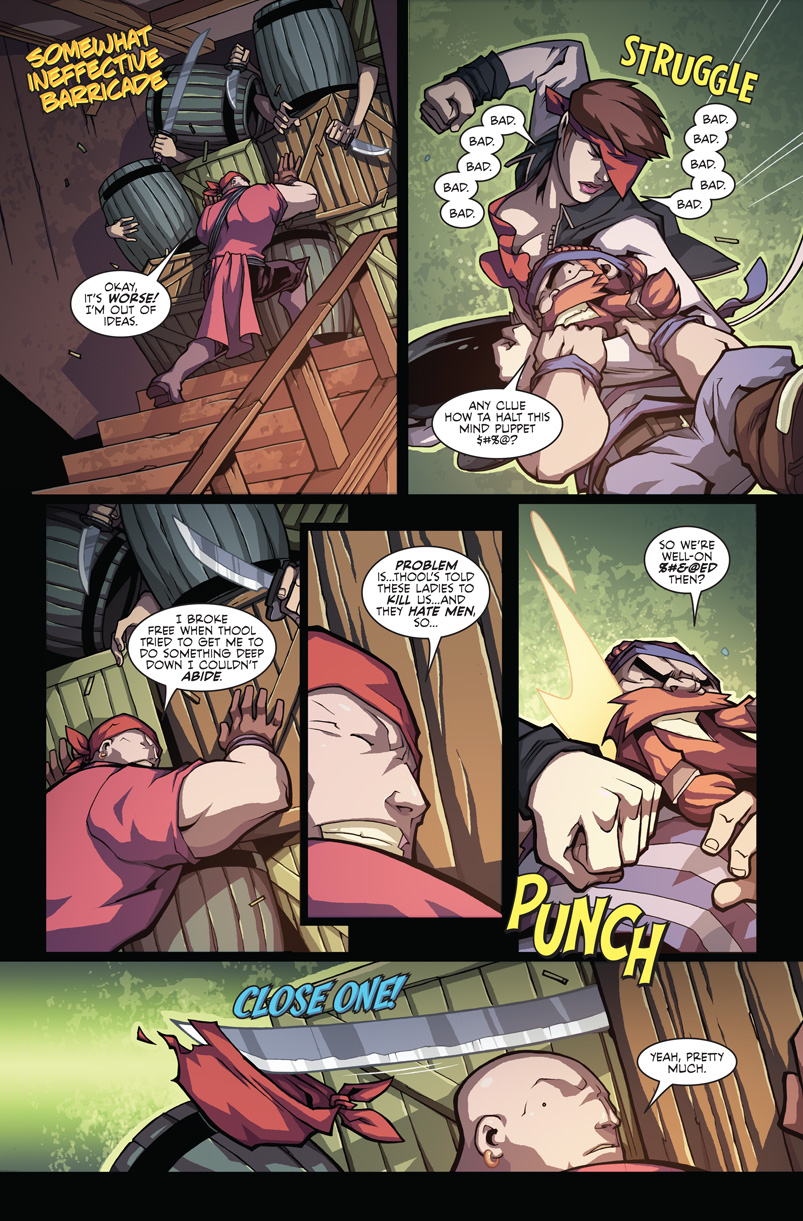
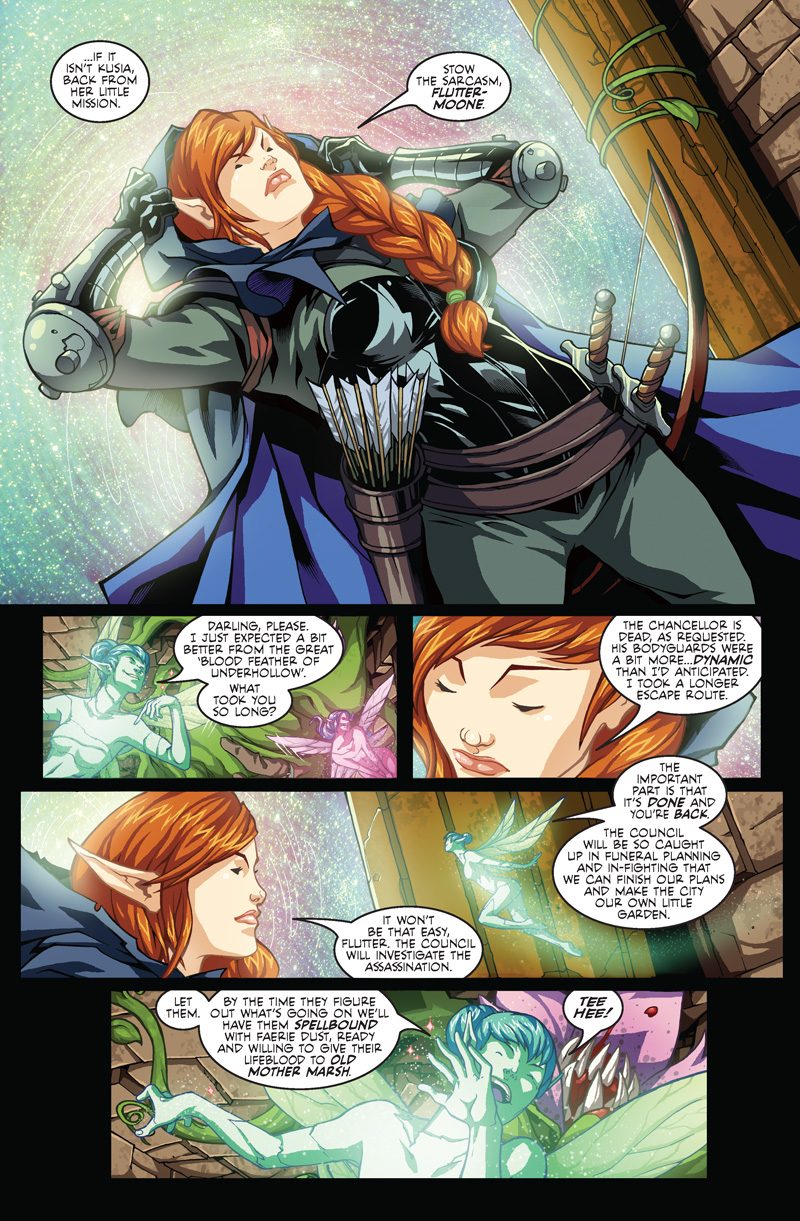
Here are a couple pages of action from issue #16 of Skullkickers showing my script and then the amazing finished artwork by line artist Edwin Huang and colorists Misty Coats and Ross A. Campbell…

ActionScriptExample_Page_1sk20130805

ActionScriptExample_Page_2sk20130807

Visual storytelling in comics lends itself well to action and athletic derring-do. Use combat to show what characters are capable of and advance the plot at the same time. The more thought and care you put into your action scenes, the better the “fight choreography” will be, generating more excitement and entertainment for your readers.

I hope you’ve found these comic writing ramblings useful. As I stated in earlier posts, this isn’t any kind of absolute-must-follow method, just the way I work and a few tips. If you find these posts helpful, feel free to let me know here (or on Twitter), share them with your friends and consider buying some of my comics or donating to my Patreon to show your support.
Creator-Owned: Working With Key Retailers

My previous post about the financials of creator-owned comics in mainstream retail paints a pretty bleak picture. The risk is high for retailers, creators and publishers, profit margins are thin and making your new comic stand out in a crowded marketplace full of worldwide pop culture icons is an uphill battle at best.

All that is true, but there are some focused marketing options available for creators willing to pound the pavement and be extra social.

Comic shop retailers aren’t just managers of chain stores carrying the exact same selection of product from store to store. They’re small, focused boutique shops that reflect what sells in their area and the tastes of the people who run the shop. You’re not dealing with franchise brand managers or accountants, these are people who work in comic retail because they love comics and the printed page. They’re passionate about the medium. Having a personal connection to you and your creation gives retailers added incentive to hand sell your story to their customers. That crucial difference is a real advantage when you’re starting out if you’re willing to take the time to build relationships with like-minded retailers.

Skullkickers_01_3rdprintVariantSkullkickers #1 Larry’s Comics Exclusive Cover

Before any of this outreach can happen you need to have a product coming out. Not just ideas or sketches, but an actual physical comic. The work has to be high quality and you need to be accessible. Retailers aren’t dealing in ‘vaporware’. They need to know what they’re getting and how they can sell it. If you don’t have physical copies of the comic in hand you’ll at least need some sort of sales sheet.

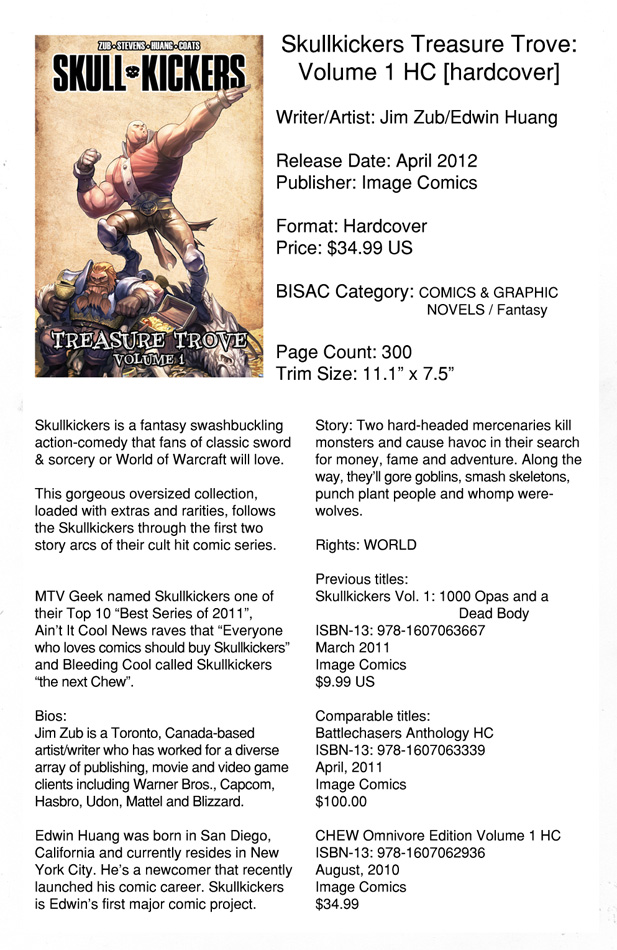
Here’s the sales sheet I did up for Skullkickers Treasure Trove. I’d include this with free copies of the comic or a poster when I approached retailers:

Skullkickers_SalesPage

It covers all the major information on what it is, who might enjoy it, the product specs and overall format. It’s a bit dry but that’s the basic info retailers need.

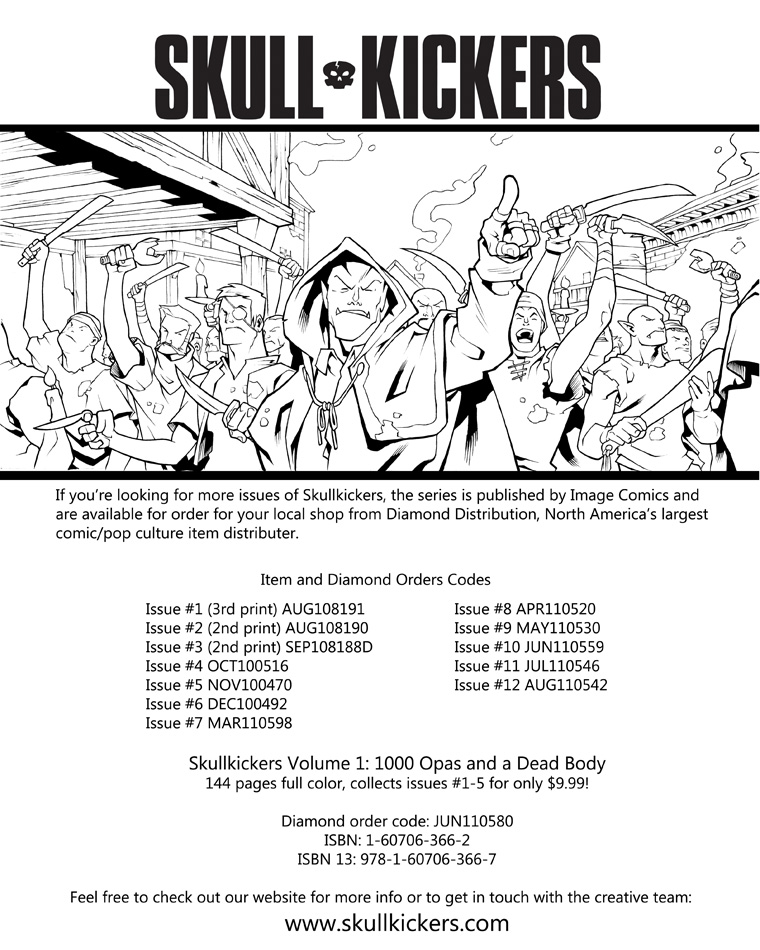
Here’s a takeaway sheet I’d hand to people at conventions in 2011 if I sold out of books:

SK_OrderInfoSheet

This one focused on the Diamond Previews ordering codes so people could show the sheet to their local comic shop and easily get back issues.

Nowadays I’ll have my tablet on hand pre-loaded with comic pages and cover artwork so I can easily show readers or retailers samples of my comic where ever I might be. If they’re enjoying that I may even show them our spiffy little promo video put together by Long Vo.

For completeness sake, here’s the new business card design I had printed for the upcoming 2013 convention season so I can easily entice new readers to try out the series after the show:

SKBusinessCard

When people are at a convention they browse a lot but aren’t able to buy everything they might be interested in. This little giveaway card is an easy way for them to remember the title and follow-up. A missed sale at a show doesn’t have to be a completely lost customer.

Although there are over 1900 Diamond Distribution accounts ordering from the Previews catalogue each month, there are only a few hundred shops that consistently go out of their way to support new creator-owned material in a big way. When you’re creating something new and are trying to gain a foothold in the comic market it’s crucial that you build up contact with as many of those shops as possible, showing them that you put out quality work and are helping market and promote it.

Email is the most convenient option but, given how much digital correspondence we all get, it’s also the easiest to ignore. Going to shops in your area in person can work well, as can approaching shops at conventions. Politely phoning can work (but never on Tuesdays or Wednesdays because that’s when they’re organizing new releases and dealing with new comic day), just make sure you’re not a pest about it. This kind of cold call outreach is slow and most outlets are not going to be enthusiastic. Steel your nerves for lukewarm responses aplenty. It can be demoralizing at times but it is important.

Retailers are the front line for your work as far as traditional comics go. Their enthusiasm for your work can go a long way. The more they like you, like the work and understand what it’s all about the easier it will be for them to sell it to their regulars. Summing up the concept in a simple statement can go a long way here. This is why I have snappy sales pitches for Skullkickers like:

Skullkickers is The Hobbit meets The Hangover.”

Skullkickers is low brow high fantasy.”

or

Skullkickers is about two mercenary monster mashers looking for fame and fortune.”

All of the above are simple and to the point. They’re the same way the retailer can pitch it to other people. I’m selling the concept to the retailer and giving them a quick way to sell it to their customers.

If you can get a small foothold at a handful of supportive stores, you can build on that word of mouth with advanced previews (I send water-marked advance PDFs to retailers on my mailing list), in-person signings and personalized sketches. That’s how independent creators like Colleen Doran, Eastman & Laird, Jeff Smith and Dave Sim did it in the 80’s/90’s and it’s still a valuable method for building an audience now in 2013.

UncannySkullkickers01-ECCCOur upcoming Uncanny Skullkickers #1 exclusive for Emerald City Comicon

The top end retailer incentive right now is probably the exclusive variant cover; a unique collectible version of a comic with a new cover and limited print run. You’re seeing more and more of these pop up lately, even from the Big Two, because they can really work well at grabbing customer attention. It’s a focused creative commitment from the creator and a big financial commitment from the retailer, creating a promotional bulwark for that title in a particular spot. If a retailer is willing to drop hundreds of dollars on a specialized comic like this they’re telling a creator they believe they can build a dedicated audience for the work. When print runs on even successful creator-owned comics are usually under 5000 copies, adding 500+ copies to that print run from just one outlet is a big deal. It’s leveraging the collectability and future success of that comic as a way to sell the variant for 3 or more times the regular cover price.

Probably the most consistent retailer variant promotion happening right now is the Phantom Variant. They’re a group of more than a dozen retailers who are teaming up with publishers and creators on exclusive cover variants in return for key placement in shops to help maximum exposure. I’ve worked with several of these shops doing signing events and exclusives and they’ve been a bedrock of enthusiastic support for Skullkickers, Makeshift Miracle and everything else I’m working on. When you go to one of their shops you can really see how committed they are to long term growth of creator-owned comics. They’re actively looking for other professional creators to support and are easy to get in contact with.

UncannySkullkickers_01_D&DRiffOur upcoming Uncanny Skullkickers #1 exclusive Phantom Variant

A great comic shop or convention that gets behind your work can make up for the short fall from dozens of other outlets that aren’t ordering any copies at all. It’s about building relationships and support, bit by bit. In a comic market crammed with more products and ideas than ever before you need to pay more attention, be more approachable and think like a retailer to build an audience through traditional sales channels.

If you found this post helpful, please let me know here (or on Twitter) and share the post with your friends. Please consider buying some of my comics online, from your local retailer or from me in person if you see me at a convention.

Digital and Print: 1 Year of Skullkickers Online

It’s been one year since I started serializing issues of Skullkickers online so it’s an ideal time to see how the site has done so far in terms of traffic and talk about online outreach as a whole.

If you’ve never read Skullkickers before, let me give you a quick introduction…

Skullkickers is a sword & sorcery buddy-adventure comic about monster mashing mercenaries on the hunt for fame and fortune. It’s The Hobbit meets The Hangover. Skullkickers is published by Image Comics and serialized online via Keenspot.

SKKeenspot1YearStats1

Skullkickers online has garnered just over 5.8 million pageviews and been visited by 272,000+ people over the past 12 months. More than 90 times the number of people who buy our monthly issues have checked out Skullickers online so far. Each month an average of 22,600+ new people come on board the story and the site generates almost 486,000 pageviews. I don’t know how it compares to other webcomics (though I’m sure it’s far lower than a lot of the long running and financially self sufficient sites) but it’s reaching 7-8 times our floppy comic print run worth of new readers every month, building up awareness of the title day by day using content we already had archived and ready to go.

In comic book shops my competition for your hard-earned dollars are worldwide icons like Batman and Spider-Man or massive media hits like The Walking Dead and Scott Pilgrim. Needless to say, standing out with that competition can be tough. Skullkickers’ single issue sales hover just off the bottom of Diamond’s Top 300 titles on any particular month while SK’s trade paperback sales are pretty good.

As we move ahead with our master plan for 36 issues divided into six story arcs (which will end up in print as 6 softcovers or a trilogy of hardcovers) I have to make sure people have an easy way to start at the beginning to get hooked. Online serialization of older content is proving to be a convenient and valuable way to do just that.

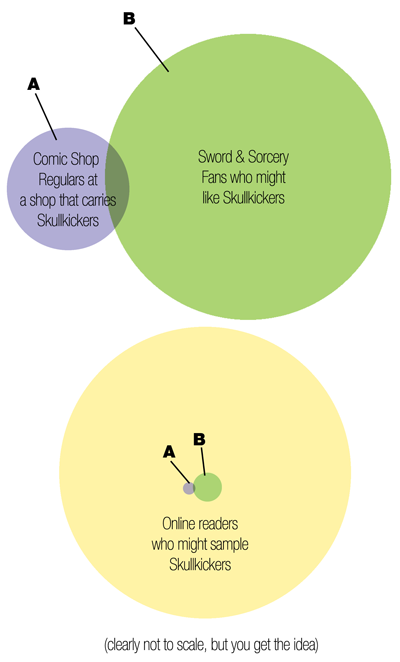
Fantasy comics have always struggled in the North American direct comic market. The Venn diagram of people who are reading superhero titles definitely includes fantasy fans, but not all comic shops carry creator-owned titles and not all comic shop regulars are fantasy readers, so our title is trying to appeal to a demographic inside a demographic inside a demographic. Online we’re available to anyone with an internet connection- obviously a much, much larger pool of fantasy fans who could become Skullkickers fans.

Even better, people who might not normally read sword & sorcery at all can still sample the series and be drawn in too. It’s global, it’s convenient and it’s available 24/7. We’re not excluding anyone at any time unless the server goes down.

SK1YearVennDiagram

Without any barriers to entry, new online readers can discover Skullkickers risk-free, reading along as a weekday ritual as I add pages, slowly growing more attached to the characters and their story. Getting these readers to sample is as simple as passing the URL to a friend, posting it on a social networking site or sending a tweet. Readers who wouldn’t have given my title a second glance at a bookstore can explore and enjoy at their own pace. It’s Free Comic Book Day every day at Skullkickers Online.

Okay, it’s all well and good to talk about outreach and an online readership, but the value of amazing comic retailers and print readers comes from their financial commitment to the series. Retailers are the bedrock of our financial viability through Image and our print readers keep us afloat. Our whole creative team works hard to ensure every issue is worth its $3.50 cover price with a fun story, great artwork and enjoyable bonus content. I know a lot of retailers and fans would assume that serializing the older issues online for free would hurt sales, but it hasn’t been the case.

As I mentioned in my post over the summer about convention sales, print and digital are working together pretty harmoniously. Our print numbers aren’t hurting because of online serialization and some of our online readers are becoming print buyers, especially the collected trade paperbacks and deluxe hardcover ‘Treasure Trove’ edition. Retailers who stock the series are benefiting from our online outreach, not hurting from it.

When readers become really attached to the series online they’re willing to buy a print copy, both for their own enjoyment and as a measure of support for our hard work. Sure, the majority of people will casually read it online for free but, by casting such a wide net to potential new readers, I’m able to expand book sales overall, reaching more and more people each month long after individual print issues have sold out. The hard-to-find early issues are absolutely crucial because they’re the entry point for new readers. Thanks to the online site they’re always available. You can start reading Skullkickers right now, right here.

I make it clear that if you’re enjoying the pages you’re reading on the site now, you can read even more of the story any time you want by making a purchase. By serializing older issues I’ve been able to jumpstart print and digital comic sales a bit too. People can catch up to the ‘current’ story any time they want via their local comic shop, Amazon, other book outlets, comiXology, Graphicly or iVerse. We’re banking on the quality of the work to convince people to pay to catch up, collect or own one of our collected editions and it seems to be working.

In 2012 I had record-breaking book sales at 5 conventions and even my worst convention was nearly equal to the best shows I had in 2011. I kept asking people how they’d heard about Skullkickers and a ridiculously high number were through good word of mouth and reading the archives online for free.

I wasn’t kidding when I said Everybody wins”.

Serializing Skullkickers online has helped keep us viable and broadened our appeal to much larger audience. Online serialization works with print, works with conventions and even works with other digital platforms. It isn’t an instant fix and doesn’t solve the financial pitfalls of creator-owned comics all by itself, but it’s definitely an important tool more creators should be looking into as they work to create a readership for their work.

I’m a storyteller with a small creator-owned comic trying to build a readership from scratch. There’s absolutely no reason for me to narrow the delivery model for my story. The more channels I can make my content available through, the better.

Comic Inking Portfolio Critique

Now that I’m more well known for comic writing than art, most of the correspondence I get asking about breaking in or feedback is writing-based. People ask me to check out their comics, read their scripts or give them feedback on their pitches. With all the deadlines I have on my plate it’s almost impossible to do that, unfortunately, and I generally send a polite “no” form letter reply.

I was really surprised to be asked about inking. Comic art inking is one of those things that’s taken for granted by a lot of people, but when you see great inking you’re amazed at how much an inker can do to improve and clarify the pencil line work. I was asked if I could put an inker in touch with editors/art directors and I was actually curious about what their inking portfolio would look like. They sent along a gallery link, I checked it out and the small jpegs there made it very difficult to tell how much their inking was bringing to the work. I requested high/print resolution samples to check out and they obliged.

Figuring that other people might find the feedback helpful too, I’m reproducing my reply below:

Thanks for sending those files along.

Looking at the high resolution images gives me a much better idea of where your current inking skills are at.

In short- you still have quite a ways to go before you’re ready to apply for professional comic inking work. You’ll need a lot of careful practice, analysis and more practice before you could reasonably be considered for an inking job with a worthy page rate.

Inking is more than just following the penciler’s line work. It’s about enhancing, clarifying and strengthening the material that’s there. In many ways it requires the same kind of skills in drawing (perspective, anatomy and composition) that the penciler has, but with an extra eye for finished lines and storytelling clarity.

When you’re working over top of a good penciler your inks are noticeably better, but even then you’re not enhancing the lines or improving the sense of 3 dimensional form in the pencils. Where the anatomy or perspective is muddy you’re not able to fix or improve upon it. There’s no sense of depth created by using different thicknesses of lines or outlines, there isn’t a consistent sense of texture adapted to the penciler’s style and there’s still a lack of confidence in the final lines themselves. Your work currently feels more like tracing than inking, and there’s a big difference between the two. It’s absolutely natural to be missing these qualities at the start when you’re learning how this stuff works and building up your skills, but those qualities stand out as work in process, not finished professional samples.

I’d recommend analyzing the work of top-notch inkers like Tim Townsend. He has great samples on his deviantART page, quite a few with pencils and inks side-by-side so you can see how he enhanced and clarified the base pencils with his own subtle flare and substantial drawing ability. You can also see how he adapts his approach to different pencilers and brings out extra subtleties in the final work. Dig into his archive and look very closely at the quality he brings to the page:

http://timtownsend.deviantart.com/gallery/

Inking positions are becoming much harder to get in the industry as things go more digital and publishers cut corners by using pencil art for many books. Getting work as an inker means you have to really bring a fantastic quality to the page and your work has to be that much better than the people already getting what little work there is. It’s a very tough job to break into and it requires a very skilled hand and keen eye. Even then, the opportunities may be limited.

I hope you understand that I’m trying to give you feedback, not trash your hopes. Only through hard work, analysis and practice will you get where you want to be and along the way there are all kinds of twists and turns. I wish you the best of luck with your creative pursuits and hope you find what you’re looking for down the road.

Sincerely,
Jim