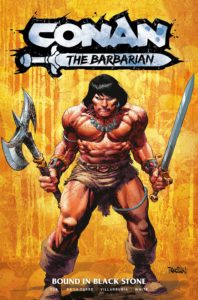
Conan the Barbarian #15 Reviews

9 Panel Grid: “Overall this was a completely masterful issue, I loved seeing something familiar from Conan, albeit something completely new because of what Jim Zub and Doug Braithwaite are doing.”

Comical Opinions: 9.5/10 “Conan the Barbarian #15 presents mature, spiritual concepts wrapped in a ferocious Conan tale. Jim Zub is digging deep to dispel Conan’s reputation as a sword-slashing meathead by sending him on a personal journey that reflects struggles everyone can relate to.”

DC Patrol: “This book is just perfection…just a beautiful book. I don’t even think you need to like Conan to enjoy this.”

Doc Lail Talks Comics: “If you have not been reading this book, find it. I don’t care if you read it digitally, I don’t care if you pick it up in person. Conan is on a path of fire with Jim Zub that he has not been on since the 70’s or possibly the early 80’s…This is one of the best books on the shelves right now.”

GoodReads: 10/10 “The art and writing have captured the mystical, salacious and errant spirit of the original works, while driving the fervor, fury and passion to its heights. Just as Howard would have done himself, if he were in the comic medium.”

Grammaticus Books: “[Zub] adds something to it without taking anything away from the original Robert E. Howard story…Great artwork by Doug Braithwaite combined with great coloring by Diego Rodriguez that makes for some excellent pages.”

Grimdark Magazine: “Bolstered by the strong foundation of ‘The Frost-Giant’s Daughter,’ Conan the Barbarian #15 is the strongest issue in the Frozen Faith arc thus far.”

League of Comic Geeks: 5/5 “I never thought I would be reading a poetic version of Conan the Barbarian. Yet here I am and there’s a very good chance that this will be one of the best books I read all week, maybe month, possibly all year.”

Lord Samper’s Library: “Now I love Howard’s opening, for ‘The Frost Giant’s Daughter’, but I’ve also got a lot of time for the way that Zub wraps a little background around this. I like background, especially when it’s done as well as this.”

Mighty Thorngren: “When I want a comic book, I want to be thoroughly pleased with the amount of action and story, and these Conan comic books deliver that like nothing else. Page after page of cool looking stuff. Doug Braithwaite has just beautiful artwork.”

Pop Culture Philosophers: “This book is awesome…The Conan books, this is the best they’ve been since back in the 70’s and 80’s, in my opinion. This is some really great stuff!”

Scifi Pulse: 9.7/10 “Overall, another fantastic issue with a great mix of strong artwork and fantastic dialogue.”

Sleepy Reader: “Jim Zub just knocks it out of the park. All the stuff he’s been setting up from the point of view from the goddess now really pays off…and I have grown very affectionate for Doug Braithwaite’s very brutal art style.”

Stygian Dogs: “Zub has seamlessly woven these layers of his grander story into this adaptation, the end result of his twist convincing readers that an exploration of these themes was always articulated in Howard’s original material. It’s a remarkable achievement and Doug Braithwaite’s work is exceptional…I can’t recommend this issue enough.”

Sword & Sorcery Book Club: “I think that this is quite a phenomenal adaptation of the Frost-Giant’s Daughter…and I like the expansion that was done to turn this into an arc and connect the Battle of Venarium and leaving Cimmeria to this story.”

Thinking Critical: “It’s still absolutely awesome…This continues to be the series of the year.”

Wakizashi’s Teahouse: “It’s glorious! The art is great by Braithwaite. An exciting tale. Really good writing by Jim Zub, quite poetic at times. Big recommend.”

Cimmerian September: The Hour of the Dragon (aka. Conan the Conqueror)

Continuing my Conan reread for Cimmerian September, the sixteenth published Conan story is The Hour of the Dragon, which serialized across five issues of Weird Tales magazine, from December 1935 to April 1936 and was later published as a complete book under the renamed title Conan the Conqueror.

At over 70,000 words told over 22 chapters, The Hour of the Dragon is the only “full-length” Conan tale written by Robert E. Howard, produced for a British publisher that unfortunately folded before it could be printed in that format. In turn, Howard sold it to Weird Tales, where all the previous Conan stories had been published.

I read Conan the Conqueror many years ago and, honestly, my memories of it were pretty murky. I knew it used plot points very similar to The Scarlet Citadel, because Howard was told that British readers would not have read the other Conan short stories, and so in my head I had it slotted as a ‘longer but derivative’ work.

I could not have been more mistaken. Rereading The Hour of the Dragon, I was able to really appreciate the ambition of its narrative, the scale of its sprawling worldbuilding, and the rich quality of its prose. Even when it stumbles a bit on occasion, the overall momentum keeps driving everything forward in a thoroughly entertaining way.

But, with such a long tale and deadlines aplenty on my plate, I won’t be able to go through the story blow-by-blow. Here’s a broad overview with some thoughts on specific elements:

A cabal of four men use a gem called the Heart of Ahriman to bring a sorcerer named Xaltotun back to life to assist them in taking the thrones of Nemedia and Aquilonia. The opening chapter showcases this dark ceremony and the eerie return of Xaltotun:

It was as if a globe of living fire flickered and burned on the dead, withered bosom. And breath sucked in, hissing, through the clenched teeth of the watchers. For as they watched, an awful transmutation became apparent. The withered shape in the sarcophagus was expanding, was growing, lengthening. The bandages burst and fell into brown dust. The shriveled limbs swelled, straightened. Their dusky hue began to fade.

Howard is ripping in this story. The way he builds atmosphere is punchy and textured, with unexpected but appropriate descriptions that really activate the reader’s imagination. Check out how he describes the army preparing for battle, with a mixture of sight and sound:

He cast a swift glance over the camp, which was beginning to swarm with activity, mail clinking and men moving about dimly in the uncertain light, among the long lines of tents. Stars still glimmered palely in the western sky, but long pink streamers stretched along the eastern horizon, and against them the dragon banner of Nemedia flung out its billowing silken folds.

Conan is struck down by Xaltotun’s magic and thought slain during the battle, but the ancient necromancer instead takes him prisoner because he wants to use the Cimmerian to further his own machinations. Yes, it’s similar to The Scarlet Citadel on a surface level, but the motivations are richer as Howard builds a web of mistrust and disloyalty amongst Xaltotun and the four who brought him back to life.

Our hero’s escape manifests thanks to a slave named Zenobia. She’s intensely scared because she knows she’s defying her master, but also incredibly brave as she risks her life to give Conan a chance in the dungeon he’s imprisoned in. She doesn’t get much word count, but the narrative effect of her actions is huge:

‘I am only a girl of the king’s seraglio,’ she said, with a certain proud humility. ‘He has never glanced at me, and probably never will. I am less than one of the dogs that gnaw the bones in his banquet hall.

‘But I am no painted toy; I am of flesh and blood. I breathe, hate, fear, rejoice and love. And I have loved you, King Conan, ever since I saw you riding at the head of your knights along the streets of Belverus when you visited King Nimed, years ago. My heart tugged at its strings to leap from my bosom and fall in the dust of the street under your horse’s hoofs.’

Color flooded her countenance as she spoke, but her dark eyes did not waver. Conan did not at once reply; wild and passionate and untamed he was, yet any but the most brutish of men must be touched with a certain awe or wonder at the baring of a woman’s naked soul.

Conan fights an ape-creature in the depths of the dungeon and finds his way out of the castle, but has to leave Zenobia behind.

Even when Conan is riding overland there’s a deft balance between keeping up momentum from the escape and lavishing the reader with textured prose to help ‘sell’ the landscape in a way that really grabbed me:

The dawn wind stirred the tall stiff grass, and there was nothing but the long rolling swells of brown earth, covered with dry grass, and in the distance the gaunt walls of a stronghold on a low hill. Too many Aquilonian raiders had crossed the mountains in not too distant days for the countryside to be thickly settled as it was farther to the east.

Dawn ran like a prairie fire across the grasslands, and high overhead sounded a weird crying as a straggling wedge of wild geese winged swiftly southward. In a grassy swale Conan halted and unsaddled his mount. Its sides were heaving, its coat plastered with sweat. He had pushed it unmercifully through the hours before dawn.

A confident balance of intense action and poetic atmosphere is Howard at his best, whether he’s describing the mundane or the magical:

“Not lightly is the veil rent; yet I will rend it a little, and show you your capital city.”

Conan did not see what she cast upon the fire, but the wolf whimpered in his dreams, and a green smoke gathered and billowed up into the hut. And as he watched, the walls and ceiling of the hut seemed to widen, to grow remote and vanish, merging with infinite immensities; the smoke rolled about him, blotting out everything. And in it forms moved and faded, and stood out in startling clarity.


The middle of this grand adventure feels quite episodic, with Conan traveling to multiple locations, using his physical strength, keen mind, and deep social connections to track down the missing gem that will allow him to defeat the necromancer and retake his throne. At each stop we’re given a sense of who Conan was in his prime and the impact he had on others before he took the crown of Aquilonia. There’s a wistful sense nostalgia to it:

The awakening of old memories, the resurge of the wild, mad, glorious days of old before his feet were set on the imperial path when he was a wandering mercenary, roistering, brawling, guzzling, adventuring, with no thought for the morrow, and no desire save sparkling ale, red lips, and a keen sword to swing on all the battlefields of the world.

Unconsciously he reverted to the old ways; a new swagger became evident in his bearing, in the way he sat his horse; half-forgotten oaths rose naturally to his lips, and as he rode he hummed old songs that he had roared in chorus with his reckless companions in many a tavern and on many a dusty road or bloody field.

All of it could have come across as overly plot-convenient, but because Howard stacks the deck against Conan over and over, and our hero loses almost as many fights as he wins, each victory along the way feels visceral and palatably earned.

The characters Conan interacts with along his journey don’t feel like NPCs waiting to spit out relevant information or provide the next bread crumb on the trail, most have a distinct sense of agency and personal stakes that drive their actions, helping or hindering the king in exile.

One point that’s brought up several times is the concept that Conan has no heir and, therefore, there was no one to rally behind once he fell in battle. Conan has to contend with assumptions he has around his personal freedom versus the responsibility he carries as leader of a country. It’s a maturation of the character as he struggles to retain his barbaric spirit even as he learns to compromise some of his earlier idealistic driving principles.

Why pursue a crown that was lost for ever? Why should he not seek forgetfulness, lose himself in the red tides of war and rapine that had engulfed him so often before? Could he not, indeed, carve out another kingdom for himself? The world was entering an age of iron, an age of war and imperialistic ambition; some strong man might well rise above the ruins of nations as a supreme conqueror. Why should it not be himself?

So his familiar devil whispered in his ear, and the phantoms of his lawless and bloody past crowded upon him. But he did not turn aside; he rode onward, following a quest that grew dimmer and dimmer as he advanced, until sometimes it seemed that he pursued a dream that never was.

Since each new location is populated with different threats and evocative locales, I think the middle is my favorite part of the story, which is odd for me since most stories live and die on their introduction or conclusion. Don’t get me wrong, the beginning and end are good too, but the central series of challenges have the most variety and, for me, feel like a Dungeons & Dragons campaign carving its way through a living, breathing world.

Speaking of D&D, Gary Gygax clearly took direct inspiration from several sections, including a treasure chest with a puzzle sequence of buttons to open it, set with a poison trap:

Along the rim of the lid seven skulls were carved among intertwining branches of strange trees. An inlaid dragon writhed its way across the top of the lid amid ornate arabesques. Valbroso pressed the skulls in fumbling haste, and as he jammed his thumb down on the carved head of the dragon he swore sharply and snatched his hand away, shaking it in irritation.

‘A sharp point on the carvings,’ he snarled. ‘I’ve pricked my thumb.’

And labyrinthian corridors and chambers that read just like DM box text from an old adventure module:

The corridor split in two branches, and he had no way of knowing which the masked priests had taken. At a venture he chose the left. The floor slanted slightly downward and was worn smooth as by many feet. Here and there a dim cresset cast a faint nightmarish twilight. Conan wondered uneasily for what purpose these colossal piles had been reared, in what forgotten age. This was an ancient, ancient land. No man knew how many ages the black temples of Stygia had looked against the stars.

Narrow black arches opened occasionally to right and left, but he kept to the main corridor, although a conviction that he had taken the wrong branch was growing in him.

Pirates, priests, executioners, mystic assassins, ghouls, and a vampire for good measure-

She reared up on the couch like a serpent poised to strike, all the golden fires of hell blazing in her wide eyes. Her lips drew back, revealing white pointed teeth.

‘Fool!’ she shrieked. ‘Do you think to escape me? You will live and die in darkness!

The Hour of the Dragon is absolutely jam-packed with sinister foes and memorable set pieces. It’s the longest canon Conan story, but also feels like it’s bursting at the seams with enough material to fill a trilogy of fantasy books written in the more drawn out way many modern readers have grown accustomed to.

The ending is inevitable and doesn’t quite hit the highs of Howard’s best, but it consistently entertains and delivers on its potential. There are spots where I would have enjoyed delving even deeper, but it’s far better to leave readers wanting more than wearing out one’s welcome.

This epic tale has been reprinted and adapted several times. The Marvel Comics version was split between classic artists Gil Kane and John Buscema over two different publications, which creates a bit of a visual disconnect, but works overall.

If you haven’t read the original Conan prose stories, I recommend the Del Rey 3-book set, which has each story unedited and essays that add context around their publication.

Zubby Newsletter #82: The Worst Fantasy Novel Ever?


I’ve been posting on social media about rereading the original Conan stories and, with an eye on purple prose, a well-meaning fan pointed me toward an infamous sword & sorcery story called The Eye of Argon.

The Eye of Argon is a sword & sorcery novella written in 1970 about a barbarian named Grignr, clearly inspired by Robert E. Howard’s Conan the Barbarian, but it’s notorious for how poorly put together it is. In an age well before the internet, this thing went “viral”, was copied and shared amongst professional authors and eventually fandom at large. It has been called the “worst fantasy novel ever” and, at quite a few science fiction conventions of the era, there would be meet-ups where people would attempt to read The Eye of Argon aloud without cracking up. Right now, if you search YouTube for “The Eye of Argon” there are hundreds of videos with dramatizations, analysis, or group readings.

I’d heard passing mention of it before, but didn’t know any specifics and had never actually read the damn thing. It’s short and readily available online, so I finally checked it out.

As you’d expect, it’s bad. The story has spelling mistakes, grammatical problems, plot issues, and misuses words in spots that leave some sentences adrift in a sea of confusion. It leans into painfully overworn genre tropes and the pacing is terrible.

And yet…

…And yet, Jim Theis was only 16 years-old when he wrote this 11,000+ word story on a typewriter and submitted it to the Ozark Science Fiction Association’s fanzine. I sure as hell didn’t write stories that long at his age, and didn’t have nearly enough confidence to even try submitting work for publication. Maybe it was blind hubris on his part, but at least he made something, finished it, and could learn from it.

In this case, unfortunately, what he learned was that a group of successful authors and fervent fans were eager to endlessly mock the hell out of him for his literary shortcomings and ensured that he would never improve or write fiction again. Even worse, multiple small press publishers reprinted the story and sold it without ever paying him a dime. Even now, 22 years after his death, people are still making money on Jim Theis’ work, regardless of its quality.

What’s odd to me is that when I read The Eye of Argon I can see a writer struggling to understand the form and function of pulpy prose. He’s misfiring all over the place but, rather than just copying sentences word for word as a crutch, he keeps trying to grab bits of poetic thunder, make it his own, and put it on the page. He fails but, by God, he’s trying.

Yes, The Eye of Argon is bad, but I’m genuinely surprised that this particular badness took hold so intensely in the mind of fandom. I’ve read worse writing from some of my college students submitted for grading, and also much worse from obsessive fan fiction writers, hopeful game designers, and cocky first-time comic creators…and all those people had access to spellcheck and a ridiculous amount of online How-To resources that would have blown young Jim Theis’ mind.

Having all this knowledge at our fingertips hasn’t solved the Dunning-Kruger effect. If anything, non-stop internet access and the ability to ‘publish’ our words and ideas in an instant has created an endless factory of Argons, an ever-flowing torrent of naive stories and hurtful criticism. Even worse, the cringe-worthy creative output you put online when you were 16 now gets to sit dormant like a landmine until it’s ready to blow up in your face thanks to deep internet archives and the virality of social media.

Don’t get me wrong, I’ve mocked terrible writing and had my mind vaporized by art portfolios so bad it was hard to believe they were sincerely trying to qualify for an art program or get a job as a professional. I snark about shitty movies and TV shows all the time and shake my head about the middling to poor quality of at least half the comics being professionally published each week. I understand the cathartic desire to filter and judge material that feels utterly incompetent, but watching nerds giddily eviscerate a hopeful teenage writer in the public square for decades is more sad than funny.

I hope the first story you ever wrote stays locked away in a drawer, so you never have to face the burning truth of its inadequacy.


Back to the Cimmerian Source, Part 4

Savage Sword of Conan #26-27, adapting Beyond the Black River.

As I mentioned above, I’m rereading all the original Robert E. Howard Conan prose stories and jot down a few thoughts about each one during September. I don’t want to overwhelm this newsletter with text, so if you want to read what I think of more of the original Cimmerian stories, click on through to the posts linked below:

14) Beyond the Black River
15) Shadows In Zamboula

I’m currently in the midst of reading The Hour of the Dragon, the only full-length Conan novel Howard ever wrote, and it’s 5-6 times as long as the other short stories, so my rundown on that is taking longer, especially while juggling writing deadlines.


Current + Upcoming Releases

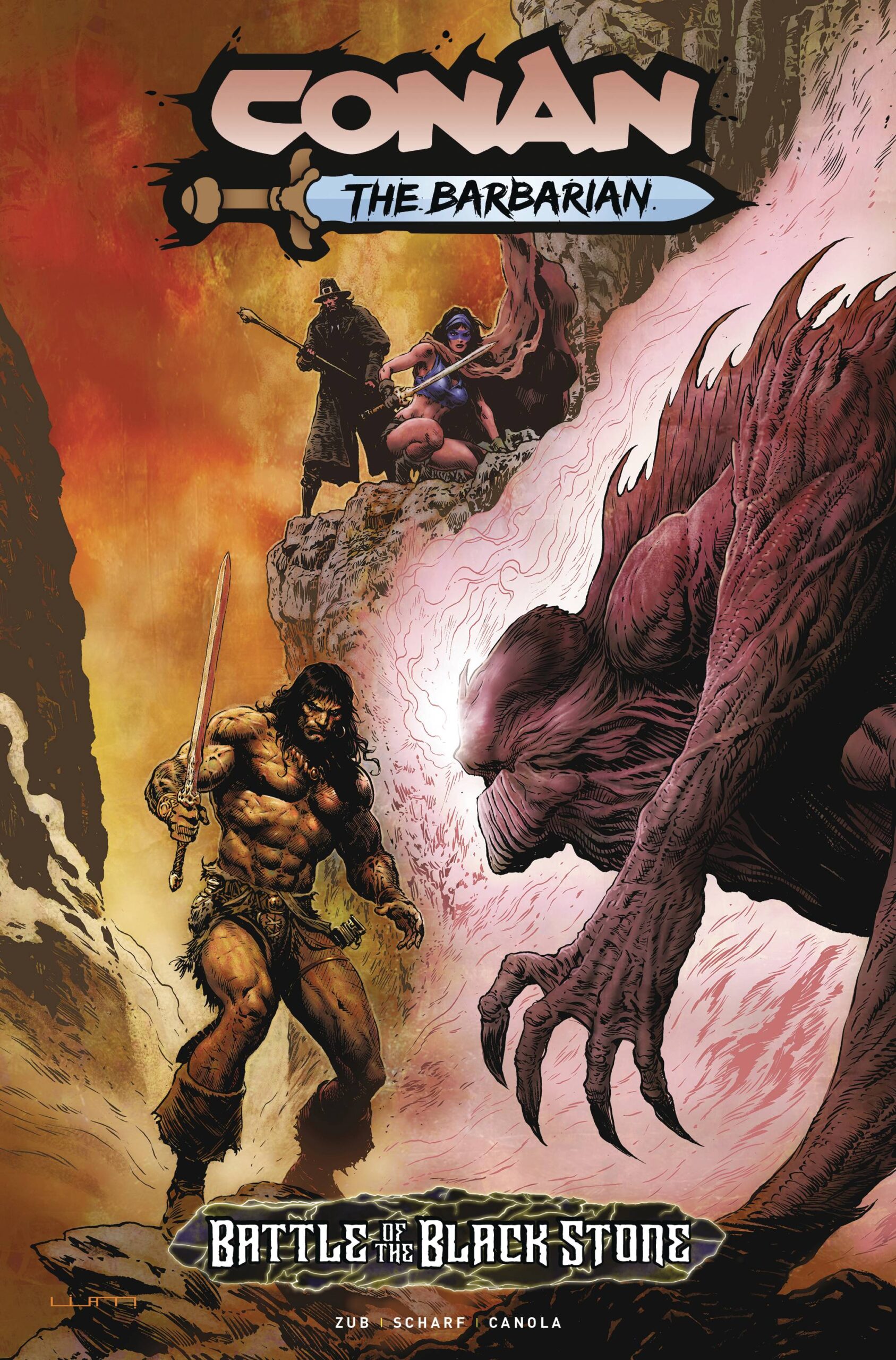
  • Conan: Battle of the Black Stone #1 (of 4) – released September 4th.
  • D&D Young Adventurer’s Collection Box Set 2 – released September 24th.
  • Conan the Barbarian #15 – released September 25th.
  • Conan: Battle of the Black Stone #2 (of 4) – releases October 2nd.
  • Conan the Barbarian #16 – releases October 30th.
  • Savage Sword of Conan #5 – releases October 30th.
  • Conan: Battle of the Black Stone #3 (of 4) – releases November 6th.
  • Conan the Barbarian Vol. 3: The Age Unconquered TPB – releases November 19th.
  • Savage Sword of Conan Vol. 1 – releases November 19th.
  • Conan the Barbarian #17 – releases November 27th.
  • Conan: Battle of the Black Stone #4 (of 4) – releases December 4th.

  • Upcoming Appearances

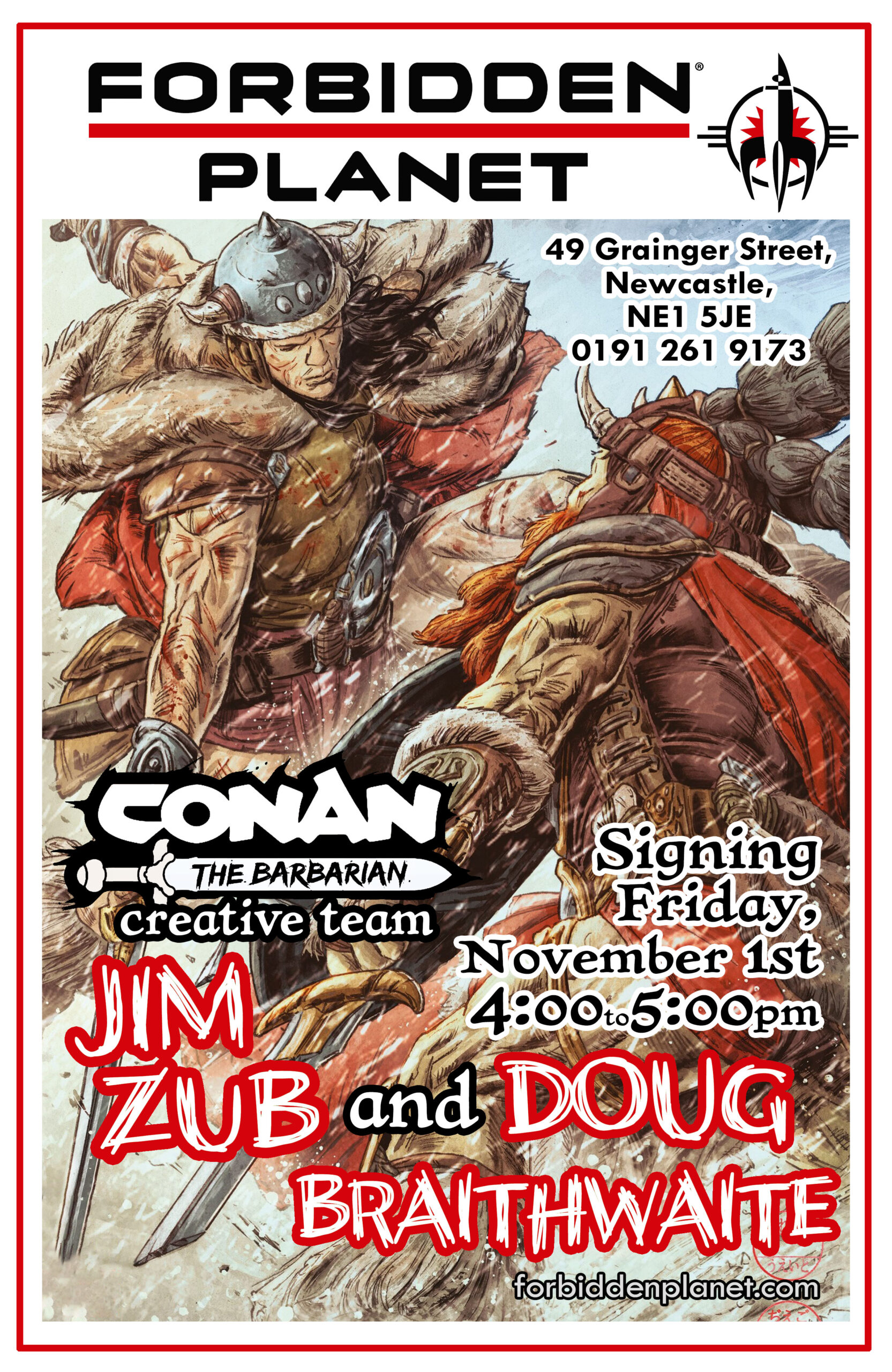
    Since I’m traveling through the UK in late October/early November, I’m adding some comic shop signings to my schedule. First out of the gate is a signing in Nottingham, at Forbidden Planet International.

    Oct 15, 2024 Kowabunga Comics Oconomowoc, WI, USA
    Oct 17-20, 2024 Gamehole Con Madison, WI, USA
    Oct 25-27, 2024 MCM Expo: London London, England, UK
    Oct 29, 2024 Forbidden Planet International Nottingham, England, UK
    Nov 4-8, 2024 D&D In a Castle Newcastle, UK


    Links and Other Things

    • The BBC has placed their entire Sound Effects Library online. It’s in-depth, searchable, downloadable and free for non-commercial use, including education.

    Jeff Shanks, Robert E. Howard scholar extraordinaire, chatted with the Sword & Sorcery Book Club about all things Conan, pulp storytelling, making his first comic, research, and more.

    • My friend Vee Mus’e is part of a new start-up tabletop roleplaying game company called Broken Door Entertainment and they’ve just launched their first crowdfunding campaign for a superhero game called Paragons.

    Luke Gygax has a new crowdfunding campaign for an old school TTRPG adventure called Wrath of the Sea Lich.

    Jim

    Cimmerian September- The Man-Eaters of Zamboula (aka. Shadows In Zamboula)

    Continuing my Conan reread for Cimmerian September, the fifteenth published Conan story is The Man-Eaters of Zamboula, which arrived in the November 1935 issue of Weird Tales magazine under the renamed title Shadows In Zamboula.

    Zamboula was originally a Stygian trading outpost but Turan took it over a generation ago and it has since been settled by a mixed populace who are not fond of outsiders:

    The babel of a myriad tongues smote on the Cimmerian’s ears as the restless pattern of the Zamboula streets weaved about him—cleft now and then by a squad of clattering horsemen, the tall, supple warriors of Turan, with dark hawk-faces, clinking metal and curved swords. The throng scampered from under their horses’ hoofs, for they were the lords of Zamboula. But tall, somber Stygians, standing back in the shadows, glowered darkly, remembering their ancient glories. The hybrid population cared little whether the king who controlled their destinies dwelt in dark Khemi or gleaming Aghrapur. Jungir Khan ruled Zamboula, and men whispered that Nafertari, the satrap’s mistress, ruled Jungir Khan; but the people went their way, flaunting their myriad colors in the streets, bargaining, disputing, gambling, swilling, loving, as the people of Zamboula have done for all the centuries its towers and minarets have lifted over the sands of the Kharamun.

    Conan has been warned that the inn of Aram Baksh is dangerous, but he pre-paid for a room there, so he settles in for a tense night while keeping his sword close at hand:

    The light began to flicker, and he investigated, swearing when he found the palm oil in the lamp was almost exhausted. He started to shout for Aram, then shrugged his shoulders and blew out the light. In the soft darkness he stretched himself fully clad on the couch, his sinewy hand by instinct searching for and closing on the hilt of his broadsword. Glancing idly at the stars framed in the barred windows, with the murmur of the breeze through the palms in his ears, he sank into slumber with a vague consciousness of the muttering drum

    In the darkness, the supposedly locked door to Conan’s room is opened from the outside, but the Cimmerian is ready and attacks:

    Noiselessly Conan coiled his long legs under him; his naked sword was in his right hand, and when he struck it was as suddenly and murderously as a tiger lunging out of the dark. Not even a demon could have avoided that catapulting charge. His sword met and clove through flesh and bone, and something went heavily to the floor with a strangling cry. Conan crouched in the dark above it, sword dripping in his hand. Devil or beast or man, the thing was dead there on the floor. He sensed death as any wild thing senses it.

    Conan discovers his attacker was a savage cannibal. Zamboula’s strange secret is that many of the city’s slaves belong to a tribe who eat human flesh and the townspeople let them feed on travelers so they don’t kill locals. Our hero hears a woman being attacked on the streets, saves her from more cannibals, and then she insists he help her slay an evil priest named Totrasmek who has cursed her lover.

    Honestly, the “man-eater” elements are incredibly awkward reading in the here and now, and the descriptions of the woman, a dancer named Zabibi, drips with the same fetishistic approach that made Xuthal of the Dusk stumble. Howard leaned into elements he knew Weird Tales editor Farnsworth Wright would respond to and put on the cover:

    He forgot all about Aram Baksh as he scrutinized her by the light of the stars. She was white, a very definite brunette, obviously one of Zamboula’s many mixed breeds. She was tall, with a slender, supple form, as he was in a good position to observe. Admiration burned in his fierce eyes as he looked down on her splendid bosom and her lithe limbs, which still quivered from fright and exertion.

    Conan and Zabibi sneak into Totrasmek’s temple, she gets kidnapped, and then Conan faces off against a massive man named Baal-pteor, who wields illusionary magic…

    Conan dodged instinctively, but, miraculously, the globe stopped short in midair, a few feet from his face. It did not fall to the floor. It hung suspended, as if by invisible filaments, some five feet above the floor. And as he glared in amazement, it began to rotate with growing speed. And as it revolved it grew, expanded, became nebulous. It filled the chamber. It enveloped him. It blotted out furniture, walls, the smiling countenance of Baal-pteor. He was lost in the midst of a blinding bluish blur of whirling speed. Terrific winds screamed past Conan, tugging, tearing at him, striving to wrench him from his feet, to drag him into the vortex that spun madly before him.

    …And specializes in choking his victims to death:

    And like the stroke of twin cobras, the great hands closed on Conan’s throat. The Cimmerian made no attempt to dodge or fend them away, but his own hands darted to the Kosalan’s bull-neck. Baal-pteor’s black eyes widened as he felt the thick cords of muscles that protected the barbarian’s throat. With a snarl he exerted his inhuman strength, and knots and lumps and ropes of thews rose along his massive arms. And then a choking gasp burst from him as Conan’s fingers locked on his throat. For an instant they stood there like statues, their faces masks of effort, veins beginning to stand out purply on their temples.

    Whose neck survives and what happens next? I won’t spoil how it all wraps up, but suffice to say it’s exciting and pulpy as all get-out. Conan does a few things early on that seem out of character for him, but by the end they’re justified in a relatively satisfying way.

    The Hyborian Age is a time of inherent brutality and there are merciless killers of every creed and color, but the “cannibal killer” material has aged particularly poor. If you can look past that as an artifact of its age, the rest of the story clips along relatively well.

    Shadows was adapted in Savage Sword of Conan #14 with dynamic pencils by the one and only Neal Adams.

    If you haven’t read the original Conan prose stories, I recommend the Del Rey 3-book set, which has each story unedited and essays that add context around their publication.

    Cimmerian September- Beyond the Black River

    Continuing my Conan reread for Cimmerian September, the fourteenth published Conan story is Beyond the Black River, which originally serialized in the May and June issues of Weird Tales magazine in 1935.

    Our story opens by introducing a new character who will be sharing the spotlight with our Cimmerian.

    He was a young man of medium height, with an open countenance and a mop of tousled tawny hair unconfined by cap or helmet. His garb was common enough for that country—a coarse tunic, belted at the waist, short leather breeches beneath, and soft buckskin boots that came short of the knee. A knife-hilt jutted from one boot-top. The broad leather belt supported a short, heavy sword and a buckskin pouch. There was no perturbation in the wide eyes that scanned the green walls which fringed the trail. Though not tall, he was well built, and the arms that the short wide sleeves of the tunic left bare were thick with corded muscle.

    His name is Balthus and he’s a settler in Conajohara, a new Aquilonian province established by annexing land from the Picts. Unexpectedly, he’s established with the same kind of heroic countenance we normally only get for Conan himself, which creates a different dynamic from many of the other canon stories.

    Don’t get me wrong, Conan is still our title character and isn’t upstaged:

    The other emerged dubiously and stared at the stranger. He felt curiously helpless and futile as he gazed on the proportions of the forest man—the massive iron-clad breast, and the arm that bore the reddened sword, burned dark by the sun and ridged and corded with muscles. He moved with the dangerous ease of a panther; he was too fiercely supple to be a product of civilization, even of that fringe of civilization which composed the outer frontiers.

    The words “savage”, “barbarian”, and “civilization” work overtime in this story. Black River drills to the core of Robert E. Howard’s theme of Civilization vs Savagery, as we see the differences and similarities between the Aquilonian settlers, the Pict warriors, and Conan, currently working for the Aquilonians but also most comfortable in the natural world.

    Conan is a scout at Fort Tuscelan, right on the border of Conajohara and the Pictish wilderness. The fort is border defense and has been bearing the brunt of Pict attacks for many weeks. Even as Conan works for Aquilonian coin, he senses how foolish and futile this struggle is:

    “Some day they’ll try to sweep the settlers out of Conajohara. And they may succeed—probably will succeed. This colonization business is mad, anyway. There’s plenty of good land east of the Bossonian marches. If the Aquilonians would cut up some of the big estates of their barons, and plant wheat where now only deer are hunted, they wouldn’t have to cross the border and take the land of the Picts away from them.”

    As Balthus and Conan talk about the situation, we learn about the Battle of Venarium, a pivotal moment in young Conan’s life:

    “But some day a man will rise and unite thirty or forty clans, just as was done among the Cimmerians, when the Gundermen tried to push the border northward, years ago. They tried to colonize the southern marches of Cimmeria: destroyed a few small clans, built a fort-town, Venarium—you’ve heard the tale.”

    “So I have indeed,” replied Balthus, wincing. The memory of that red disaster was a black blot in the chronicles of a proud and warlike people. “My uncle was at Venarium when the Cimmerians swarmed over the walls. He was one of the few who escaped that slaughter. I’ve heard him tell the tale, many a time. The barbarians swept out of the hills in a ravening horde, without warning, and stormed Venarium with such fury none could stand before them. Men, women, and children were butchered. Venarium was reduced to a mass of charred ruins, as it is to this day. The Aquilonians were driven back across the marches, and have never since tried to colonize the Cimmerian country. But you speak of Venarium familiarly. Perhaps you were there?”

    “I was,” grunted the other. “I was one of the horde that swarmed over the walls.”

    The Battle of Venarium has become important to several Conan pastiche stories, including my own, acting as a bit of an ‘origin point’ for the character, showing him in his first battle. We showed Venarium in Conan the Barbarian #0, our Free Comic Book Day issue:

    Conan and Balthus find a corpse and realize that the man has been slain by a swamp demon summoned by Zogar Sag, a Pict Shaman with terrifying powers. When that demon uses its illusionary powers to sound like a woman in danger, Balthus is ambushed and Conan narrowly saves him:

    Looking over his shoulder, Balthus felt his hair stand up stiffly. Something was moving through the deep bushes that fringed the trail—something that neither walked nor flew, but seemed to glide like a serpent. But it was not a serpent. Its outlines were indistinct, but it was taller than a man, and not very bulky. It gave off a glimmer of weird light, like a faint blue flame. Indeed, the eery fire was the only tangible thing about it. It might have been an embodied flame moving with reason and purpose through the blackening woods.

    Conan snarled a savage curse and hurled his ax with ferocious will. But the thing glided on without altering its course. Indeed it was only a few instants’ fleeting glimpse they had of it—a tall, shadowy thing of misty flame floating through the thickets. Then it was gone, and the forest crouched in breathless stillness.

    Conan and Balthus finally return to Fort Tuscelan to make their report and the commander asks Conan to lead a strike force to sneak into enemy territory and slay the shaman. Balthus insists on being part of the unit and Conan agrees. As this hand-picked group of warriors silently make their way down river we assume they’re going to kick ass, but the narrative takes a solid swerve:

    The man did not reply. Wondering if he had fallen asleep, Balthus reached out and grasped his shoulder. To his amazement, the man crumpled under his touch and slumped down in the canoe. Twisting his body half about, Balthus groped for him, his heart shooting into his throat. His fumbling fingers slid over the man’s throat—only the youth’s convulsive clenching of his jaws choked back the cry that rose to his lips. His finger encountered a gaping, oozing wound—his companion’s throat had been cut from ear to ear.

    In that instant of horror and panic Balthus started up—and then a muscular arm out of the darkness locked fiercely about his throat, strangling his yell. The canoe rocked wildly. Balthus’ knife was in his hand, though he did not remember jerking it out of his boot, and he stabbed fiercely and blindly. He felt the blade sink deep, and a fiendish yell rang in his ear, a yell that was horribly answered. The darkness seemed to come to life about him. A bestial clamor rose on all sides, and other arms grappled him. Borne under a mass of hurtling bodies the canoe rolled sidewise, but before he went under with it, something cracked against Balthus’ head and the night was briefly illuminated by a blinding burst of fire before it gave way to a blackness where not even stars shone.

    The Picts completely ambush our heroes and Balthus is knocked out. When he wakes up, he’s tied up in the Pict camp and all of the warriors on the mission are dead except for Conan, who managed to dive to safety, and one other prisoner, who is about to have a really bad day with a sabretooth tiger summoned by Zogar Sag:

    Full on the woodsman’s breast it struck, and the stake splintered and snapped at the base, crashing to the earth under the impact. Then the saber-tooth was gliding toward the gate, half dragging, half carrying a hideous crimson hulk that only faintly resembled a man. Balthus glared almost paralyzed, his brain refusing to credit what his eyes had seen.

    In that leap the great beast had not only broken off the stake, it had ripped the mangled body of its victim from the post to which it was bound. The huge talons in that instant of contact had disemboweled and partially dismembered the man, and the giant fangs had torn away the whole top of his head, shearing through the skull as easily as through flesh.

    Conan comes to Balthus’ rescue, but now they have to make their getaway, stay hidden as they cross through enemy territory thick with warriors, warn the fort that a major attack is coming, and try to evacuate the nearest Aquilonian settlement before it’s too late.

    I won’t spoil how it all plays out, just know that it’s Howard channeling some of his most powerful prose, thick with dark atmosphere and action while waxing philosophical about the nature of duty and sacrifice, man and beast:

    “Barbarism is the natural state of mankind,” the borderer said, still staring somberly at the Cimmerian. “Civilization is unnatural. It is a whim of circumstance. And barbarism must always ultimately triumph.”

    Beyond the Black River was adapted in Savage Sword of Conan #26 and 27, with art by John Buscema and Tony Dezuniga.

    If you haven’t read the original Conan prose stories, I recommend the Del Rey 3-book set, which has each story unedited and essays that add context around their publication.

    Zubby Newsletter #81: Crossing The Gap

    “Nobody tells this to people who are beginners, I wish someone told me. All of us who do creative work, we get into it because we have good taste. But there is this gap. For the first couple years you make stuff, it’s just not that good. It’s trying to be good, it has potential, but it’s not. But your taste, the thing that got you into the game, is still killer. And your taste is why your work disappoints you. A lot of people never get past this phase, they quit.

    Most people I know who do interesting, creative work went through years of this. We know our work doesn’t have this special thing that we want it to have. We all go through this. And if you are just starting out or you are still in this phase, you gotta know its normal and the most important thing you can do is do a lot of work. Put yourself on a deadline so that every week you will finish one story. It is only by going through a volume of work that you will close that gap, and your work will be as good as your ambitions. And I took longer to figure out how to do this than anyone I’ve ever met. It’s gonna take awhile. It’s normal to take awhile. You’ve just gotta fight your way through.”– Ira Glass

    I definitely felt this frustration when I was starting out, and see it a lot in first-early comics from new creators. That nervous-awkward feeling because they finished a comic and are proud of it, but know it’s not clicking like the work that inspires them. They feel that gap.

    Getting their first project done was incredibly hard and finishing it didn’t hit that high, so clearly they’re not cut out for this because creativity is supposed to feel good and inspiring and this doesn’t feel like that at all, so they quit.

    The bad news is that it’s not destiny or the muses driving the work. You making this stuff is not inevitable or unstoppable. It’s messy and annoying and jam-packed with doubt because there are no guarantees on the other side of completion and there never will be.

    And the people you know who aren’t in this field tell you you’re “brilliant” because they want to be supportive and don’t know any better, and that’s incredibly kind, but the compliment doesn’t fit how you feel or the quality you see, so you carry this dichotomy around with nowhere to put it.

    When I was coordinating the Animation program at Seneca, there was an inevitable drop in student morale during second year (before it slooowly climbed back up). We’d warn students that drop was coming and they’d chuckle about it on the first day of class when I brought it up, but it always happened. Foundational learning was done (but not yet mastered) and we were moving into more advanced lessons, assignments where we wanted them to not just follow along and demonstrate the basics, but show us their creativity in storytelling and design. The vast majority of material handed in was poorly stitched-together monstrosities of current trends and obvious influences, surface level aesthetics at best, and when we called them on it they’d absolutely crumble. Maybe they weren’t cut out for this art thing after all. They wanted the work to be just as good as the stuff that inspired them and the gap was so damn obvious.

    But, what they didn’t realize, was they were actually making important progress. They weren’t as good as they thought they were and were finally aware of it. They’d pushed through a crucial barrier – They could finally see the gap and work to close it!

    The process hurts, but take comfort that you have a goal to achieve and see quality worth striving for. Being aware and chipping away at improving your craft is far better than producing utter trash and thinking you’re brilliant. Oh sure, you’d love to have that mind-melting level of confidence, but ignorance and hubris is so much worse in the long run. As frustrating as it can be, seeing quality and striving to reach it is a crucial aspect of the journey, wherever it leads.

    Mind the gap and carry on.


    Free Scripts


    A new writer reached out with questions about how much detail they should have in their comic scripts. Every writer I know approaches it differently, and the amount of detail given when describing panels varies from project to project depending on the artist, specific reference required, and complexity of each scene. I have a lot of writing tutorials free on my website and, for more direct examples, browse these free full issue scripts available on my Patreon:

    SKULLKICKERS #1 and WAYWARD #1 full scripts
    WAYWARD #6 full script
    CARGO, a sci-fi short story script

    For the price of a coffee you can dig into my Patreon script archive – over 300 scripts produced for practically every major comic publisher in North America – and compare the script I wrote to the published version to see how it all came together.


    Last Chance Bundle


    Speaking of Skullkickers, you have only a few days left to take advantage of the Skullkickers digital Bundle of Holding deal! Over 1000 pages of comics and gaming goodness for $10? Ridiculous.

    If you’ve never read my creator-owned action-comedy series, this is where my sword & sorcery writing career begins!


    Back to the Cimmerian Source, Part 3

    People of the Black Circle cover art by Margaret Brundage.

    In previous newsletters I mentioned Cimmerian September, with bloggers and vloggers reading and chatting about Conan stories. I’m hoping to reread all the original Robert E. Howard Conan prose stories and jot down a few thoughts about each one. I don’t want to overwhelm this newsletter with text, so if you want to read what I think of more of the original Cimmerian stories, click on through to the posts linked below:

    9) Queen of the Black Cost
    10) The Devil In Iron
    11) People of the Black Circle – Part 1 Part 2
    12) A Witch Shall Be Born
    13) The Servants of Bit-Yakin


    Quite a Trip

    The 2024 Tripwire Awards have been announced and Conan creators are nominated for 4 awards:
    Best Writer, Best Cover Artist, Best New Series, and Best New Talent!

    Vote here on your favorites until October 14th.


    Current + Upcoming Releases

  • Conan: Battle of the Black Stone #1 (of 4) – released September 4th.
  • D&D Young Adventurer’s Collection Box Set 2 – releases September 24th.
  • Conan the Barbarian #15 – releases September 25th.
  • Conan: Battle of the Black Stone #2 (of 4) – releases October 2nd.
  • Conan the Barbarian Vol. 3: The Age Unconquered TPB – releases October 9th.
  • Conan the Barbarian #16 – releases October 30th.
  • Savage Sword of Conan #5 – releases October 30th.
  • Conan: Battle of the Black Stone #3 (of 4) – releases November 6th.
  • Savage Sword of Conan Vol. 1 – releases November 19th.
  • Conan the Barbarian #17 – releases November 27th.

  • Upcoming Appearances

    Oct 15, 2024 Kowabunga Comics Oconomowoc, WI, USA
    Oct 17-20, 2024 Gamehole Con Madison, WI, USA
    Oct 25-27, 2024 MCM Expo: London London, England, UK
    Nov 4-8, 2024 D&D In a Castle Newcastle, UK


    Links and Other Things

    Blood and Thunder: The Life and Art of Robert E. Howard, Mark Finn‘s excellent biography of the creator of Conan, is now finally available as an ebook on Kindle.

    • The documentary Mike Mignola: Drawing Monsters by my friend Jim Demonakos is now available on a slew of different platforms: Amazon, AppleTV, Google Play, Microsoft, Vimeo, YouTube.

    • I made this pork tenderloin recipe last night for Stacy and friends and it turned out great. I don’t usually try out a new recipe with company coming over, but in this case it was a solid choice.

    Have a great weekend!
    Jim

    Cimmerian September- The Servants of Bit-Yakin (aka. Jewels of Gwahlur)

    Continuing my Conan reread for Cimmerian September, the thirteenth published Conan story is The Servants of Bit-Yakin, which arrived in the March 1935 issue of Weird Tales magazine under the renamed title Jewels of Gwahlur.

    This story starts with our hero in the midst of an intense challenge – Conan scales an incredibly steep cliff wall:

    The cliffs rose sheer from the jungle, towering ramparts of stone that glinted jade-blue and dull crimson in the rising sun, and curved away and away to east and west above the waving emerald ocean of fronds and leaves. It looked insurmountable, that giant palisade with its sheer curtains of solid rock in which bits of quartz winked dazzlingly in the sunlight. But the man who was working his tedious way upward was already halfway to the top.

    He came from a race of hillmen, accustomed to scaling forbidding crags, and he was a man of unusual strength and agility. His only garment was a pair of short red silk breeks, and his sandals were slung to his back, out of his way, as were his sword and dagger.

    The man was powerfully built, supple as a panther. His skin was bronzed by the sun, his square-cut black mane confined by a silver band about his temples. His iron muscles, quick eyes and sure feet served him well here, for it was a climb to test these qualities to the utmost. A hundred and fifty feet below him waved the jungle. An equal distance above him the rim of the cliffs was etched against the morning sky.

    The Cimmerian is taking this treacherous route to reach a mysterious temple and its hidden treasure, jewels called “The Teeth of Gwahlur”, before another group lead by opportunists named Zhargeba and Thutmekri beats him to it. The entire first chapter sets up why Conan is racing there and exploration of the temple. It’s not action-packed, but Howard’s prose has an immediacy and lyricism that makes the location feel rich with texture and atmosphere:

    Conan passed into a broad, lofty hall, lined with tall columns, between which arches gaped, their doors long rotted away. He traversed this in a twilight dimness, and at the other end passed through great double-valved bronze doors which stood partly open, as they might have stood for centuries. He emerged into a vast domed chamber which must have served as audience hall for the kings of Alkmeenon.

    It was octagonal in shape, and the great dome up in which the lofty ceiling curved obviously was cunningly pierced, for the chamber was much better lighted than the hall which led to it. At the farther side of the great room there rose a dais with broad lapis-lazuli steps leading up to it, and on that dais there stood a massive chair with ornate arms and a high back which once doubtless supported a cloth-of-gold canopy.

    In one chamber he finds the perfectly preserved body of Yelaya, the famous oracle of the temple:

    It was no effigy of stone or metal or ivory. It was the actual body of a woman, and by what dark art the ancients had preserved that form unblemished for so many ages Conan could not even guess. The very garments she wore were intact—and Conan scowled at that, a vague uneasiness stirring at the back of his mind. The arts that preserved the body should not have affected the garments. Yet there they were—gold breast-plates set with concentric circles of small gems, gilded sandals, and a short silken skirt upheld by a jeweled girdle. Neither cloth nor metal showed any signs of decay.

    Yelaya was coldly beautiful, even in death. Her body was like alabaster, slender yet voluptuous; a great crimson jewel gleamed against the darkly piled foam of her hair.

    There’s so much exploration described, room by room with traps, secret doors, and tucked away treasures, that it really feels like the pre-cursor to old school Dungeons & Dragons adventures. By the end of chapter one Conan has fallen through a collapsed section of floor and carried deeper into the depths by a rushing current.

    Conan slowly makes his way back to the oracle chamber, and when he returns he’s in for a surprise:

    The breath sucked through his teeth, the short hairs prickled at the back of his scalp. The body still lay as he had first seen it, silent, motionless, in breast-plates of jeweled gold, gilded sandals and silken skirt. But now there was a subtle difference. The lissome limbs were not rigid, a peach-bloom touched the cheeks, the lips were red—

    With a panicky curse Conan ripped out his sword.

    “Crom! She’s alive!”

    At his words the long dark lashes lifted; the eyes opened and gazed up at him inscrutably, dark, lustrous, mystical. He glared in frozen speechlessness.

    And for a few moments, Yelaya’s words send a chill down his spine, but then he realizes something is wrong:

    “Goddess! Ha!” His bark was full of angry contempt. He ignored the frantic writhings of his captive. “I thought it was strange that a princess of Alkmeenon would speak with a Corinthian accent! As soon as I’d gathered my wits I knew I’d seen you somewhere. You’re Muriela, Zargheba’s Corinthian dancing girl.

    Zargheba is setting up a scam to trick the priests who worship at this temple to give Thutmekri the priceless jewels by using Muriela as a stand in for the real oracle. The fact that she looks like the real oracle is far-fetched to say the least, but in a dimly lit temple with the priests rarely looking directly at her out of deference it stumbles over the line into plausibility.

    Conan convinces Muriela to work with him instead and then sneaks outside, with one of my favorite sections of prose in this story:

    He glided down the marble steps like a slinking panther, sword in hand. Silence reigned over the valley, and above the rim of the cliffs, stars were blinking out. If the priests of Keshia had entered the valley there was not a sound, not a movement in the greenery to betray them. He made out the ancient broken-paved avenue, wandering away to the south, lost amid clustering masses of fronds and thick-leaved bushes. He followed it warily, hugging the edge of the paving where the shrubs massed their shadows thickly, until he saw ahead of him, dimly in the dusk, the clump of lotus-trees, the strange growth peculiar to the black lands of Kush. There, according to the girl, Zargheba should be lurking. Conan became stealth personified. A velvet-footed shadow, he melted into the thickets.

    Chapter two ends with Conan finding Zargheba’s severed head. Someone or something else is in the area and on the hunt.

    Chapter three gets jumbled as Conan watches the ceremony with Muriela play out, there’s a betrayal, she gets kidnapped, and there are more traps and secret chambers. The story feels like it could run out of steam until, finally, in chapter four the Servants of Bit-Yakin emerge and start tearing people apart in an adrenalin-pumping scene:

    Conan saw bodies tossed like chaff in the inhuman hands of the slayers, against whose horrible strength and agility the daggers and swords of the priests were ineffective. He saw men lifted bodily and their heads cracked open against the stone altar. He saw a flaming torch, grasped in a monstrous hand, thrust inexorably down the gullet of an agonized wretch who writhed in vain against the arms that pinioned him. He saw a man torn in two pieces, as one might tear a chicken, and the bloody fragments hurled clear across the cavern. The massacre was as short and devastating as the rush of a hurricane. In a burst of red abysmal ferocity it was over, except for one wretch who fled screaming back the way the priests had come, pursued by a swarm of blood-dabbled shapes of horror which reached out their red-smeared hands for him. Fugitive and pursuers vanished down the black tunnel, and the screams of the human came back dwindling and confused by the distance.

    I’ll leave it up to you to read the rest to find out if Conan gets the treasure and saves Muriela. The amount of character names, lore, and keeping track of locations gets a bit much in spots, but on the whole it’s a solid Conan adventure elevated by Howard’s intense writing.

    Roy Thomas and Dick Giordano adapted the story in Savage Sword of Conan #25 in 1977 and P. Craig Russell skillfully adapted it in 2005 for Dark Horse.

    If you haven’t read the original Conan prose stories, I recommend the Del Rey 3-book set, which has each story unedited and essays that add context around their publication.

    Cimmerian September: A Witch Shall Be Born


    Continuing my Conan reread for Cimmerian September, the twelfth published Conan story is A Witch Shall Be Born, which arrived in the December 1934 issue of Weird Tales magazine.

    Our story opens on Taramis, the Queen of Khauran, as she awakens to a shocking revelation- Salome, the twin sister she thought died in childbirth, is alive and in her royal chamber.

    It was as if she gazed upon another Taramis, identical with herself in every contour of feature and limb, yet animated by an alien and evil personality. The face of this stranger waif reflected the opposite of every characteristic the countenance of the queen denoted. Lust and mystery sparkled in her scintillant eyes, cruelty lurked in the curl of her full red lips. Each movement of her supple body was subtly suggestive.

    Yup, it’s evil twin time and there are almost 2800 words as Taramis fails to figure out Salome’s painfully obvious plan – Bad sister is going to imprison good sister and pretend to be the Queen, kicking off a reign of witch-ful evil. Despite Howard’s efforts to make this opening hit the mark, it’s so slow and trope-laden that the whole thing feels inert right off the starting blocks.

    Chapter two moves ahead as a courageous warrior named Valerius (you know, like “valorous”) tells a young woman about the Queen suddenly betraying her people, letting enemy forces in the front gate, and Conan, the Captain of the Guard, boldly stating that she is not who she appears to be:

    “He shouted to the guardsmen to stand as they were until they received an order from him—and such is his dominance of his men, that they obeyed in spite of the queen. He strode up to the palace steps and glared at Taramis—and then he roared: ‘This is not the queen! This isn’t Taramis! It’s some devil in masquerade!'”

    Which might have been interesting if we didn’t already know that Conan is 100% correct. The problem with this section is that it’s a character telling us exciting stuff that’s already happened instead of experiencing any excitement in the moment. A character relaying past events is a valid storytelling choice, but after that rough opening it once again struggles to generate story momentum.

    Finally, after Conan is captured by Constantius, Salome’s new evil general-consort, we cut to the present and the narration fights to get back on track. Conan is dragged out to the desert outside the city walls and crucified, an iconic moment captured in several famous illustrations and reproduced on the “Tree of Woe” in the original Conan the Barbarian movie:

    Blood started afresh from the pierced palms as the victim’s mallet-like fists clenched convulsively on the spike-heads. Knots and bunches of muscle started out of the massive arms, and Conan bent his head forward and spat savagely at Constantius’s face. The voivode laughed coolly, wiped the saliva from his gorget and reined his horse about.

    “Remember me when the vultures are tearing at your living flesh,” he called mockingly.

    Including the infamous “vulture bite”:

    Instantly the vulture exploded into squawking, flapping hysteria. Its thrashing wings blinded the man, and its talons ripped his chest. But grimly he hung on, the muscles starting out in lumps on his jaws. And the scavenger’s neckbones crunched between those powerful teeth. With a spasmodic flutter the bird hung limp. Conan let go, spat blood from his mouth. The other vultures, terrified by the fate of their companion, were in full flight to a distant tree, where they perched like black demons in conclave.

    Our hero is left to die, but a group of Zuagir tribesmen happen across him, including their leader, Olgerd Vladislav. Olgerd decides to give Conan a chance to live, if he can survive the crucifixion post being cut down with him still on it:

    “If it falls forward it will crush him,” objected Djebal. “I can cut it so it will fall backward, but then the shock of the fall may crack his skull and tear loose all his entrails.”

    “If he’s worthy to ride with me he’ll survive it,” answered Olgerd imperturbably. “If not, then he doesn’t deserve to live. Cut!”

    It’s a nasty bit of business, but dramatic and well done, ending the chapter with intensity as Conan joins the Zuagir.

    Unfortunately, chapter three switches back to a passive approach. A scholar named Astreas writes a letter describing the events of the past seven months as “Taramis” rules cruelly and terrifies the populace with her reign of terror. Again, exciting events that could have worked if unveiled in the moment are rendered distant and less engaging.

    We find out that Conan has worked his way up to second in command of the Zuagir and they’ve been successful in building up their forces and raiding other settlements. We also find out that Salome now has some kind of monster:

    “Taramis, apparently possessed of a demon, stops at nothing. She has abolished the worship of Ishtar, and turned the temple into a shrine of idolatry. She has destroyed the ivory image of the goddess which these eastern Hyborians worship and filled the temple of Ishtar with obscene images of every imaginable sort—gods and goddesses of the night, portrayed in all the salacious and perverse poses and with all the revolting characteristics that a degenerate brain could conceive.”

    The rest of the chapter is Salome gloating to the imprisoned Queen Taramis, cutting off the head of one of her allies (who we didn’t know about until this moment), and then Salome tossing that head to a deaf beggar in the streets while talking about her secrets to one of her minions…which is just as sloppy as it sounds.

    Chapter four returns us to Conan in the present. Olgerd Vladislav is flush with confidence from his recent success, but Conan turns the tables on him, revealing that he’s secretly built his own loyal force amongst the Zuagir and is ready to take over:

    “And what did you tell these outcasts to gain their allegiance?” There was a dangerous ring in Olgerd’s voice.

    “I told them that I’d use this horde of desert wolves to help them destroy Constantius and give Khauran back into the hands of its citizens.”

    “You fool!” whispered Olgerd. “Do you deem yourself chief already?”

    The men were on their feet, facing each other across the ebony board, devil-lights dancing in Olgerd’s cold gray eyes, a grim smile on the Cimmerian’s hard lips.

    They fight, Conan easily bests him and, since Olgerd saved his life, our Cimmerian sends him into exile instead of killing him.

    Chapter five kicks off with a person, not named, who reveals to a group of rebels meeting in secret that he has discovered that Taramis is a fake because he pretended to be a deaf beggar for months so he could sneak around the palace and find out information. It’s clunky, but now there’s a rebel force ready to fight from inside the city gates and Conan’s Zuagir ready to attack from outside.

    Once again, Howard leans away from his strengths as an action-packed active storyteller and tells us about events happening at a distance. Salome gave a crystal ball-like device to a character we’d never heard of before so he can report from the battlefield when Constantius and Conan’s armies clash:

    “They have ripped our ranks apart, broken and scattered us! It is a trick of that devil Conan! The siege engines are false—mere frames of palm trunks and painted silk, that fooled our scouts who saw them from afar. A trick to draw us out to our doom! Our warriors flee! Khumbanigash is down—Conan slew him. I do not see Constantius. The Khaurani rage through our milling masses like blood-mad lions, and the desert-men feather us with arrows. I—ahh!”

    There was a flicker as of lightning, or trenchant steel, a burst of bright blood—then abruptly the image vanished, like a bursting bubble, and Salome was staring into an empty crystal ball that mirrored only her own furious features.

    Chapter six has a pitched battle with Valerius finding and freeing the real Taramis while Conan storms the gates. It’s finally written in the active prose readers expect but, by this point it feels too little, too late. A Witch Shall Be Born may have a really iconic scene, but almost everything else around it feels rushed and unpolished.

    I think that, even with the evil twin trope central to the story, a lot of this could be fixed by structuring it so we experience each event as it happens instead of being told about it second-hand. Epistolary writing can be an interesting creative choice, but feels at odds with the action here.

    All that said, once again John Buscema’s artwork propels the comic adaptation in Savage Sword of Conan #5 to impressive visual heights, turning a clunker into a near-classic.

    If you haven’t read the original Conan prose stories, I recommend the Del Rey 3-book set, which has each story unedited and essays that add context around their publication.

    Cimmerian September: People of the Black Circle – Part 2

    Continuing my Conan reread for Cimmerian September, the eleventh published Conan story is People of the Black Circle, which originally serialized across three issues of Weird Tales magazine, from September to November 1934.

    Picking up from where we left off in Part 1 – Conan and Yasmina escape from the Wazuli tribe and Conan pays a traveling villager they happen across for her clothes so Yasmina will have something more appropriate for travel and also have a better disguise. When Yasmina changes he’s impressed with what he sees-

    Conan waited with some impatience while the Devi, for the first time in her pampered life, dressed herself. When she stepped from behind the rock he swore in surprise, and she felt a curious rush of emotions at the unrestrained admiration burning in his fierce blue eyes. She felt shame, embarrassment, yet a stimulation of vanity she had never before experienced, and a tingling when meeting the impact of his eyes. He laid a heavy hand on her shoulder and turned her about, staring avidly at her from all angles.

    “By Crom!” said he. “In those smoky, mystic robes you were aloof and cold and far off as a star! Now you are a woman of warm flesh and blood! You went behind that rock as the Devi of Vendhya; you come out as a hill-girl—though a thousand times more beautiful than any wench of the Zhaibar! You were a goddess—now you are real!”

    In the distance they see Mount Yimsha, home of the Black Circle Seers, and Yasmina realizes she may be able to use her feminine wiles to enact her original plan and have Conan slay her brother’s killers-

    She stared at the peak as at a human enemy, feeling all her anger and hatred stir in her bosom anew. And another feeling began to take dim shape. She had plotted to hurl against the masters of Yimsha the man in whose arms she was now carried. Perhaps there was another way, besides the method she had planned, to accomplish her purpose. She could not mistake the look that was beginning to dawn in this wild man’s eyes as they rested on her. Kingdoms have fallen when a woman’s slim hands pulled the strings of destiny.

    Khemsa, the mage who rebelled from the Black Seers, and Gitara, Yasmina’s traitorous handmaid, intercept them on their journey, intent on taking Yasmina for themselves as leverage. A quick scuffle breaks out until even more trouble arrives-

    The crimson cloud balanced like a spinning top for an instant, whirling in a dazzling sheen on its point. Then without warning it was gone, vanished as a bubble vanishes when burst. There on the ledge stood four men. It was miraculous, incredible, impossible, yet it was true. They were not ghosts or phantoms. They were four tall men, with shaven, vulture-like heads, and black robes that hid their feet. Their hands were concealed by their wide sleeves. They stood in silence, their naked heads nodding slightly in unison. They were facing Khemsa, but behind them Conan felt his own blood turning to ice in his veins. Rising, he backed stealthily away, until he could feel the stallion’s shoulder trembling against his back, and the Devi crept into the shelter of his arm. There was no word spoken. Silence hung like a stifling pall.

    All four of the men in black robes stared at Khemsa. Their vulture-like faces were immobile, their eyes introspective and contemplative. But Khemsa shook like a man in an ague. His feet were braced on the rock, his calves straining as if in physical combat. Sweat ran in streams down his dark face.

    Khemsa’s former masters have arrived and they are none too pleased that their boy betrayed them. The Seers try to overpower Khemsa’s mind and, at first he’s able to resist thanks to his deep love for Gitara. Unfortunately, that also means she’s a weakness they can exploit-

    The girl shrank and wilted like a leaf in the drought. Irresistibly impelled, she tore herself from her lover’s arms before he realized what was happening. Then a hideous thing came to pass. She began to back toward the precipice, facing her tormentors, her eyes wide and blank as dark gleaming glass from behind which a lamp has been blown out. Khemsa groaned and staggered toward her, falling into the trap set for him. A divided mind could not maintain the unequal battle. He was beaten, a straw in their hands. The girl went backward, walking like an automaton, and Khemsa reeled drunkenly after her, hands vainly outstretched, groaning, slobbering in his pain, his feet moving heavily like dead things.

    On the very brink she paused, standing stiffly, her heels on the edge, and he fell on his knees and crawled whimpering toward her, groping for her, to drag her back from destruction. And just before his clumsy fingers touched her, one of the wizards laughed, like the sudden, bronze note of a bell in hell. The girl reeled suddenly and, consummate climax of exquisite cruelty, reason and understanding flooded back into her eyes, which flared with awful fear. She screamed, clutched wildly at her lover’s straining hand, and then, unable to save herself, fell headlong with a moaning cry.

    Even though Khemsa and Gitara are traitors and villains, the tragic way they’re destroyed by the Seers of the Black Circle is wonderfully dramatic and engaging. Punchy and powerful. Then the Seers turn their focus to Conan and Yasmina-

    He saw their outlines fading, dimming, becoming hazy and nebulous, as a crimson smoke billowed around their feet and rose about them. They were blotted out by a sudden whirling cloud—and then he realized that he too was enveloped in a blinding crimson mist—he heard Yasmina scream, and the stallion cried out like a woman in pain. The Devi was torn from his arm, and as he lashed out with his knife blindly, a terrific blow like a gust of storm wind knocked him sprawling against a rock. Dazedly he saw a crimson conoid cloud spinning up and over the mountain slopes. Yasmina was gone, and so were the four men in black.

    Conan is enraged and heads toward Mount Yimsha intent on getting Yasmina back, but there’s even more trouble brewing for our hero. The barbarian tribesmen he leads have found out that their seven brethren are already dead and they blame our hero. Conan has to run from his former allies, find a way to break into the near-impregnable fortress of the Black Circle and try to rescue Yasmina. It’s a tightly churning stew of loyalty and betrayal, lust and courage, all of it written with bombast from scene to scene.

    I won’t spoil how it all turns out, but I do need to include an excerpt of the hauntingly powerful sequence where the Master of Mount Yimsha uses his mental power to try and break Yasmina’s will. The way Howard describes her surreal psychic journey is top notch pulp-drama:

    She knew the agonies of childbirth, and the bitterness of love betrayed. She suffered all the woes and wrongs and brutalities that man has inflicted on woman throughout the eons; and she endured all the spite and malice of women for woman. And like the flick of a fiery whip throughout was the consciousness she retained of her Devi-ship. She was all the women she had ever been, yet in her knowing she was Yasmina. This consciousness was not lost in the throes of reincarnation. At one and the same time she was a naked slave-wench groveling under the whip, and the proud Devi of Vendhya. And she suffered not only as the slave-girl suffered, but as Yasmina, to whose pride the whip was like a white-hot brand.

    Life merged into life in flying chaos, each with its burden of woe and shame and agony, until she dimly heard her own voice screaming unbearably, like one long-drawn cry of suffering echoing down the ages.

    I’d read People of the Black Circle before, but previously it hadn’t made a strong impact on me. This time it really hit the mark and I may have to reevaluate my Top Five Favorite Conan Stories list when Cimmerian September is complete…

    This story was first adapted to comics in Savage Sword of Conan #16-19 with jaw-dropping artwork by John Buscema and Alfredo Alcala:

    If you haven’t read the original Conan prose stories, I recommend the Del Rey 3-book set, which has each story unedited and essays that add context around their publication.

    Cimmerian September: People of the Black Circle – Part 1

    Continuing my Conan reread for Cimmerian September, the eleventh published Conan story is People of the Black Circle, which originally serialized across three issues of Weird Tales magazine, from September to November 1934.

    Given the larger format of this Conan story, I’m going to gloss over quite a bit, but there’s still a lot to cover so it’ll take two blogposts.

    Chapter one opens with the King of of Vendhya lying on his deathbed, struck down by some kind of mystic curse from afar. His sister, the Devi Yasmina, is by his side, distraught and unable to stop the inevitable:

    “Swift!” he gasped, and his weakening voice was rational. “I know now what brings me to the pyre. I have been on a far journey and I understand. I have been ensorcelled by the wizards of the Himelians. They drew my soul out of my body and far away, into a stone room. There they strove to break the silver cord of life, and thrust my soul into the body of a foul night-weird their sorcery summoned up from hell. Aie! I feel their pull upon me now! Your cry and the grip of your fingers brought me back, but I am going fast. My soul clings to my body, but its hold weakens. Quick—kill me, before they can trap my soul for ever!”

    And kill him she does, kicking off our story with dark intensity.

    Chapter two keeps things rolling by moving the narrative ahead to another location. Chunder Shan, the governor of Peshkhauri, writing a letter to the king to tell him he has seven tribesman captured from a barbaric horde that’s hounded their borders, and is ready to negotiate terms with their leader, as per Devi Yasmina’s orders, when he’s interrupted by an unexpected visitor – the Devi herself in person, which is high unusual and incredibly dangerous.

    Yasmina’s research has uncovered that her brother was struck down by the Black Seers of Mount Yimsha and, since the barbarians know the untamed lands better than any other, she wants to trade the seven prisoners for the heads of those Black Circle Seers. And that plan might have worked, but the barbarian leader sneaks into the governor’s chamber and, wouldn’t you know it, it’s our boy Conan:

    The invader was a tall man, at once strong and supple. He was dressed like a hillman, but his dark features and blazing blue eyes did not match his garb. Chunder Shan had never seen a man like him; he was not an Easterner, but some barbarian from the West. But his aspect was as untamed and formidable as any of the hairy tribesmen who haunt the hills of Ghulistan.

    The governor is so shocked that he blurts out Yasmina’s identity and Conan immediately springs into action:

    The governor shouted desperately and caught at his sword, but the hillman moved with the devastating speed of a hurricane. He sprang, knocked the governor sprawling with a savage blow of his knife-hilt, swept up the astounded Devi in one brawny arm and leaped for the window. Chunder Shan, struggling frantically to his feet, saw the man poise an instant on the sill in a flutter of silken skirts and white limbs that was his royal captive, and heard his fierce, exultant snarl: “Now dare to hang my men!” and then Conan leaped to the parapet and was gone.

    Chapter three changes focus as the reader finds out that Gitara, Yasmina’s handmaid, is betraying her by aligning with Khemsa, a dark mage who serves the Black Seers. Khemsa is deeply in love with Gitara and she wants him to break ties with the Black Seers so they can strike out on their own and kidnap the Devi themselves and, with some lusty encouragement, he agrees:

    “I love you!” she cried fiercely, writhing her body against his, almost strangling him in her wild embrace, shaking him in her abandon. “I will make a king of you! For love of you I betrayed my mistress; for love of me betray your masters! Why fear the Black Seers? By your love for me you have broken one of their laws already! Break the rest! You are as strong as they!”

    A man of ice could not have withstood the searing heat of her passion and fury. With an inarticulate cry he crushed her to him, bending her backward and showering gasping kisses on her eyes, face and lips.

    Neither of them realize a mercenary named Kerim Shah has overheard their rooftop conspiracy plot. He sends a message to notify a neighboring kingdom that the King is dead and the Devi has been kidnapped so now is the time for them to make their move. Meanwhile, Khemsa uses magic to slay the seven tribesman (ruining any leverage the Vendhya have over the barbarians) and we get our first glimpse of magic hypnosis as he kills a guard in this nasty passage:

    Lifting his voice slightly he spoke to the guardsman. “I have no more use for you. Kill yourself!”

    Like a man in a trance the warrior thrust the butt of his spear against the base of the wall, and placed the keen head against his body, just below the ribs. Then slowly, stolidly, he leaned against it with all his weight, so that it transfixed his body and came out between his shoulders. Sliding down the shaft he lay still, the spear jutting above him its full length, like a horrible stalk growing out of his back.

    Chapter four showcases Yasmina kidnapped by Conan. He knows that she is the perfect leverage to get his seven tribesman back, but first he has to lose their pursuers. That gets more difficult when a group of other tribesman attack and kill Conan’s horse. Luckily, the leader of this tribe owes Conan a favor, but they’ll need to hide out in their village for now. Yasmina’s had a stressful couple of days, and falls unconscious in this lyrical bit of prose:

    Yasmina, snuggled warmly in her captor’s arms, grew drowsy in spite of herself. The motion of the horse, though it was uneven, uphill and down, yet possessed a certain rhythm which combined with weariness and emotional exhaustion to force sleep upon her. She had lost all sense of time or direction. They moved in soft thick darkness, in which she sometimes glimpsed vaguely gigantic walls sweeping up like black ramparts, or great crags shouldering the stars; at times she sensed echoing depths beneath them, or felt the wind of dizzy heights blowing cold about her. Gradually these things faded into a dreamy unwakefulness in which the clink of hoofs and the creak of saddles were like the irrelevant sounds in a dream.

    Chapter five is the next morning. Yasmina and Conan banter and bristle a bit at each other before the chief of this tribe holds court with his people. The warriors want to kill Conan and take Yasmina for themselves, but the chief will have none of it. Khemsa and Gitara secretly arrive and Khemsa uses his magic to control a villager and have him deliver a magic trap to the chief:

    He no longer held a smooth shining sphere in his fingers. And he dared not look; his tongue clove to the roof of his mouth, and he could not open his hand. His astonished warriors saw Yar Afzal’s eyes distend, the color ebb from his face. Then suddenly a bellow of agony burst from his bearded lips; he swayed and fell as if struck by lightning, his right arm tossed out in front of him. Face down he lay, and from between his opening fingers crawled a spider—a hideous, black, hairy-legged monster whose body shone like black jade. The men yelled and gave back suddenly, and the creature scuttled into a crevice of the rocks and disappeared.

    With the chief dead, the villagers immediately attack, intent on killing Conan and taking Yasmina, kicking off a wild chase and escape. That completes the first part of three when it was originally serialized in Weird Tales, so it’s a natural point for us to end here as well.

    There are a lot of characters and moving parts to the plot, but all of it is well introduced, and events move at a nice clip. Magic is critical to the story, but feels substantial and atmospheric instead of just a way to handwave events.

    This story was first adapted to comics in Savage Sword of Conan #16-19 with jaw-dropping artwork by John Buscema and Alfredo Alcala:

    CLICK HERE FOR PART TWO!