Yearly Archives: 2012 - Page 10

Rambling About How I Write Comics – Part Two

In part one I talked a lot about story flow and initial brainstorming. This time I’m going to go more in-depth with the planning process.

As I mentioned before, I’m a story structure nut. I rarely write my comic scripts without previously breaking down the story into point form notes that act as a guide for the main ‘beats’.

This is how I do it.

After brainstorming a jumble of ideas – possible set pieces, action scenes, motivations, characters, themes, jokes, sometimes even snippets of dialogue I think might be important, I start putting them in a rough sequence.

• In order for this ‘thing’ to work/happen, what needs to come before it?
• What information does the reader need in order for this next part to make sense?
• How do we get from this part to the next one?
• Most important – Is this entertaining?

Assembled in rough order, what seemed like a lot of ‘stuff’ when I began opens up into chunks of content with gaps in between that need to be filled – Gaps of logic, gaps of motivation, gaps of time, you name it. Before I tighten all that up, I start separating the story into issues or chapters.

I’ll use Skullkickers as my major example here. In Skullkickers, I have 5 issues for each story arc, and each one of those arcs builds towards the master story (which, at this point, looks like it’s going to encompass 6 arcs). Based on the type of story Skullkickers is (unapologetically over-the-top action-comedy sword & sorcery), it feeds on action, and lots of it. Each issue needs to open in an entertaining way and end with some kind of cliffhanger or surprise. That kind of storytelling fits Skulkickers very well, so when I start separating my brainstormed bits into 5 ‘parts’ I start to see if certain issues are overloaded or skimpy in terms of content:

• Have we given the characters proper motivation to do what they’re going to do?
• Is there enough action?
• Do we open strong and end strong?
• Are the stakes being raised in each issue of the arc with bigger/badder threats leading to the climax?
• Am I avoiding repetition in the types of conflict being shown and how our characters deal with them?
• Most important – Is this fun? Does it ‘feel’ like a Skullkickers story?

The above questions are specific to the pacing of Skullkickers. A lot of them carry over to other stories but that list isn’t perfect. Each project I work on has different story flow parameters and different questions core to how I think they should work. Quite a few people have told me that Makeshift Miracle reads like a completely different person wrote it, and I’m proud of that. It was built to read very differently.

Scenes get trimmed or expanded to fit. Threats are added, moved or taken away. I double check my master story plan (the 6 arc plan) to make sure the overplot that needs to be addressed in this arc is included. At every stage I need to be able to ask myself “Why are the characters doing this?” and have a valid answer that fits the plot and their personalities. It has an internal logic. It can take quite a bit of time, but the exercise of doing the story breakdown helps generate a lot of new ideas for me. If any parts I came up with aren’t used, I put them away for possible future use.

The original idea for the first story arc of Skullkickers was “by the end of the story these two idiots have to literally kick the skull of a gigantic creature”. That was the climax. I had to figure out how to get them there. I worked out the ending and then put a bunch of lesser, but increasing, threats in the way. Knowing where it was headed helped me brainstorm the assassinated noble, the zombie attack in the morgue, the necromancer, the possessed leg – all the rest. I varied the types of action, the location and the motivations along the way so it kept the reader wondering where it would all lead. You can read the whole story arc online for FREE starting right here, if you want.

My story breakdown reminds me of all the important plot points I need to cover so I don’t waste space. It keeps me from writing material that might get cut. Over 17 issues of Skullkickers (300+ pages), I’ve only cut/majorly rewritten 5-6 pages. I think that’s a good ratio. I don’t expect that the exact same methodical story building technique will work for everyone, but it works for me.

In my next post I’ll talk about page-by-page notes I use before I start scripting. From there, I’ll probably do a post about dialogue and timing. I hope you find my ramblings useful. If so, feel free to let me know here (or on Twitter) and share the posts with your friends.

Click here to Read Part 3

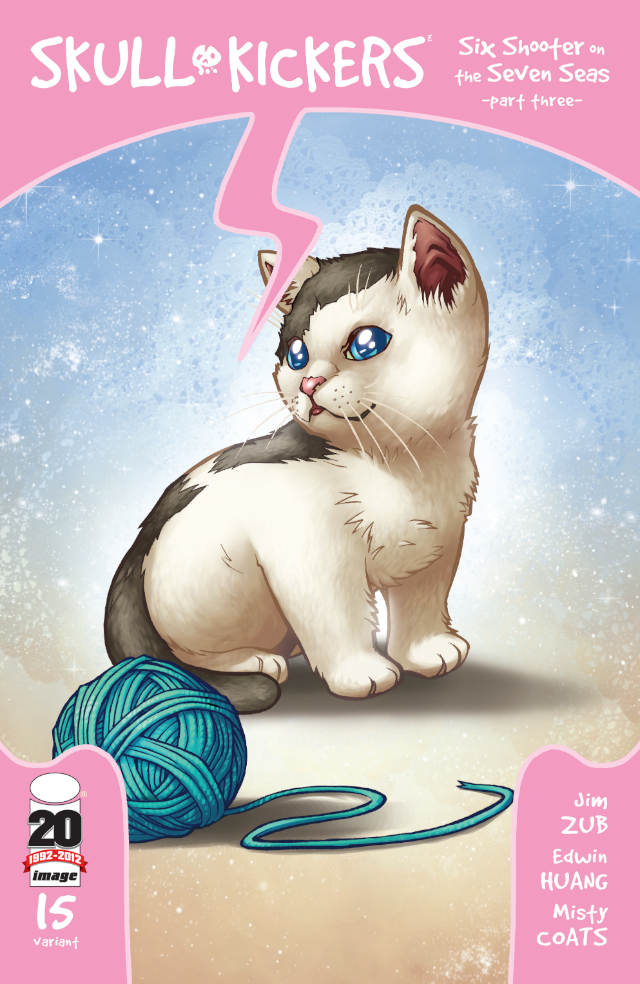
Skullkickers Kitten Variant Cover at SDCC!

Image has unveiled their San Diego Comicon 2012 exclusive items and we’re quite happy to announce that one of those spiffy exclusives is the infamous SKULLKICKERS KITTEN COVER!

If you’re at the show next week, make sure you swing by BOOTH #2729 and grab a copy. They’ll be selling for $5 personalized, or $10 signed/raw as an incentive for fans to keep their copy rather than flipping it.

Rambling About How I Write Comics – Part One

While blabbing away on Twitter last night the conversation organically moved into comic writing. Explaining my process in short 140 character tweets was kind of a pain, and I realized it was worthy of a few blog posts, so here goes.

Comic writing is pretty free form in that there’s no standard format. Some writers do broad outlines of what’s happening in the issue and then let the artist draw the story, coming back at the end to add dialogue to the pages (this is the original ‘Marvel Method’) but that’s pretty rare nowadays. The stories being written now are way more intricate and most artists aren’t used to winging it quite so much.

The norm at this point is ‘full script’, which is just what it sounds like – writing out page by page and panel by panel descriptions of the action and dialogue so the artist can plan and illustrate the entire issue. It’s more time consuming, but also a lot more focused. Even within that full script approach, unlike movies and TV, there’s no standard for script format, terminology, spacing or anything. Each writer kind of kit-bashes a script format together that works for them and goes from there. If the format is clear and the artist gets the information they need, that’s the most important part. Everything else is just personal preference and a general professional look to the work. I previously posted up a copy of my script for Skullkickers #1 you can check out HERE if you want to see my particular scripting style.

I’m a story planning junkie. I know there are people who just dive in and start writing ‘page 1’ without any idea where things will go, letting the muses kiss their fingertips clattering along the keyboard, but I’m not one of those people. I plan a lot of the story structure up front and it’s time consuming, but once that idea and pacing phase is done I write fearlessly because I know the overall plan and won’t lose my way. I can clearly visualize scenes and anticipate how they’re going to play out, driving me to get to them. If I come up with better ideas along the way or inspiration strikes a scene, I can work it into the structure and adapt. I rarely need to cut or heavily revise material because I’ve built a solid story foundation to work from.

So, how does that work?

The first thing I do is brainstorm a series of point form ‘things’ – facts that need to be relayed to the reader so the story makes sense – character traits, settings, antagonists, goals, character changes or revelations. It’s a giant jumble of story ideas, characters and key moments – the raw story ingredients all piled up.

Then, I look at the length of my story. If it’s a work-for-hire comic story then the format is probably a set number of pages. If it’s my own project then I rough out how much space I think I’ll need to make it work (number of issues or number of pages for a self-contained graphic novel). Once I know the number of issues/chapters I can start to plug in my jumbled pile of elements and get a sense of story flow.

The classic approach to story flow is called the ‘3 Act Play’ and it’s one constantly used for movies, sitcoms, short films, novels… you name it. If you don’t know what it is and you’re shown it, you won’t be able to un-see it, but that’s not a bad thing. It’s a very logical way of building a story and isn’t as rigid as it may sound.

In simplest terms:

ACT 1 – INTRODUCTION: Who, What, Where and When (‘Why’ may not be answered in this stage). Who are the main characters? What are their initial goals? Where are we? When does this take place? Giving your audience this information in an entertaining way engages them and preps them for the larger story to come. Even in a mystery you need to impart enough of the above for people to feel grounded in the story and ready for act 2.

TRANSITION – THE CHOICE: In the classic version of the 3 Act Play the transition between Act 1 and Act 2 is the main character(s) really diving in to the challenges before them in a way they can’t go back from. If they could just back away without consequence, then the threat level doesn’t seem so bad. Once they’ve agreed to the mission, told that person they want to date or picked up the cursed artifact, they’re pulled in and can’t go back to their old life. They have to work through the resulting conflict.

ACT 2 – CONFLICT: Conflict can take on many forms and most stories have multiple types of conflict woven together. Physical, mental, emotional conflict. This is where all those classic concepts of Man VS Man, Man VS Nature, Man VS Technology, Man VS Society, Man VS Himself, Man VS Wo-Man comes into it. Your characters need something to rail against. Epic or mundane, there’s something to overcome. When it comes to classic Hollywood blockbusters this tends to be once-in-a-lifetime kind of conflict where people are saving the kingdom, the world, the universe kind of stuff, but conflicts can be as quiet or bombastic as you want. Romantic comedies have the exact same structure, just with a different set of goals and outcomes.

This act is the real meat of your story. Ideally, the audience wants to enjoy the shifting threats, victories, failures and unexpected twists that come from the conflict. There’s usually ‘callbacks’ to the things we learned about the characters from the introduction, but not so obviously that the audience can see exactly where the story is going. Creating unexpected but appropriate conflict is one of the toughest elements of storytelling, especially with a media culture that’s inundated with stories and has ‘seen it all’. If you can surprise them, that’s ideal. If not, at the very least make them care about the characters so they want to see it through to the end.

TRANSITION – CLIMAX: The biggest action, the most important decision, the most intense outcome is almost always saved for the end of act 2. It’s the payoff for everything we’ve built and is called ‘climax’ for a reason. This is where people admit their love for one another, the world is saved or the most ridiculous special effects money is spent. After this, it’s a steep downhill finish as things are resolved.

ACT 3 – RESOLUTION: Did they live “happily ever after”? Are their lives an echo of who they were at the start? Has everything changed after conflict? This act tends to be the shortest since the audience has been given almost everything and we’re emotionally winding down. Medals are given out, things are learned (or ignored) and credits are rolled. If this is just one part of a larger story then there may be a lot of unanswered questions, but that’s okay as long as we’re keeping them in mind for the future, things moved forward and felt relevant to the whole.

An even shorter way of explaining it is the old stage magic credo:

“First I tell ’em what I’m gonna do, then I do it, then I tell ’em what I done.”

That’s a weird part of working on Skullkickers. Even if it feels ridiculous and random (because that’s how I want it to come across), the structure underneath isn’t. I’ve created a story that reads like it’s out of control and can’t possibly all work, but after the original short stories it was actually tightly built to feel that way. Underneath that chaotic mass is a larger structured story I’m chipping away at that, if I do my job correctly, will pay off in exciting ways, surprising the audience while still feeling appropriate. That’s the plan, anyways.

Whew. Okay, I went into a bit more depth then I’d originally planned. In another blog post I’ll talk about how I take my idea pile and use aspects of the 3 Act Play to make it all work together.

Click here to read Part 2

Maximum Pixelation Interview

Dan Spezzano from Maximum Pixelation interviewed me all about the Pathfinder comic series I’m writing. Some good new information on content and future plans. Check it out.

Makeshift Miracle Promo on Electric Playground

The crew at The Electric Playground filmed this interview with me at TCAF back in May and it’s finally available online. Check it out!

Newsarama Interview Now Up

Albert Ching at Newsarama put together a new interview with me all about the Pathfinder comic series I’m writing that starts in August. There’s brand new preview artwork and some solid information in there for folks to check out. Click on through!

Interview Attack!

Lots of new interviews being posted up lately. Check ’em out:

ICV2 has a two part Pathfinder interview (part one, part two).

Geek Native covers info about Pathfinder.

Panel Bound talks about Pathfinder writing.

Panel Pals goes through general career stuff and how I got my start in comics.

Skewed and Reviewed covers working in comics, Pathfinder and Skullkickers stuff.

Father’s Day

Since it’s Father’s Day today, let me tell you a little story about my Dad.

Beyond raising me and letting my brother and I grow up as comic book loving RPG-playing nerd boys, he helped me start on this weird and wonderful career in comics.

The year is 2002. I’m living in Halifax working at a small animation studio, struggling to get by. Finances are tight, way tighter than my girlfriend and I had planned when we decided to move out east. Work isn’t steady. It’s a stressful and difficult time.

One of the only things going well was the little webcomic I was creating in my spare time. It was called the Makeshift Miracle (yes, the same one I relaunched with UDON and am rebuilding now a decade later). Three times a week I would work away in the evening creating new pages and posting them online, learning about comic storytelling – what worked and what didn’t. Even when everything else was a mess, I could focus a bit on Makeshift and feel like I was making creative progress.

With San Diego Comicon coming up fast and furious, there was a lot of talk among webcomic creators about being at the show. Joey Manley was organizing a Modern Tales get together. Scott McCloud was insistent this was the year webcomics would really break out and make an impression on mainstream comic readers. It was exciting times. Still, no matter how amazing it sounded, there was no way I’d be able to attend. My finances were shot and my credit card was maxed.

When Dad heard about this convention, he asked me flat-out.

“I know the comic thing is your hobby, but is this trip important?”

I couldn’t really say it was. Not really. It was just a comic convention. A bunch of webcomic people meeting in person and hanging out isn’t “important”. But it felt like it was the start of something exciting and just about everyone I knew and respected creating comics online at that point was going to be there. Even though I told my Dad that it wasn’t important, he could tell deep down I kind of thought it was.

That was that. He cleared my credit card bill and insisted that I book a flight to San Diego. He helped push me that crucial last step. I attended my first comic convention thanks to his immense generosity and kindness.

I cut as many corners as possible and used every contact I had to make it work. My friend Cam drove me to the airport on the back of his motorcycle so I didn’t need a taxi. My friend Aeire picked me up at the airport so I wouldn’t have to pay for a cab in California either. I split meals and made PB&J sandwiches. I crashed on hotel floors and friends’ couches, leaning on everyone I even vaguely knew, many of whom had never even met me in person before.

It was worth it. The friendships I made that week in San Diego helped me feel like I was part of a larger creative community. It inspired me to want more from my art and stories. Less than a year later, after a roller coaster ride of ups and downs personally and financially, I started working at UDON.

I’ve attended San Diego Comicon every single year since. In a few weeks it’ll actually be my 10th SDCC in a row and, no matter how crazy and frustrating it can be at times, I feel it’s an important annual milestone for me. A good time to look back at where I’ve been and where I hope to be in the years ahead.

My father helped make my silly comic book dream a reality.
It’s just one of the many reasons I’ll forever be in his debt.

Love ya, Dad.

Pathfinder Interview With Freemantle

There’s a new interview at Robert James Freemantle’s blog all about the upcoming Pathfinder comic series, along with some nostalgic chatter about growing up playing tabletop RPGs and how that’s influenced my writing. Click on through and give it a read.

Pathfinder Interview at Geeklore

Nerd news site Geeklore has a new interview up with me chatting about the upcoming Pathfinder comic series and tabletop role-playing game.